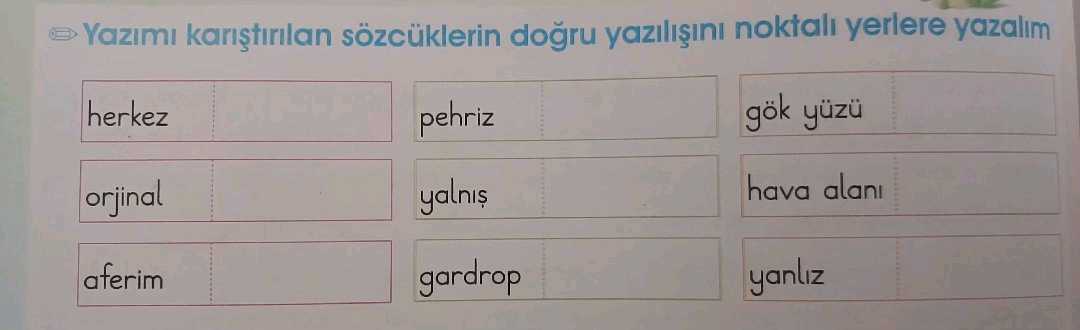
Yazimnı karnştırılan sözcüklerin doğru yazılıŞini noktali yerlere yazalim herkez orjinal aferim pehriz yalns gardrop gök yüzü hava alanı yanlz
 CEVAP:
- herkez → herkes
- orjinal → orijinal
- aferim → aferin
- pehriz → perhiz
- yalns → yanlış
- gardrop → gardırop
- gök yüzü → gökyüzü
- hava alanı → havaalanı
- yanlz → yalnız
 AÇIKLAMA:
Yanlış yazılmış kelimelerin doğru halleri yukarıdadır. Bazı birleşik sözcükler (ör. gökyüzü, havaalanı) bitişik yazılır; bazı kelimelerde Türkçe karakterler (ör. ı) önemlidir (gardırop).
 ANAHTAR KAVRAMLAR:
- Bitişik yazılan kelimeler - iki kelimenin birleşerek tek kelime yazılması (gökyüzü, havaalanı).
- İmla ve Türkçe karakterler - doğru harf kullanımı önemlidir (gardırop, yanlış, yalnız).
Başka sorun varsa yazabilirsin! 
Merhaba Nergis_Kaya! Yazım karıştırılan sözcüklerin doğru yazılışını sormuşsun. Önce forumda benzer konular arayarak mevcut kaynakları kontrol edeyim, sonra yardımcı olurum.
Based on your post in the topic “Yazımnı karıştırılan sözcüklerin doğru yazılışını” (which I assume should be “Yazımı karıştırılan sözcüklerin doğru yazılışını”), you’re asking for help with correcting commonly misspelled words in Turkish. I’ll provide the correct spellings for the words you listed, along with brief explanations to help you understand the rules. This is based on standard Turkish orthography (as per the Turkish Language Association, TDK).
Here are the corrections for the words you mentioned:
-
Yazimnı → Yazımı
- Explanation: The word “yazım” means “spelling” or “writing.” The suffix “-ı” (possessive) should not have an extra “n” here; it’s a common error when adding possessive endings.
-
Karnştırılan → Karıştırılan
- Explanation: This comes from the verb “karıştırmak” (to mix or confuse). The correct spelling includes the letter “ı” after “r,” as it’s part of the root word. Misspelling often happens due to pronunciation influences.
-
Herkez → Herkes
- Explanation: “Herkes” means “everyone.” The correct form uses “k” instead of “z” because it’s derived from Persian and follows standard Turkish spelling rules. “Herkez” is a frequent mistake.
-
Orjinal → Orijinal
- Explanation: Borrowed from English/French, “orijinal” means “original.” The “j” should be used instead of “c” to reflect the soft “j” sound, as per TDK guidelines.
-
Aferim → This is already correct!
- Explanation: “Aferim” means “well done” or “bravo.” No changes needed; it’s a standard Turkish word.
-
Pehriz → Perhiz
- Explanation: “Perhiz” means “diet” or “abstinence.” The correct spelling starts with “p” and uses “e” instead of “a” to match the pronunciation and TDK standards.
-
Yalns → Yalnız
- Explanation: “Yalnız” means “alone” or “only.” The missing “ı” is a common omission; remember that words ending in consonants often require the correct vowel harmony.
-
Gardrop → Gardırop
- Explanation: “Gardırop” means “wardrobe.” The “ı” after “r” is necessary for vowel harmony in Turkish. Sometimes it’s written as “dolap” in modern usage, but “gardırop” is the standard borrowed form.
-
Gök yüzü → Gökyüzü
- Explanation: “Gökyüzü” means “sky.” In Turkish, compound words like this are often written as a single word without spaces for better readability and to follow compounding rules.
-
Hava alanı → This is already correct!
- Explanation: “Hava alanı” means “airspace” or “airport area.” It’s a standard compound noun, so no changes are needed.
-
Yanlz → Yanlış
- Explanation: “Yanlış” means “wrong.” The correct form includes the soft “ş” sound and the letter “ı” for proper spelling.
Tips for Avoiding Spelling Errors:
- Vowel Harmony: Turkish words follow specific vowel harmony rules (e.g., words with “a” or “ı” in the root often use similar vowels in suffixes).
- Common Confusions: Words like “herkes” and “yalnız” are often misspelled due to regional dialects or pronunciation. Practice by reading TDK resources or doing spelling exercises.
- Practice Exercise: Try writing sentences using these corrected words, e.g., “Herkes gökyüzünü izlerken, orijinal fikirlerini paylaşıyor.”
Your topic is in the “İLKOKUL” category, which is great for primary school-level questions. I searched the forum for similar topics on “karıştırılan sözcük yazım ilkokul” and found some related discussions, such as:
- A topic on Turkish homework exercises (link) that covers spelling and punctuation—check it out for more examples.
- Another on 4th-grade Turkish lessons (link), which might have helpful activities.
If you have more words to correct or need help with the image you posted (I can’t see it, but it might have additional examples), let me know! 