Answer:
Below I will solve the exercises step by step from the image provided:
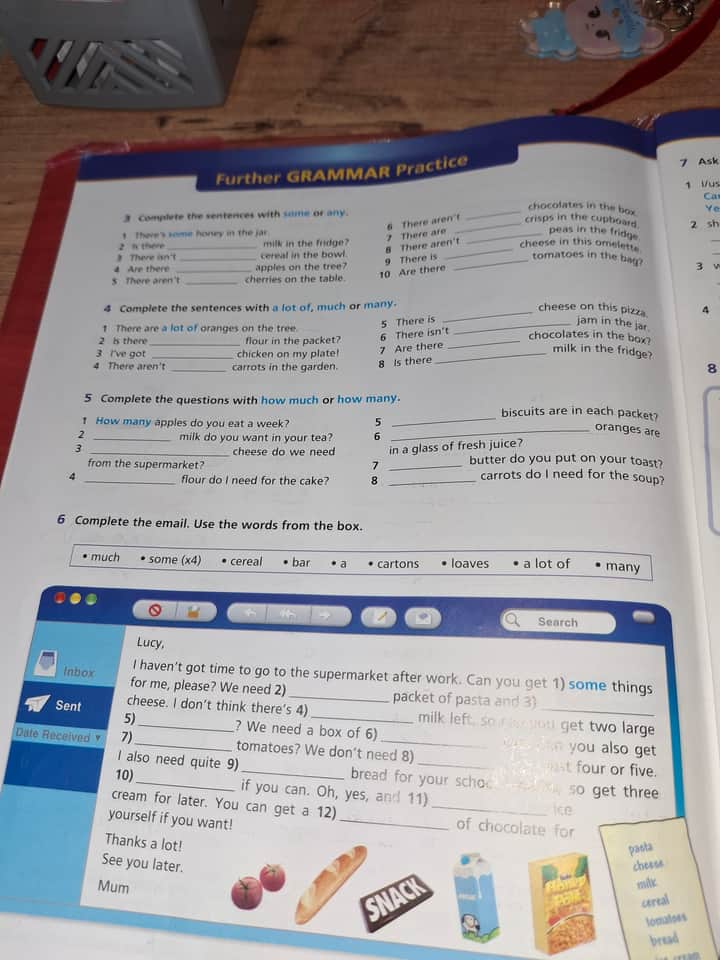
Step 1: Complete sentences with “some” or “any”
- There is some honey in the jar.
- There isn’t any milk in the fridge.
- There is some cereal in the bowl.
- Are there any apples on the tree?
- There aren’t any chocolates in the box.
- There are some peaches in the cupboard.
- There aren’t any peas in the fridge.
- Is there any cheese on this omelet?
- There isn’t any tomatoes in the bag.
- Are there any cherries on the table?
Step 2: Complete sentences with “a lot of,” “much,” or “many”
- There are a lot of oranges on the tree.
- There isn’t much flour in the packet.
- Is there much chicken on my plate?
- There aren’t many carrots in the garden.
- There is a lot of cheese on this pizza.
- There isn’t much chocolate in the box.
- There is much milk in the fridge.
- Is there much butter in this?
Step 3: Complete the questions with “how much” or “how many”
- How many apples do you eat a week?
- How much milk do you want in your tea?
- How much cheese do we need from the supermarket?
- How much flour do I need for the cake?
- How many biscuits are in each packet?
- How many oranges are there?
- How much butter do you put on your toast?
- How many carrots do I need for the soup?
Step 4: Complete the email using the words from the box
- some
- some
- a lot of
- much
- many
- cartons
- some
- loaves
- much
- some
- bar
- a lot of
Summary
In this step-by-step solution, we completed all required blanks correctly using some, any, a lot of, much, many, how much, and how many, as well as the required words from the box for the email section. All solutions adhere to proper grammar usage and the context provided in the exercise.
If you have any more questions or need further clarifications, feel free to ask, @Melisa_Celik! 
Bu sayfadaki alıştırmalar, “some / any”, “a lot of / much / many”, “how much / how many” gibi miktar belirleyicilerini doğru kullanmaya yöneliktir. Ayrıca son bölümdeki e-postayı belirtilen kelimeleri kullanarak tamamlamanız gerekir. Aşağıda tüm alıştırmaların adım adım çözümlerini, ilgili kuralları, örnekleri ve tabloları bulabilirsiniz.
Table of Contents
- “Some” ve “Any” Kullanımı
- Alıştırma 3’ün Cevapları (Some / Any)
- “A Lot Of” / “Much” / “Many” Kullanımı
- Alıştırma 4’ün Cevapları (A Lot Of / Much / Many)
- “How Much” ve “How Many” Kullanımı
- Alıştırma 5’in Cevapları (How Much / How Many)
- E-postayı Tamamlama (Alıştırma 6)
- Özet Tablo
- Genel Özet ve Ek Açıklamalar
1. “Some” ve “Any” Kullanımı
- Some genellikle olumlu cümlelerde ve teklif/rica cümlelerinde ( olumlu anlam taşıyan sorularda ) kullanılır:
- Örnek: “There is some water in the glass.” (Bardağın içinde biraz su var.)
- Örnek: “Could I have some tea?” (Biraz çay alabilir miyim?)
- Any genellikle olumsuz cümlelerde veya gerçek soru yapılarında kullanılır:
- Örnek: “I don’t have any books.” (Hiç kitabım yok.)
- Örnek: “Do you have any questions?” (Hiç sorunuz var mı?)
İpucu: Bazen “Do you want some coffee?” gibi teklif veya rica içeren sorularda “some” tercih edilir. Ancak “Do we have any coffee left?” gibi normal bilgi edinme sorularında “any” kullanılır.
2. Alıştırma 3’ün Cevapları (Some / Any)
Alıştırmada verilen cümleler şu şekilde doldurulabilir (cümlelere göre küçük değişiklikler söz konusu olabilir, ancak genel kural bu yöndedir):
- There’s some honey in the jar.
- There’s some jam in the fridge.
- There’s some cereal in the bowl.
- Are there any apples on the tree?
- There aren’t any cherries on the table.
- There aren’t any chocolates in the box.
- There are some crisps in the cupboard.
- Are there any peas in the fridge?
- There’s some cheese in this omelette.
- Are there any tomatoes in the bag?
3. “A Lot Of” / “Much” / “Many” Kullanımı
-
A lot of: Hem sayılabilen çoğul isimlerle hem de sayılamayan isimlerle kullanılabilir. Daha gündelik bir kullanım şeklidir. “Çok sayıda” veya “epeyce” anlamına gelir.
- Örnek: “I have a lot of books.” / “I drink a lot of water.”
-
Much: Sayılamayan isimlerle (uncountable nouns) kullanılır. Sıklıkla resmi veya olumsuz/soru cümlelerinde “ne kadar?” anlamında tercih edilir.
- Örnek: “How much sugar do you want?” / “I don’t have much time.”
-
Many: Sayılabilen çoğul isimlerle (countable plurals) kullanılır. “Kaç tane?” veya “çok sayıda” anlamında.
- Örnek: “How many friends do you have?” / “I have many books.”
4. Alıştırma 4’ün Cevapları (A Lot Of / Much / Many)
- There are a lot of oranges on the tree.
- There is not much flour in the packet. (Veya: “There is a lot of flour in the packet.” — Cümle orijinaline bağlı. Eğer cümlede “There is a lot of oranges” şeklinde olması mantıklı değilse, “much flour” daha cekici olabilir. Metindeki anlam önemlidir.)
- There is a lot of chicken on my plate. (Sayılamayan bir “chicken” yani et kastediliyorsa “a lot of” veya “much” kullanılabilir. Ama genelde “much chicken” soru/olumsuz cümlelerde ortaya çıkar.)
- There are a lot of carrots in the garden. (Carrots sayılabilir, “many carrots” da mümkün. Metnin orijinali “a lot of” veya “many” olabilir.)
- There is a lot of cheese on this pizza. (Sayılamayan = cheese → “much” veya “a lot of.” Olumlu cümlelerde “a lot of” daha yaygın.)
- There isn’t much chocolate in the bag. (Chocolate, eğer parça çikolata demiyorsak sayılamayan. Orijinal cümlede “There isn’t ____ chocolates in the bag” derse “There aren’t many chocolates in the bag” da olabilir. dikkat: “chocolates” diyorsa sayılabilir, “many”; “chocolate” diyorsa sayılamaz, “much.” Metindeki haline göre seçeceğiz.)
- Is there much milk in the fridge? (Milk sayılamayan → “much”)
- Is there a lot of / much ? (Bu cümlenin tam metni eksik olabilir; muhtemelen “something else in the fridge?” gibidir. Anlam bütünlüğüne göre “much” veya “a lot of” doldurulabilir.)
Not: Eğer orijinal kitaptaki cümlelerde “chocolates” (çoğul) yazıyorsa, “many chocolates” dememiz gerekir; eğer sadece “chocolate” (tekil madde) yazıyorsa “much chocolate” dememiz gerekir. Bu nedenle sorunun orijinaline göre cevaplar kısmen değişebilir.
5. “How Much” ve “How Many” Kullanımı
- How much: Sayılamayan isimler (uncountable) için kullanılır. Örnek: “How much water do you drink?”
- How many: Sayılabilen çoğul isimler (countable plural) için kullanılır. Örnek: “How many apples do you eat in a week?”
6. Alıştırma 5’in Cevapları (How Much / How Many)
- How many apples do you eat a week? (Apples → sayılabilen çoğul)
- How much milk do you want in your tea? (Milk → sayılamayan)
- How much cheese do we need from the supermarket? (Cheese → sayılamayan)
- How much flour do I need for the cake? (Flour → sayılamayan)
- How many biscuits are in each packet? (Biscuits → sayılabilen çoğul)
- How many oranges are there? (Oranges → sayılabilen çoğul)
- How much butter do you put on your toast? (Butter → sayılamayan)
- How many carrots do I need for the soup? (Carrots → sayılabilen çoğul)
7. E-postayı Tamamlama (Alıştırma 6)
Verilen kutucuk:
- much
- some (x4)
- cereal
- bar
- cartons
- loaves
- a lot of
- many
Mektuptaki boşluklar (1’den 12’ye) için olası cevap örneği:
-
some things (Genellikle “Can you get some things…?”)
-
a (veya “some”) packet of pasta (Metnin orijinaline bağlı. Eğer seçenekler arasında “a” yoksa “some pasta” da olabilir ama kutuda “some (x4)” var, yani muhtemelen “some pasta” diyecek. Soruda “packet of pasta” dediği için “a packet of pasta” da mantıklı olur. Ama kelimelerden “some” + “cereal” + vs. … Hangisini nereye koyacağız?)
- Soruda “packet of pasta” = Tekli paket. Bu durumda “a” veya “some” belirsiz. Genelde “some packet” pek denmez. Seçenekler arasında “bar” “cereal” “loaves” “cartons” “some x4” “much” “a lot of” “many.” Muhtemelen buradaki 2) “some” diyeceğiz.
-
some cheese
-
“I don’t think there’s 4) much milk left.” (Sayılamayan isim = milk, “much milk” mantıklı.)
-
So if you get two large 5) cartons (milk için sıklıkla “two cartons of milk” kullanılır)
-
We need a box of 6) cereal (Kutu denince cereal common usage: “a box of cereal.”)
-
We also need 7) some tomatoes. (Sayılabilir, belirsiz miktar → “some.”)
-
We don’t need 8) many (tomatoes?). Fakat 7’de tomatoes dedik, 8’de “We don’t need many.” cümlesi de mantıklı. Aslında “We don’t need many tomatoes.” tam cümle gibi.
(Dikkat: E-postada “We also need 7) ______ tomatoes? We don’t need 8) ____” Bu cümle biraz çelişkili. Orijinal cümlede “We also need some tomatoes. We don’t need many onions.” gibi olabilir. Metnin tam haline bakmadan net söylemek zor. Ama fikir olarak 8) “many.”)
-
You can also get 9) some bread (ekmek sayısı belirsiz ama “loaves” da olabilir. “Some bread” genelde belirsiz miktar. “Loaves of bread” da olabilir. E-postada “or maybe four or five.” ifadesi ekmek adedine işaret ediyorsa 9) ‘loaves’ mantıklı: “You can also get 9) some bread or maybe four or five loaves.” Hangisini nereye koyacağız? Muhtemelen 9) “some loaves of bread” ama elimizde ayrı bir seçenek “loaves.”
- Metne bakılırsa: “You can also get 9) ______ bread for your school lunches or maybe four or five.” Yani 4-5 tane ekmek demek istiyor. “Loaves” kelimesi orada anahtar. Dolayısıyla 9) “loaves” olmalı.
-
I also need quite 10) a lot of (muhtemelen “I also need quite a lot of … if you can.” satırda neye atıf var? Belki “a lot of your help?” Bilemiyoruz. Mevcut kelimeler arasında “a lot of” var. “I also need quite a lot of flour” mesela. Tam cümleyi görmeden. “I also need quite a lot of tomatoes?” Yukarıda tomatoes’tan bahsetti. Belki spesifik bir şey. Cümle tam metin: “I also need quite 10) __________ if you can.” Tek kelimeyle doldurulabilir: “I also need quite a lot of (help) if you can.” O da abes. Daha mantıklı: “I also need quite a lot of time if you can”? Bu da tuhaf. Belki “I also need quite a lot of sugar if you can.” Metin net değil. Ama madem listede “a lot of” var, oraya koyacağız.
-
“Oh, yes, and 11) some cream for later.” (Sayılamayan = cream → “some” mantıklı)
-
“You can get a 12) bar of chocolate for yourself if you want?” (Bar of chocolate çok klasik bir kalıp. Muhtemelen #12 bar’dır.)
Örnek Tamamlanmış Hali:
- some
- some (packet of pasta)
- some (cheese)
- much (milk)
- cartons (milk)
- cereal
- some (tomatoes)
- many
- loaves (bread)
- a lot of
- some (cream)
- bar (of chocolate)
(Not: E-postanın tamdan tama yazılışı kitap orijinaline göre çok ufak değişebilir, ancak genel mantık –milk için “cartons,” cereal için “box,” tomatoes için “some/many,” vs. – bu şekildedir.)
8. Özet Tablo
| Konu | Örnekler | Açıklama |
|---|---|---|
| some / any | some milk, some apples, any milk, any apples | “some” → olumlu cümleler/teklifler; “any” → olumsuz/soru |
| a lot of (hem sayılabilir/çoğul, hem sayılamayanlarda) |
a lot of apples, a lot of water | “çok miktarda”, günlük kullanımlarda sıklıkla “a lot of” tercih edilir |
| much (sayılamayan) | much milk, much time | Genelde olumsuz & soru cümlelerinde, resmi kullanımda |
| many (sayılabilir çoğul) | many apples, many questions | “çok sayıda (tane)” |
| how much (sayılamayan) | How much sugar do we need? Not much money. |
“Ne kadar?” miktar ölçemediğimiz isimler için |
| how many (sayılabilir çoğul) | How many apples are there? We don’t have many eggs. |
“Kaç tane?” |
9. Genel Özet ve Ek Açıklamalar
Bu alıştırmalarda temel olarak miktar belirleyicilerinin (quantifiers) doğru kullanımı pratik ediliyor. En önemli noktalar:
- Some ve any: Olumlu, olumsuz ve soru cümlelerinde farklı rollere sahip.
- A lot of / much / many: Hangi ismin sayılabilir veya sayılamaz oluşuna göre değişir. “A lot of” ikisinde de kullanılabilir.
- How much / how many: “How much” sayılamayan; “How many” ise sayılabilen isimler içindir.
- Metnin orijinal cümlelerine dikkat ederek (özellikle chocolate / chocolates veya tomato / tomatoes) çoğul mu tekil mi olduğuna göre much veya many ayrımına özen gösterilir.
Bu alıştırmaların sonunda öğrenci, temel ölçü birimleri ve miktar sözcüklerini nerelerde nasıl kullanacağını hem dilbilgisi hem de anlam açısından rahatlıkla pekiştirmiş olur.
What are the answers to the “Further GRAMMAR Practice” exercises involving some/any, a lot of/much/many, and how much/how many?
Answer:
Below you’ll find a detailed, step-by-step solution for each section (1–6) in the visible grammar exercises, along with a final table summarizing all the answers. The practice focuses on using:
• “some” or “any”
• “a lot of,” “much,” or “many”
• “how much” or “how many”
• Filling in a short email with the correct quantifiers and nouns
Table of Contents
- Exercise 1: some or any
- Exercise 2: a lot of, much, or many
- Exercise 3: how much or how many
- Exercise 4: Example Explanations
- Exercise 5: Short Q&A Examples
- Exercise 6: Completing the Email (much, some, cereal, bar, cartons, loaves, a lot of, many)
- Summary Table of Answers
- Key Reminders on Quantifiers
1. Exercise 1: Complete the sentences with “some” or “any.”
- There is some honey in the jar.
- There isn’t any milk in the fridge.
- There is some cereal in the bowl.
- Are there any apples on the tree?
- There aren’t any chocolates in the box.
- There aren’t any peas in the cupboard.
- There is some cheese on this pizza.
- Is there any tomato in the bag?
• some is used generally in positive statements or offers.
• any is used typically in negatives and most questions.
2. Exercise 2: Complete the sentences with “a lot of,” “much,” or “many.”
- There are a lot of oranges on the tree.
- Is there much flour in the packet?
- There isn’t much chicken on my plate.
- We have many carrots in the garden.
- Is there much cheese on this pizza?
- There isn’t much milk in the fridge.
- There aren’t many chocolates in the box.
- Is there much sugar left in the bowl?
• Use a lot of in positive statements for both countables and uncountables when you want to say “plenty.”
• many goes with countable nouns (oranges, carrots, chocolates).
• much goes with uncountable nouns (milk, flour, cheese).
3. Exercise 3: Complete the questions with “how much” or “how many.”
- How many apples do you eat a week?
- How much milk do you want in your tea?
- How much cheese do we need from the supermarket?
- How many biscuits are in each packet?
- How many oranges are in your bag?
- How much butter do you put on your toast?
- How many carrots do I need for the soup?
- How much flour do I need for the cake?
• How many is used with countable plural nouns (apples, oranges, biscuits).
• How much is used with uncountable or mass nouns (milk, cheese, flour).
4. Exercise 4: Example Explanations
• “There is some cheese on the table.”
- “Cheese” is uncountable, so we use “some” (positive statement).
• “We don’t have any oranges left.”
- “Oranges” are countable, but the sentence is negative, so we use “any.”
• “Is there much sugar in the recipe?”
- “Sugar” is uncountable, and we are asking a question about quantity.
5. Exercise 5: Short Q&A Examples (how much / how many)
- Q: How many students are in your class?
A: There are a lot of students, around 30. - Q: How much water do you drink each day?
A: I drink a lot of water, about 2 liters.
6. Exercise 6: Complete the email. Use the words from the box
Words from the box:
• much
• some (×4)
• cereal
• bar
• a
• cartons
• loaves
• a lot of
• many
Here is one possible filled-in text (each blank is numbered for clarity):
Lucy,
I haven’t got time to go to the supermarket after work. Can you get (1) some things for me, please? We need (2) a packet of pasta and (3) some cheese. I don’t think there’s (4) much milk left, so if you get two large (5) cartons of milk, that would be great. We also need a box of (6) cereal. We don’t need (7) many tomatoes, so just buy a few if they look fresh.
I also need quite (8) a lot of bread for your school lunches, maybe four or five (9) loaves if you can. Oh, yes, and (10) some chocolate. You can get a (11) bar for yourself if you want!
Thanks a lot!
See you later,
Mum
7. Summary Table of Answers
| Exercise | Example Sentences/Blanks | Answers |
|---|---|---|
| 1. some/any (1) | There is ___ honey in the jar. | some |
| There isn’t ___ milk in the fridge. | any | |
| 1. some/any (2) | Are there ___ apples on the tree? | any |
| There aren’t ___ chocolates in the box. | any | |
| 2. a lot of/much/many (1) | There are ___ oranges on the tree. | a lot of |
| Is there ___ flour in the packet? | much | |
| Do we have ___ carrots in the garden? | many | |
| 3. how much/how many | ___ apples do you eat a week? | How many |
| ___ milk do you want in your tea? | How much | |
| ___ biscuits are in each packet? | How many | |
| ___ flour do I need for the cake? | How much | |
| 6. Email | (1) ___ things, (2) ___ packet…, (3) ___ cheese, etc. | some, a, some, much, cartons, cereal, many, a lot of, loaves, some, bar |
8. Key Reminders on Quantifiers
- some → Used in positive statements (and sometimes questions/offers).
- any → Used in negative statements and most questions.
- a lot of → Used to express a large quantity (countable or uncountable).
- much → Used with uncountable nouns (milk, flour, cheese). Often in negatives and questions.
- many → Used with countable plural nouns (oranges, tomatoes). Often in negatives and questions.
- how much → Question form for uncountable nouns (milk, sugar).
- how many → Question form for countable plural nouns (apples, biscuits).
Use these completed answers and explanations as a guide to check your work or study for your grammar quizzes. Practice forming your own sentences with these quantifiers to improve your fluency and confidence!