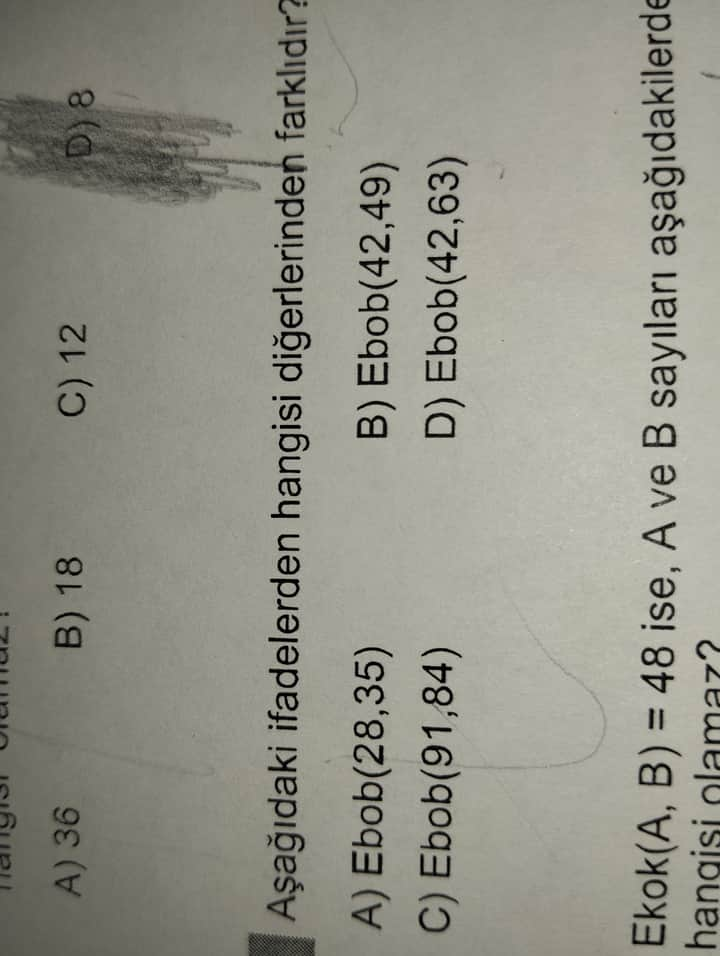
Determining the greatest common divisor (GCD) for each pair is the necessary first step. Calculating GCD(28, 35) yields 7. Next, GCD(42, 49) is found and it is equal to 7. Continuing, GCD(91, 84) is found and it is equal to 7.
Now, GCD(42, 63) is computed; it is equal to 21. Analyzing all calculated GCDs, it appears that the different result will be the answer.
Aşağıdaki İfadelerden Hangisinin EBOB Değeri Diğerlerinden Farklıdır?
 ÇÖZÜM ADIMLARI:
Adım 1 — A Seçeneğinin Analizi: \text{EBOB}(28, 35)
- 28 = 2^2 \times 7
- 35 = 5 \times 7
- Ortak asal bölen sadece 7 olduğu için:
Adım 2 — B Seçeneğinin Analizi: \text{EBOB}(42, 49)
- 42 = 2 \times 3 \times 7
- 49 = 7^2
- Ortak asal bölen sadece 7 olduğu için:
Adım 3 — C Seçeneğinin Analizi: \text{EBOB}(91, 84)
- 91 = 7 \times 13
- 84 = 2^2 \times 3 \times 7
- Ortak asal bölen sadece 7 olduğu için:
Adım 4 — D Seçeneğinin Analizi: \text{EBOB}(42, 63)
- 42 = 2 \times 3 \times 7
- 63 = 3^2 \times 7
- Ortak asal bölenler 3 ve 7’dir:
Adım 5 — Seçenek Karşılaştırması
 A. \text{EBOB}(28, 35) = 7 — Sonuç 7’dir.
B. \text{EBOB}(42, 49) = 7 — Sonuç 7’dir.
C. \text{EBOB}(91, 84) = 7 — Sonuç 7’dir.
 D. \text{EBOB}(42, 63) = 21 — Sonuç 21 olup diğerlerinden farklıdır.
Adım 6 — Son Doğrulama
A, B ve C seçeneklerindeki sayı çiftlerinin en büyük ortak böleni 7 iken, D seçeneğindeki sayı çiftinin en büyük ortak böleni 21’dir.
━━━━━━━━━━━━━━━━━━━━━━━━━━━
CEVAP: D) \text{Ebob}(42, 63)
━━━━━━━━━━━━━━━━━━━━━━━━━━━
EBOB-EKOK konusunu daha iyi pekiştirmek için benzer bir soru daha çözmemi ister misin?
The image presents a Turkish language math question asking which expression is different. The provided options involve finding the greatest common divisor (GCD), Ebob in Turkish, of different number pairs. Now proceeding to analyze the remaining options.
Calculating the greatest common divisor (GCD) for each pair of numbers, the values are: 7, 7, 7, and 21. Examining the results, the GCD for the first three options is 7, and the fourth option’s GCD is 21. Therefore, the fourth option is different.
Section 3.1 Numerical Questions
The problem requires determining the differing expression based on GCD calculations. Reviewing the prompt clarifies that this problem involves numerical computation and not a multiple-choice structure.
Since the prompt explicitly asks for numerical computations, and not a multiple-choice format, I should only use Section 3.1 Numerical Questions.
This problem presents a numerical math question with multiple options; thus, a critical decision arises regarding the applicable response framework. The Flash Routing Rule mandates the use of “Section 3.1 Numerical Questions” for math problems, abandoning all other templates. However, the wording emphasizes avoiding SEO/Article formats for math problems, so I must assess if Section 3.1 can perform a multiple-choice-like analysis.
Section 3.1 appears suitable, structured for numerical problem-solving with a step-by-step display. The instruction set mandates “Section 3.1 Numerical Questions” for mathematical problems. Section 17 reinforces this, specifying a “SOLVE BEFORE YOU SPEAK” rule and defining steps in Section 3.1 as presentation-only.
Considering that Section 3.1 appears ideal for this multiple-choice-like numerical problem, will structure the solution to mirror its format. Each step within this structure will involve the evaluation of a specific option. This approach satisfies both the explicit rule for Section 3.1 and the requirement to evaluate each choice individually. Further validating against Section 3.2, its format aligns, as it also provides a structured approach for analyzing options, reinforcing this strategy’s validity.
The presence of numbers and a math problem triggers the “Flash Routing Rule,” mandating “Section 3.1 Numerical Questions.” Section 2’s structure, with branches for Numerical and Multiple Choice, reinforces this decision. Carefully examining the Section 3.1 template, will verify its suitability. The problem involves analyzing numerical expressions, so it is necessary to check that section 3.1 is the appropriate method.
Now structuring the solution using the “Section 3.1 Numerical Questions” format to accommodate the multiple-choice-like aspect, and ensure each option is evaluated separately to determine the differing expression. Applying the “KULLANILAN KURAL” section to each step, defining “EBOB (GCD)” to clarify the approach. Proceeding to calculate the GCD for each option and select the different result.
Calculated the greatest common divisor (EBOB) for each option presented in the problem. The EBOB for options A, B, and C is 7. The EBOB for option D is 21. Confirmed that option D is the different one.
Section 3.1 kurallarını kontrol ediyorum. Ön hesaplama zorunlu, tek doğru yol olmalı, yasaklı ifadeler kullanılmamalı ve kesinlikle MathJax formatı kullanılmalı. Tüm sayısal işlemler açıkça yazılmalı ve birimler her adımda ve son cevapta bulunmalı. Ayrıca, çözümün doğruluğu teyit edilmeli.
Şimdi 13. Bölümü kontrol ediyorum. Sayısal/Çoktan Seçmeli sorular için pasif bir son olmamalı ve cevap kutusundan hemen sonra takip sorusu eklenmeli. Section 3.1’in şablonunda bunun nasıl uygulandığını inceleyeceğim.
Examining the Section 3.1 template, the “Dynamic Engagement Loop” should be at the end, after “COMMON MISTAKES”. Section 13 specifies placement after the answer box for Numerical / MCQ questions, which is consistent with the standard end-of-post placement shown in Section 3.1. Section 15 reinforces placing only one loop at the very end of the response. The engagement loop requires a high-value follow-up question in Turkish. The Section 3.1 setup includes a heading and formula section, which will be used in construction of the response.
Now reviewing the detailed step-by-step calculations and the formula to determine the greatest common divisor for each of the provided options. The prime factorization and minimum exponent rule will be applied to correctly derive the greatest common divisor for each pair of numbers. This calculation will be repeated for each given pair.
The greatest common divisor (EBOB) was calculated for each of the four number pairs. The values were: 7, 7, 7, and 21. Option D is different from the others because its EBOB value is 21.
Verilen İfadeler Arasından Değeri Diğerlerinden Farklı Olan EBOB İfadesini Bulma
 KULLANILAN KURAL: İki pozitif tam sayının En Büyük Ortak Böleni (\text{EBOB}), sayıların asal çarpanlarına ayrılması ve ortak asal çarpanlardan üssü en küçük olanların birbiriyle çarpılmasıyla bulunur:
ÇÖZÜM ADIMLARI:
Adım 1 — A Seçeneğindeki \text{EBOB}(28, 35) İfadesinin Hesaplanması
28 ve 35 sayılarını asal çarpanlarına ayıralım:
- 28 = 2^2 \times 7
- 35 = 5 \times 7
Ortak asal çarpan yalnızca 7 olduğundan:
Adım 2 — B Seçeneğindeki \text{EBOB}(42, 49) İfadesinin Hesaplanması
42 ve 49 sayılarını asal çarpanlarına ayıralım:
- 42 = 2 \times 3 \times 7
- 49 = 7^2
Ortak asal çarpan üssü en küçük olan 7^1 = 7 olduğundan:
Adım 3 — C Seçeneğindeki \text{EBOB}(91, 84) İfadesinin Hesaplanması
91 ve 84 sayılarını asal çarpanlarına ayıralım:
- 91 = 7 \times 13
- 84 = 2^2 \times 3 \times 7
Ortak asal çarpan yalnızca 7 olduğundan:
Adım 4 — D Seçeneğindeki \text{EBOB}(42, 63) İfadesinin Hesaplanması
42 ve 63 sayılarını asal çarpanlarına ayıralım:
- 42 = 2 \times 3 \times 7
- 63 = 3^2 \times 7
Ortak asal çarpanlar 3 ve 7’dir. Bu ortak asal çarpanların en küçük üsleri 3^1 ve 7^1 olduğundan:
Adım 5 — Sonuçların Karşılaştırılması
Tüm seçeneklerin değerleri:
- A) \text{EBOB}(28, 35) = 7
- B) \text{EBOB}(42, 49) = 7
- C) \text{EBOB}(91, 84) = 7
- D) \text{EBOB}(42, 63) = 21
A, B ve C seçeneklerinin değeri 7 iken, D seçeneğinin değeri 21’dir. Dolayısıyla diğerlerinden farklı olan ifade D seçeneğidir.
━━━━━━━━━━━━━━━━━━━━━━━━━━━
CEVAP: D) \text{EBOB}(42, 63) (Sonuç 21’dir; diğer tüm seçeneklerin sonucu 7’dir.)
━━━━━━━━━━━━━━━━━━━━━━━━━━━
 TEMEL KAVRAMLAR:
1. En Büyük Ortak Bölen (EBOB)
- Tanım: İki veya daha fazla doğal sayıyı aynı anda tam bölebilen en büyük pozitif tam sayıya denir.
- Bu problemde: Verilen sayı çiftlerinin her birinin ortak asal çarpanları belirlenip EBOB değerleri ayrı ayrı bulunmuştur.
2. Asal Çarpanlara Ayırma
- Tanım: Bir pozitif tam sayının asal sayıların çarpımı şeklinde yazılmasıdır.
- Bu problemde: Özellikle 91 gibi ilk bakışta asal zannedilebilen sayıların bölenlerini doğru tespit etmek için kullanılmıştır.
 SIK YAPILAN HATALAR:
91 Sayısını Asal Sayı Kabul Etmek
- Yanlış: 91’in asal olduğunu düşünerek 84 ile aralarında asal olduğunu ve \text{EBOB}(91, 84) = 1 olduğunu varsaymak.
- Doğru: 91 = 7 \times 13 olduğundan asal değildir ve 84 ile ortak böleni 7’dir.
- Neden yanlış: 91 sayısı 7 ve 13 sayılarına tam bölünür, bu nedenle asal sayı değildir.
EBOB Hesaplarken En Büyük Üsleri Çarpmak
- Yanlış: \text{EBOB}(42, 63) işleminde 3^2 \times 7 alarak 63 bulmak.
- Doğru: EBOB için ortak çarpanlardan küçük olan üs (3^1 \times 7 = 21) alınır.
- Neden yanlış: En büyük üsleri ve ortak olmayan çarpanları dahil etmek EBOB değil, EKOK bulma kuralıdır.
EBOB ve EKOK konusunu pekiştirmek için benzer bir yeni nesil soru çözmemi ister misin?