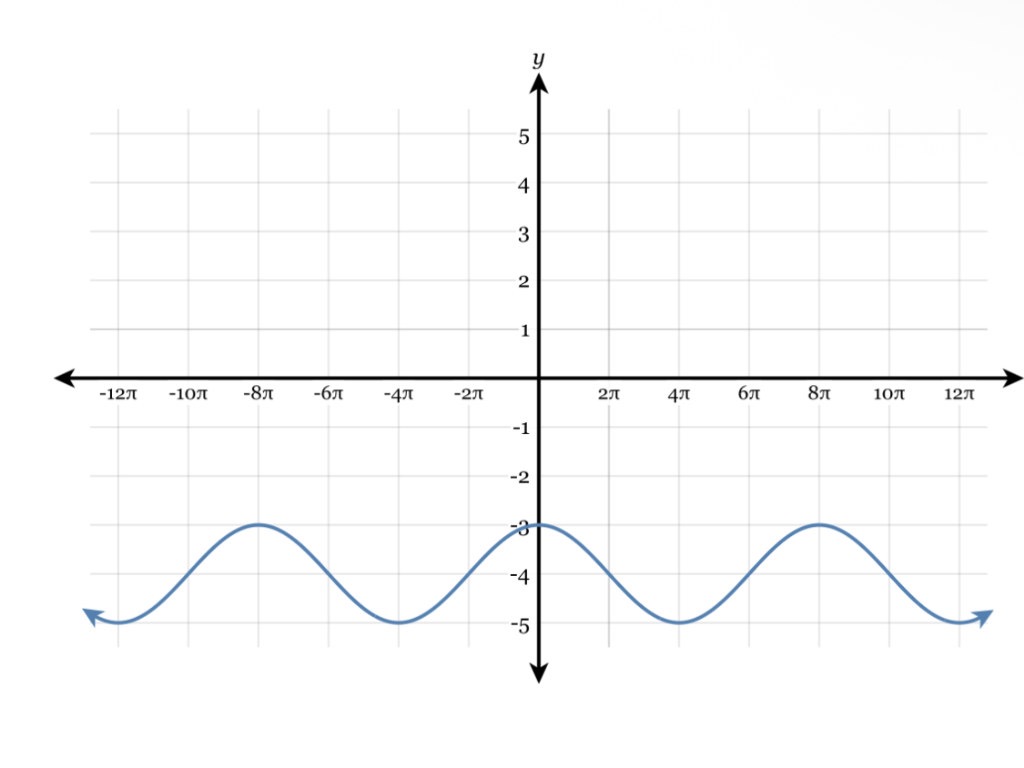
Definition: The horizontal central axis y = D about which the trigonometric function oscillates.
In this problem: The midline is at y = -4, indicating the parent cosine wave shifted down by 4 units.
2. Period and Frequency
Definition: The horizontal length required for the function to complete one full cycle.
In this problem: The graph completes one full cycle every 8\pi units, resulting in B = \frac{1}{4}.
COMMON MISTAKES:
Setting Parameter B Equal to the Period
Wrong: Writing B = 8\pi directly into the cosine function.
Right: Using the relationship B = \frac{2\pi}{\text{Period}} = \frac{2\pi}{8\pi} = \frac{1}{4}.
Why it’s wrong: The value B represents spatial frequency, which is inversely proportional to the period length T.
Confusing Peak-to-Trough Distance with Full Period
Wrong: Assuming the distance from peak to trough (0 to 4\pi) is the full period.
Right: The distance between a peak and the adjacent trough is only half a period (\frac{T}{2} = 4\pi \implies T = 8\pi).
Why it’s wrong: A complete period requires the wave to go from peak to peak or from trough to trough.
Would you like me to show you how to express this exact same graph using a sine function, or would you like a similar practice problem to test your skills?
 FORMULA USED:
 SOLUTION STEPS:
 ANSWER: y = \cos\left(\frac{1}{4}x\right) - 4 (or y = \cos\left(\frac{x}{4}\right) - 4)
 KEY CONCEPTS:
 COMMON MISTAKES:
 Setting Parameter B Equal to the Period