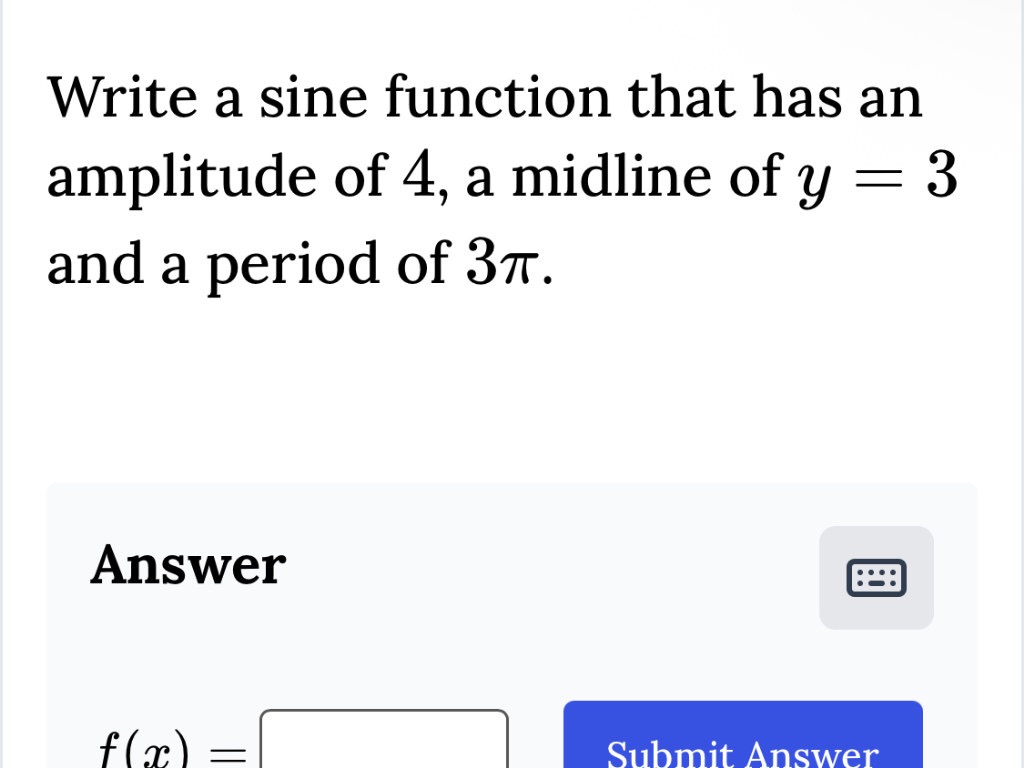
Write a sine function that has an
amplitude
of
4, a midline ofy =3
and a period of 37.
Answer
f(z) =
Submit Answer
Sinav_Rehberi
(YKS ve LGS Sınav Rehberi)
2
Write a Sine Function with Amplitude 4, Midline y = 3, and Period 3\pi
 FORMULA USED:
The general equation for a standard sine function is:
f(x) = A \sin(Bx) + D
Where:
- |A| = Amplitude
- D = Vertical shift (Midline equation y = D)
- B = Frequency coefficient, related to the Period (P) by the formula:
\text{Period} = \frac{2\pi}{B} \implies B = \frac{2\pi}{\text{Period}}
 SOLUTION STEPS:
Step 1 — Identify the Amplitude (A)
The problem states that the amplitude is 4.
A = 4
Step 2 — Identify the Midline (D)
The midline is given as y = 3. This represents the vertical shift of the function.
D = 3
Step 3 — Calculate the Frequency Coefficient (B)
The period of the function is given as 3\pi. Using the period formula B = \frac{2\pi}{\text{Period}}:
B = \frac{2\pi}{3\pi}
Cancel out \pi from the numerator and denominator:
B = \frac{2}{3}
Step 4 — Assemble the Complete Function
Substitute A = 4, B = \frac{2}{3}, and D = 3 into the standard sine function equation f(x) = A \sin(Bx) + D:
f(x) = 4 \sin\left(\frac{2}{3}x\right) + 3
━━━━━━━━━━━━━━━━━━━━━━━━━━━
 ANSWER:
f(x) = 4 \sin\left(\frac{2}{3}x\right) + 3
(or written as 4 sin((2/3)x) + 3 for text input boxes)
━━━━━━━━━━━━━━━━━━━━━━━━━━━
 KEY CONCEPTS:
1. Amplitude (A)
- Definition: The maximum distance the graph rises above or falls below its midline.
- In this problem: Determines the height of the peaks (4 units above and below the midline y = 3, reaching maximum y = 7 and minimum y = -1).
2. Midline (D)
- Definition: The horizontal reference axis y = D running midway between the maximum and minimum values of the trigonometric function.
- In this problem: Shifts the entire baseline of the graph up to y = 3.
3. Period (P)
- Definition: The horizontal length of one complete cycle of the wave before it repeats.
- In this problem: A full cycle completes every 3\pi units along the x-axis.
 COMMON MISTAKES:
 Confusing Period with the Coefficient B
- Wrong: Putting the period directly into the function: f(x) = 4 \sin(3\pi x) + 3.
- Right: Calculating B = \frac{2\pi}{\text{Period}} = \frac{2}{3} first, yielding f(x) = 4 \sin\left(\frac{2}{3}x\right) + 3.
- Why it’s wrong: The term inside the sine function represents angular frequency (B), not the period length itself.
Would you like me to generate a similar practice problem with a phase shift to help you master transformed sine functions?