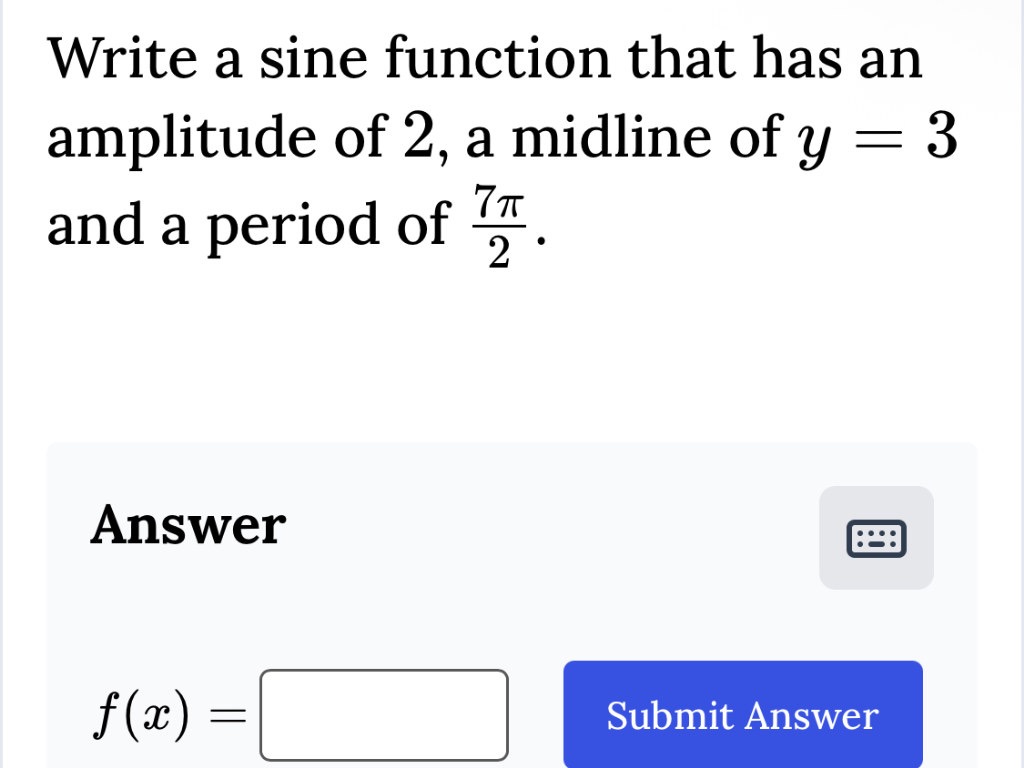
Write a sine function that has an
of
2, a midline of y =3
and a period of1
Sinav_Rehberi
Ağustos 16, 2026, 4:29öö
2
y = 3 , and Period \frac{7\pi}{2} FORMULA USED:
The standard form of a sine function without a horizontal phase shift is:
f(x) = A \sin(Bx) + D
Where:
A is the amplitude.D is the vertical shift corresponding to the midline equation y = D .B is the frequency coefficient, calculated from the period T using:
B = \frac{2\pi}{T}
SOLUTION STEPS:
Step 1 — Identify the Given Parameters
Amplitude (A ) = 2
Midline (y ) = 3 , which means D = 3
Period (T ) = \frac{7\pi}{2}
Step 2 — Calculate the Coefficient B T = \frac{7\pi}{2} into the period formula B = \frac{2\pi}{T} :
B = \frac{2\pi}{\frac{7\pi}{2}}
To simplify, multiply 2\pi by the reciprocal of the denominator:
B = 2\pi \cdot \frac{2}{7\pi} = \frac{4\pi}{7\pi} = \frac{4}{7}
Step 3 — Construct the Final Function A = 2 , B = \frac{4}{7} , and D = 3 into the standard equation f(x) = A \sin(Bx) + D :
f(x) = 2 \sin\left(\frac{4}{7}x\right) + 3
━━━━━━━━━━━━━━━━━━━━━━━━━━━ANSWER:
f(x) = 2 \sin\left(\frac{4}{7}x\right) + 3
━━━━━━━━━━━━━━━━━━━━━━━━━━━
KEY CONCEPTS:
1. Amplitude (A )
Definition: The vertical distance from the midline to the peak or trough of the sine wave.In this problem: Given directly as 2 , so A = 2 .
2. Midline (D )
Definition: The horizontal center line y = D around which the trigonometric graph oscillates.In this problem: Given as y = 3 , which sets the vertical displacement D = 3 .
3. Period (T )
Definition: The horizontal distance required for the function to complete one full cycle.In this problem: Given as \frac{7\pi}{2} , which yields the coefficient B = \frac{4}{7} .
COMMON MISTAKES:
Wrong: f(x) = 2 \sin\left(\frac{7\pi}{2}x\right) + 3 Right: f(x) = 2 \sin\left(\frac{4}{7}x\right) + 3 Why it’s wrong: The coefficient B inside the sine function represents frequency, not the period itself. You must always use the relationship B = \frac{2\pi}{T} .
Wrong: B = 2\pi \div \frac{7\pi}{2} = 2\pi \cdot \frac{7\pi}{2} = 7\pi^2 Right: B = 2\pi \cdot \frac{2}{7\pi} = \frac{4}{7} Why it’s wrong: Dividing by a fraction requires flipping the second fraction (multiplying by its reciprocal \frac{2}{7\pi} ).
Would you like me to generate a similar practice problem involving cosine or phase shifts to test your skills?
 FORMULA USED:
 SOLUTION STEPS:
 ANSWER:
 KEY CONCEPTS:
 COMMON MISTAKES:
 Using the Period Directly Inside the Function