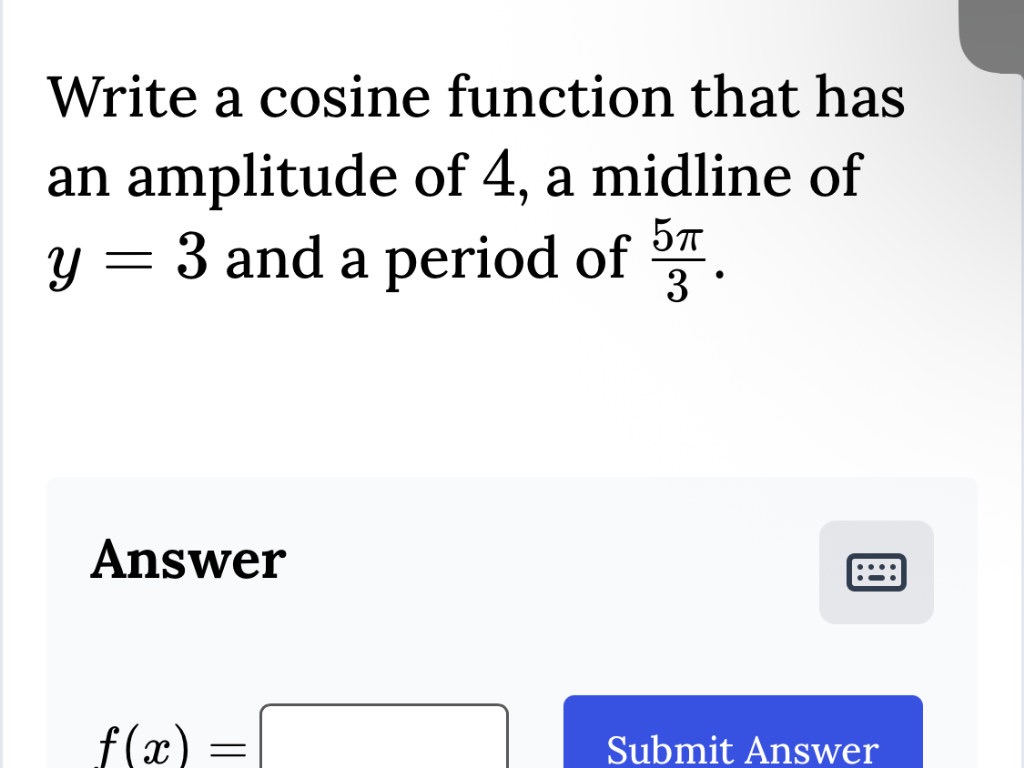
Write a cosine function that has
an amplitude of 4, a midline of
y =3 and a period of1
Answer
f(z) =
Submit Answer
Write a cosine function that has an amplitude of 4, a midline of y=3 and a period of 1 Submit Answer
Finding the Equation of a Cosine Function
 Formula Used:
\text{General form of a cosine function: } f(x) = A \cos(B x) + D
\text{Formula for period } P \text{ and frequency factor } B: B = \frac{2\pi}{P}
 Solution Steps:
Step 1 — Identify Given Parameters
From the problem statement, we are given:
- Amplitude A = 4
- Midline y = 3, which gives vertical shift D = 3
- Period P = \frac{5\pi}{3}
Step 2 — Calculate the Value of B
Substitute the given period P = \frac{5\pi}{3} into the formula B = \frac{2\pi}{P}:
B = \frac{2\pi}{\frac{5\pi}{3}}
B = 2\pi \times \frac{3}{5\pi}
B = \frac{6\pi}{5\pi} = \frac{6}{5}
Step 3 — Write the Final Cosine Function
Substitute A = 4, B = \frac{6}{5}, and D = 3 into the general form f(x) = A \cos(B x) + D:
f(x) = 4\cos\left(\frac{6}{5}x\right) + 3
━━━━━━━━━━━━━━━━━━━━━━━━━━━
 Answer:
f(x) = 4\cos\left(\frac{6}{5}x\right) + 3
(Equivalent form: f(x) = 4\cos(1.2x) + 3)
━━━━━━━━━━━━━━━━━━━━━━━━━━━
 Key Concepts:
1. Amplitude (A)
- Definition: The height from the center line (midline) to the peak or trough of the wave.
- In this problem: Given as 4, setting the vertical stretch factor A = 4.
2. Midline (D)
- Definition: The horizontal line y = D around which the cosine wave oscillates.
- In this problem: Given as y = 3, setting the vertical translation D = 3.
3. Period (P)
- Definition: The horizontal length of one complete cycle of the cosine graph.
- In this problem: Given as \frac{5\pi}{3}, which determines the horizontal stretch/compression factor B = \frac{6}{5}.
 Common Mistakes:
 Direct Placement of Period into the Function
- Wrong: Writing f(x) = 4\cos\left(\frac{5\pi}{3}x\right) + 3
- Right: Writing f(x) = 4\cos\left(\frac{6}{5}x\right) + 3
- Why it’s wrong: The value multiplying x inside the cosine function is the frequency coefficient B, not the period P itself. You must always use B = \frac{2\pi}{P} to calculate the coefficient.
Would you like me to generate a similar practice problem on trigonometric transformations to test your understanding?