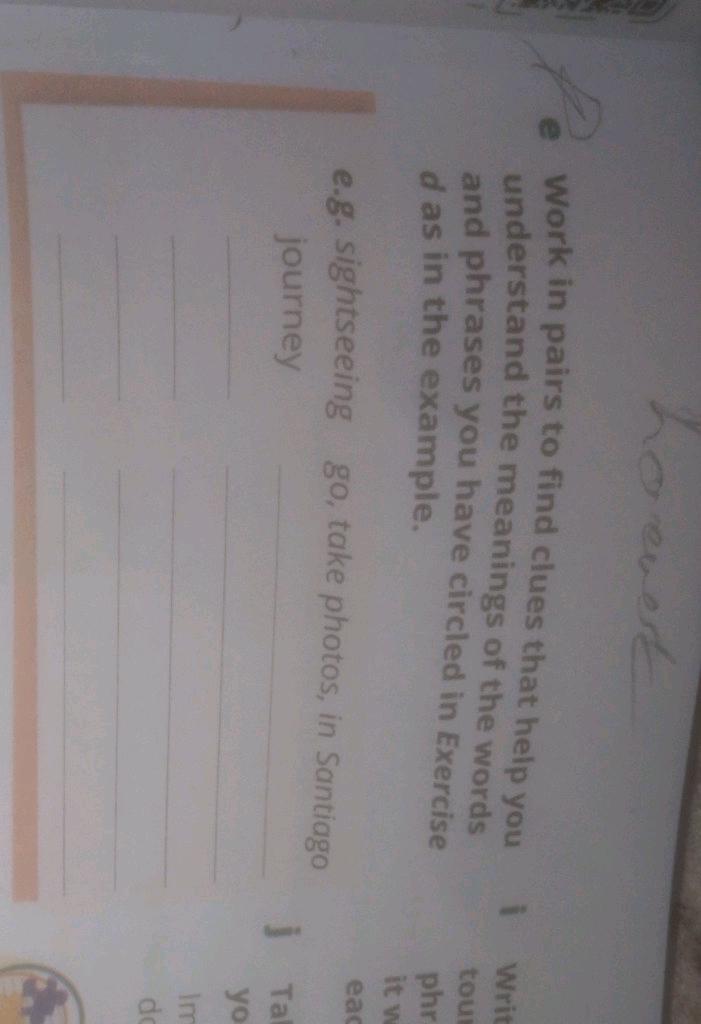
Work in pairs to find clues that help you understand the meanings of the words and phrases you have circled in Exercise d as in the example.
E) g. sightseeing, go, take photos, in Santiago, journey
Exercise Solution: Finding Context Clues for Travel Vocabulary
This exercise focuses on using context clues (related words, verbs, and settings in a reading text) to deduce the meaning of unfamiliar words and phrases without using a dictionary.
Solution and Example Clues
Here is how you can complete the lines for the common travel-related vocabulary circled in this unit:
- sightseeing:
go, take photos, in Santiago(Given Example) - journey:
travel, long distance, trip, walk, road, arrive - destination:
place, final stop, arrive, city, goal, Santiago - accommodation / hostel:
stay, room, sleep, hotel, book, night - souvenir:
buy, gift, shop, remember, take home - route / trail:
path, map, follow, direction, walk
How Context Clues Work
- Associated Verbs: Verbs that naturally occur with the noun (e.g., take photos \rightarrow sightseeing, book / stay \rightarrow accommodation).
- Setting & Location: Specific place names mentioned nearby in the passage (e.g., in Santiago, on the trail).
- Synonyms & Related Words: Words belonging to the same semantic field (e.g., trip, travel \rightarrow journey).
 Key Concepts:
- Context Clue: Information in the surrounding text that helps decipher the meaning of an unknown word.
- Collocation: Words that naturally go together in English (e.g., go sightseeing, on a journey).
 Common Mistake:
- Wrong: Writing a full dictionary definition in the blank.
- Right: Writing short clue words or phrases directly found in the reading text.
Would you like me to identify the context clues for any specific sentences or other words from your reading text?