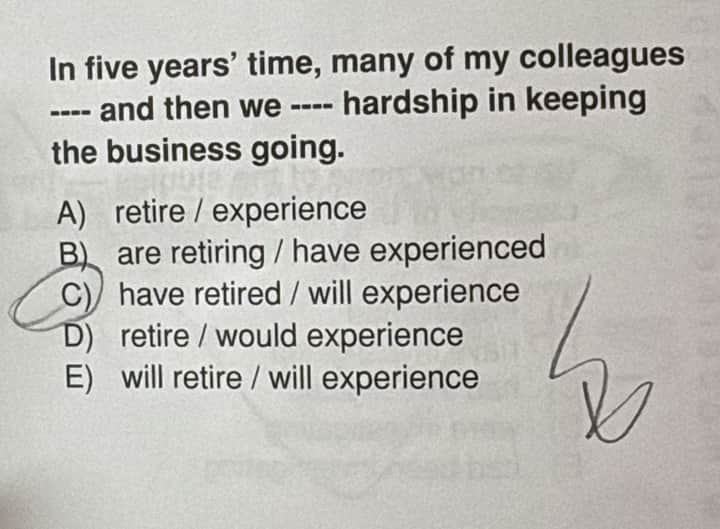
Option E is correct because “In five years’ time” pinpoints a future moment, so both verbs need the will-future form:
- “will retire” (not present perfect “have retired,” which describes an action completed by now)
- “will experience”
In contrast, option C’s “have retired” wrongly uses the present perfect, implying colleagues have already retired before now, not at that future point.
Would you like more examples to practice future tenses?
Why Option E is Correct Instead of Option C in the Sentence Completion
Önemli Noktalar
- Time reference uses future expressions (“In five years’ time”) indicating actions that will happen.
- The first blank requires a future simple tense because the event (retiring) will take place in the future.
- The second blank also needs future simple tense to express a forthcoming action (experiencing hardship).
- Option C uses present perfect (“have retired”) incorrectly for a future event, while E consistently uses future simple (“will retire / will experience”).
The phrase “In five years’ time” clearly points to the future, so the verbs must align with future tense. Option E correctly uses “will retire” (future simple) for the first blank and “will experience” (future simple) for the second blank, describing events that will happen in the future. Option C’s phrase “have retired” (present perfect) talks about a completed action in the past or at an unspecified time, which contradicts the future time frame given by the sentence.
İçindekiler
- Time Expressions and Tense Agreement
- Explanation of Option E Correctness
- Explanation of Option C Incorrectness
- Quick Checklist: Choosing the Right Tense for Future Time Expressions
Time Expressions and Tense Agreement
The expression “In five years’ time” sets the time frame in future. For English tenses, this means:
- Future Simple for planned or certain actions: “will + verb”
- Present Perfect shows completed actions connected to the present, not suitable for future fixed points without auxiliary future words
In this sentence, the whole context is about what will happen in the future, so the verbs must match this future perspective consistently. Mixing present perfect with future time expression causes grammatical inconsistency.
Pro Tip: Whenever you see fixed future time expressions like “in five years”, “next month”, “tomorrow”, prefer future simple tense for main verbs.
Explanation of Option E Correctness
- “will retire” is future simple tense, appropriate for an action that will happen in the future.
- “will experience” also future simple, indicating something to be encountered in the future.
Together, they show a clear, logical sequence of future events (retiring first, then experiencing hardship). This matches the sentence meaning perfectly.
Explanation of Option C Incorrectness
- “have retired” is present perfect tense, referring to an action completed at an unspecified past time or recently, which conflicts with “in five years’ time” (future).
- This creates a tense/time inconsistency between the future time reference and present perfect tense.
Thus, option C is grammatically incorrect in this future context.
Warning: Present perfect cannot be used with specific future time expressions like “in five years’ time” because it refers to past completions.
Quick Checklist: Choosing the Right Tense for Future Time Expressions
- [x] If sentence has specific future time (in five years, next week) → Use future simple (will + verb).
- [x] Do NOT use present perfect with specific future time expressions.
- [x] Use future tenses consistently in both clauses if talking about future events.
Sonraki Adımlar
Would you like me to explain other common errors with tense usage in future time contexts or provide practice sentences for better understanding?