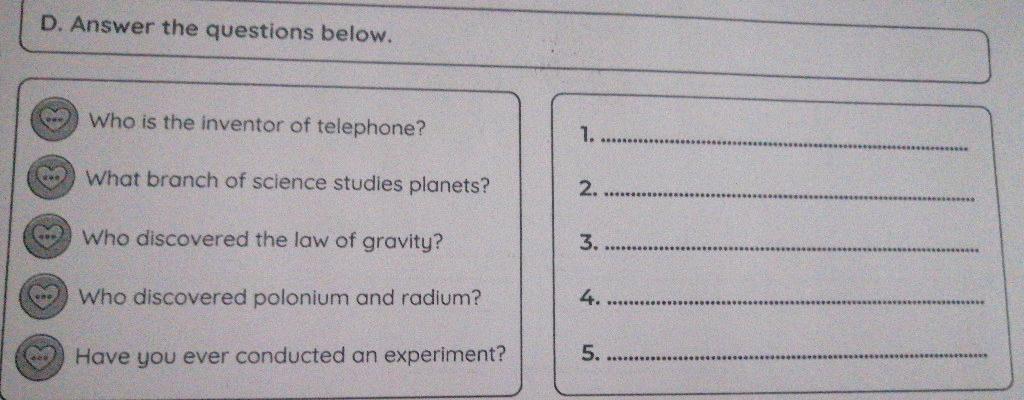
D. Answer the questions below.
Who is the inventor of telephone?
eWhat branch of science studies planets?
Who discovered the law of gravity?
3Who discovered polonium and radium?
Have you ever conducted an experiment?
Answers to the General Science and History Questions
Key Takeaways
- Alexander Graham Bell is widely credited as the primary inventor of the telephone.
- Astronomy is the scientific study of celestial objects like planets and stars.
- Sir Isaac Newton formulated the universal law of gravitation.
- Marie Curie, along with her husband Pierre, discovered the radioactive elements polonium and radium.
The telephone was invented by Alexander Graham Bell, who received the first patent for the device in 1876. While other inventors like Antonio Meucci contributed to its development, Bell’s work led to the first practical and commercially successful communication system.
Table of Contents
- Detailed Answers for the Exercise
- Comparison Table of Scientific Discoveries
- Summary Table
- Frequently Asked Questions
 Detailed Answers for the Exercise
Based on the image provided, here are the correct answers to fill in the blanks:
1. Who is the inventor of the telephone?
- Answer: Alexander Graham Bell. He successfully transmitted the first intelligible speech on March 10, 1876, saying, “Mr. Watson, come here, I want to see you.”
2. What branch of science studies planets?
- Answer: Astronomy. Specifically, Planetary Science (or Planetology) is the sub-discipline that focuses on the formation, evolution, and physical properties of planets.
3. Who discovered the law of gravity?
- Answer: Sir Isaac Newton. According to the famous story, he was inspired after watching an apple fall from a tree, leading him to conclude that the same force governs both the apple and the moon’s orbit.
4. Who discovered polonium and radium?
- Answer: Marie Curie and Pierre Curie. Marie Curie was the first woman to win a Nobel Prize and remains the only person to win Nobel Prizes in two different scientific fields (Physics and Chemistry).
5. Have you ever conducted an experiment?
- Answer: This is a personal question. You can answer: “Yes, I have conducted a simple experiment in my science class,” or “No, I haven’t yet, but I would like to.”
 Comparison of Scientific Contributions
| Feature | Alexander Graham Bell | Isaac Newton | Marie Curie |
|---|---|---|---|
| Primary Field | Communication / Engineering | Physics / Mathematics | Physics / Chemistry |
| Major Discovery | Practical Telephone | Law of Universal Gravitation | Radioactivity (Polonium/Radium) |
| Impact | Revolutionized global communication | Explained the motion of celestial bodies | Advanced cancer treatments and nuclear science |
 Summary Table
| Question Number | Topic | Correct Answer |
|---|---|---|
| 1 | Invention | Alexander Graham Bell |
| 2 | Branch of Science | Astronomy |
| 3 | Physics | Isaac Newton |
| 4 | Chemistry | Marie Curie |
| 5 | Personal Experience | (Student’s Choice) |
 Frequently Asked Questions
1. Was Alexander Graham Bell the only person working on the telephone?
No. Elisha Gray filed a patent caveat on the same day as Bell, and Antonio Meucci is also recognized for his early work on “voice communication” devices.
2. Is there a difference between Astronomy and Astrology?
Yes. Astronomy is a rigorous branch of science based on observation and physics. Astrology is a belief system that suggests the positions of stars influence human affairs; it is not considered a science.
3. What is the law of gravity in simple terms?
It is the principle that every mass exerts an attractive force on every other mass. The more mass an object has, the stronger its pull.
Would you like me to provide a short biography of Marie Curie or explain how Isaac Newton’s law of gravity works in more detail?