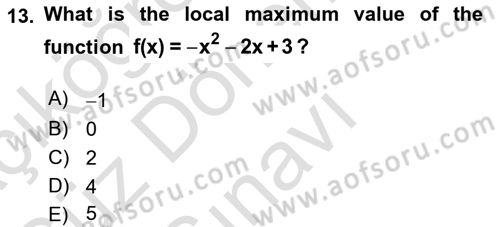
What is the local maximum value of the function ( f(x) = -x^2 - 2x + 3 )?
Önemli Noktalar
- The function is a quadratic function with a negative leading coefficient (−1), meaning it opens downward.
- The local maximum of a downward-opening parabola is at its vertex.
- The vertex’s x-coordinate is given by ( x = -\frac{b}{2a} ).
- Calculating the vertex value provides the local maximum.
The function ( f(x) = -x^2 - 2x + 3 ) is a downward parabola. Its vertex, where the local maximum occurs, can be found using the vertex formula ( x = -\frac{b}{2a} ). Here, ( a = -1 ), ( b = -2 ). Plugging in:
[
x = -\frac{-2}{2 \times -1} = -\frac{-2}{-2} = -1
]
Calculate ( f(-1) ):
[
f(-1) = -(-1)^2 - 2(-1) + 3 = -1 + 2 + 3 = 4
]
Thus, the local maximum value is 4.
İçindekiler
Finding the Vertex
The vertex of a quadratic function ( f(x) = ax^2 + bx + c ) is the point where the function attains its maximum or minimum. For ( a < 0 ), this point is a maximum.
- For ( f(x) = -x^2 - 2x + 3 ), coefficients are ( a = -1 ), ( b = -2 ).
- Use the vertex formula for ( x ):
[
x = -\frac{b}{2a}
]
- Substitute values:
[
x = -\frac{-2}{2(-1)} = -\frac{-2}{-2} = -1
]
This is the x-coordinate of the vertex, where the local maximum occurs.
Pro Tip: The sign of the leading coefficient (a) determines whether the parabola opens upward (minimum) or downward (maximum). Negative means maximum.
Calculating the Maximum Value
Substitute ( x = -1 ) back into the function to find the maximum value:
[
f(-1) = -(-1)^2 - 2(-1) + 3 = -1 + 2 + 3 = 4
]
Therefore, ( f(x) ) reaches its local maximum value of 4 at ( x = -1 ).
Summary Table
| Element | Details |
|---|---|
| Function | ( f(x) = -x^2 - 2x + 3 ) |
| Coefficients ( a, b, c ) | -1, -2, 3 |
| Vertex x-coordinate | ( -1 ) |
| Local maximum value | ( 4 ) |
| Parabola direction | Opens downward (max at vertex) |
Sık Sorulan Sorular
1. How do you know the function has a maximum and not a minimum?
Because the leading coefficient ( a = -1 ) is negative, the parabola opens downward, so the vertex is a local maximum.
2. What if the coefficient ( a ) was positive?
If ( a ) were positive, the parabola opens upward and the vertex would be a local minimum.
3. Can quadratic functions have multiple local maxima?
No, quadratic functions have a single vertex point which is either the global maximum or minimum.
Sonraki Adımlar
Would you like me to explain how to find local maxima/minima using derivatives for more complex functions?
What is the local maximum value of the function (f(x) = -x^2 - 2x + 3)?
- Quadratic functions with a negative leading coefficient are concave down and thus have a local (and global) maximum.
- The vertex of (f(x)=ax^2+bx+c) occurs at (x=-\frac{b}{2a}).
- You can verify the extremum either by the vertex formula or by setting the first derivative to zero.
The local maximum value of (f(x)) is 4.
1. Vertex of a Quadratic
A general quadratic (f(x)=ax^2+bx+c) has its vertex at
[
x_v = -\frac{b}{2a},\quad y_v = f(x_v).
]
Here, (a=-1), (b=-2), (c=3).
- Compute (x_v = -\frac{-2}{2\cdot(-1)} = -1).
- Then (y_v = f(-1) = -(-1)^2 -2(-1) +3 = -1 +2 +3 = 4.)
Because (a<0), this vertex is a maximum.
2. Derivative Method
Differentiate and find critical points:
[
f’(x) = \frac{d}{dx}(-x^2 -2x +3) = -2x -2.
]
Set (f’(x)=0):
[
-2x -2 = 0 \quad\Longrightarrow\quad x=-1.
]
Evaluate (f(-1)=4).
The second derivative (f’'(x)=-2<0) confirms a local maximum at (x=-1).
| Property | Value |
|---|---|
| Leading coefficient (a) | (-1) |
| Vertex (x)-coordinate | (-1) |
| Local maximum value | 4 |
Summary Table
| Method | Critical Point (x) | Maximum (f(x)) |
|---|---|---|
| Vertex formula | (-1) | 4 |
| Derivative ((f’=0)) | (-1) | 4 |
FAQ
Q1: What happens if (a>0) in (ax^2+bx+c)?
A1: The parabola is concave up and has a local minimum at its vertex.
Q2: Is this maximum also a global maximum?
A2: Yes, for a downward-opening parabola ((a<0)), the local maximum is also the global maximum.
Q3: Can we use completing the square instead?
A3: Absolutely. Completing the square on (-x^2-2x+3) yields (-(x+1)^2+4), directly showing a maximum of 4 at (x=-1).
Would you like me to generate a few practice problems on finding the vertices of quadratics?
@Gulce_Gedikli1