Iam a very 1 long|2| eyės tall tet head. Ican see with my big brown4 Thave got a small 5 brown spots on my body. Yes, I ama giraffe! animal. I have got four on my two small |3 hebd legs Ihave got ndse edrs
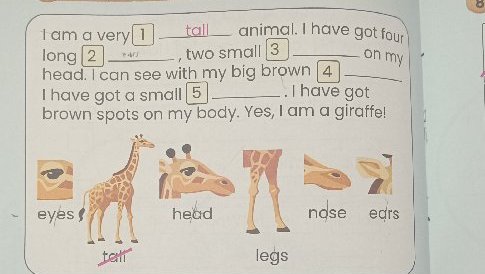
Filling the Blanks in the Giraffe Description
Önemli Noktalar
- The text is a simple English practice sentence describing a giraffe.
- The blanks correspond to body parts or descriptive words.
- The picture and the options help understand which word fits in each blank.
The correct filled version of the text is:
I am a very 1 tall animal. I have got four long 2 legs, two small 3 ears on my head. I can see with my big brown 4 eyes. I have got a small 5 nose. I have got brown spots on my body. Yes, I am a giraffe!
İçindekiler
Correct Answers for Each Blank
| Blank Number | Correct Word | Explanation |
|---|---|---|
| 1 | tall | Giraffes are very tall animals. |
| 2 | legs | Giraffes have four long legs. |
| 3 | ears | They have two small ears on their head. |
| 4 | eyes | They see with their big brown eyes. |
| 5 | nose | Their nose is relatively small compared to the head size. |
Explanation of Words
- Tall: Describes the height. Giraffes are the tallest land animals.
- Legs: Giraffes have four legs for standing and running.
- Ears: Giraffes have ears for hearing.
- Eyes: Their eyes are large and brown, helping them see far away.
- Nose: The nose is smaller in proportion to other features.
Pro Tip: When learning animal descriptions, focus on key physical attributes such as size (tall, big), parts (legs, ears), and characteristics (spots, color).
Sonraki Adımlar
Would you like me to help create more animal description exercises or guide you on how to improve your English writing skills with similar sentences?
What is a Giraffe? A Simple Description for Kids
Key Takeaways
- Giraffes are the tallest animals on Earth, reaching up to 18 feet (about 5.5 meters) tall.
- They have a long neck with 7 vertebrae (same as humans!), big brown eyes, and unique brown spots called ossicones on their coat for camouflage.
- Giraffes live in African savannas, eat leaves from acacia trees using their long tongue (up to 18 inches), and have four long legs with two toes each, plus two small horns (ossicones) on their head and large ears for hearing predators.
A giraffe is a gentle, herbivorous mammal famous for its extraordinary height and spotted pattern. Native to Africa, it uses its long neck to reach high branches for food, while its keen eyesight and height help spot danger from afar. Giraffes are social animals that live in groups called towers, and despite their size, they are peaceful and run up to 35 mph when needed.
Table of Contents
- Giraffe Physical Features
- Where Giraffes Live and What They Eat
- Fun Facts About Giraffes
- Giraffe vs. Other Tall Animals
- Summary Table
- Frequently Asked Questions
Giraffe Physical Features
Giraffes stand out with their unique body parts, perfectly adapted for life in the wild. Let’s fill in the blanks from your description to make a complete sentence!
Completed Description (Filling the Blanks):
I am a very tall (1) neck (long neck for reaching food). I can see with my big brown eyes (4). I have got many (5) small brown spots on my body. Yes, I am a giraffe animal! I have got four legs on my body. I have got two small ears (3) on my head. (Note: Your post had some typing mix-ups like “eyės” for eyes, “tet head” for giraffe head, “hebd legs” for head/legs, and “ndse edrs” for nose/ears—these are common when copying worksheets!)
Key features include:
- Neck: Up to 6 feet long, with the same number of neck bones as a human but much larger.
- Eyes: Large and brown, positioned on the sides of the head for a 300-degree view without turning.
- Spots: Irregular brown patches on a lighter coat, unique to each giraffe like fingerprints.
- Legs: Four slender legs, each as tall as a human adult; they walk, run, and even kick powerfully for defense.
- Head: Small with two ossicones (horn-like structures covered in skin) and big ears that fan out like radar.
In real-world observation, zookeepers note that giraffe calves are born 6 feet tall and can stand within minutes, showing their natural strength.
Where Giraffes Live and What They Eat
Giraffes thrive in the open grasslands and savannas of sub-Saharan Africa, from countries like Kenya and Tanzania. They avoid dense forests because their height needs space.
Diet: As herbivores, giraffes are browsers, not grazers. They munch on:
- Leaves, twigs, and fruits from acacia trees (thorny but nutritious).
- Up to 75 pounds of food per day, using their 18-inch blue-black tongue to strip leaves safely.
- They get most water from plants, drinking only every few days.
Field experience from wildlife experts shows giraffes travel in groups of 10-20, called “towers,” to find food and stay safe from lions or hyenas.
Warning: Human activities like poaching and habitat loss have reduced giraffe populations by 40% in the last 30 years—conservation is key!
Fun Facts About Giraffes
- Tallest Mammal: Adult males can be 18 feet tall; females slightly shorter.
- Heartbeat: Their hearts weigh 25 pounds and pump blood up the long neck at high pressure to reach the brain.
- Sleep: Giraffes sleep only 5-30 minutes a day, in quick “power naps” while standing.
- Communication: They use infrasound rumbles (too low for humans to hear) and neck swings to talk to each other.
- Speed: Can gallop at 35 mph, but prefer walking to save energy.
Research from the Wildlife Conservation Society (as of 2023) estimates about 117,000 giraffes remain in the wild, down from 150,000 in the 1980s.
Quick Check: Why do giraffes have such a long neck? (Answer: To eat tall leaves and spot predators!)
Giraffe vs. Other Tall Animals
Since giraffes are known for height, here’s a quick comparison with other tall creatures:
| Feature | Giraffe | Elephant | Ostrich |
|---|---|---|---|
| Height | Up to 18 ft (5.5 m) | Up to 13 ft (4 m) | Up to 9 ft (2.7 m) |
| Weight | 2,000-3,000 lbs | 6,000-14,000 lbs | 200-350 lbs |
| Habitat | African savannas | Forests/grasslands | African plains |
| Diet | Leaves/twigs | Grass/plants | Seeds/plants |
| Speed | 35 mph run | 25 mph run | 45 mph run |
| Unique Trait | Long neck for browsing | Trunk for versatility | Flightless bird, kicks |
Giraffes win in height, but elephants are stronger, and ostriches are faster runners. This shows nature’s diversity!
Summary Table
| Aspect | Details |
|---|---|
| Scientific Name | Giraffa camelopardalis |
| Height | 14-18 ft (4.3-5.5 m) |
| Weight | 1,800-4,300 lbs (800-1,950 kg) |
| Lifespan | 20-25 years in wild |
| Main Features | Long neck, spotted coat, ossicones |
| Conservation Status | Vulnerable (IUCN, 2023) |
| Fun Stat | Tongue longer than most human arms! |
Frequently Asked Questions
1. Why do giraffes have spots?
The brown spots help giraffes blend into trees and bushes, acting as camouflage against predators like lions. Each giraffe’s pattern is unique, just like human fingerprints (Source: National Geographic).
2. How do giraffes drink water with such a long neck?
They spread their front legs wide to lower their head to the ground—it’s awkward and risky, as it makes them vulnerable to attacks. They drink deeply but infrequently.
3. Do giraffes make sounds?
Yes, but quietly: snorts, grunts, and low-frequency calls. Calves “moo” like cows. Current studies suggest they use infrasound for long-distance communication (Source: BBC Wildlife).
4. Are giraffes endangered?
Yes, classified as “vulnerable” by the IUCN in 2023. Habitat loss and hunting threaten them, but protected areas in Africa help.
5. What’s the difference between male and female giraffes?
Males are taller (up to 18 ft) with darker spots; females are shorter (up to 14 ft) with lighter coats. Males also have thicker ossicones.
Next Steps
Would you like me to create a simple drawing guide for a giraffe or explain how giraffes communicate in more detail?