8th Grade English: Making Invitations & Expressing Personal Opinions
 KEY FORMULA / RULE: In English reading comprehension, matching synonymous expressions is essential: “abroad” means in or to a foreign country (“another country”). When expressing opinions about activities, positive adjectives (e.g., terrific, amazing, impressive) indicate preference, while negative adjectives (e.g., ridiculous, boring, unbearable, terrible) express dislike.
 SOLUTION & OPTION ANALYSIS
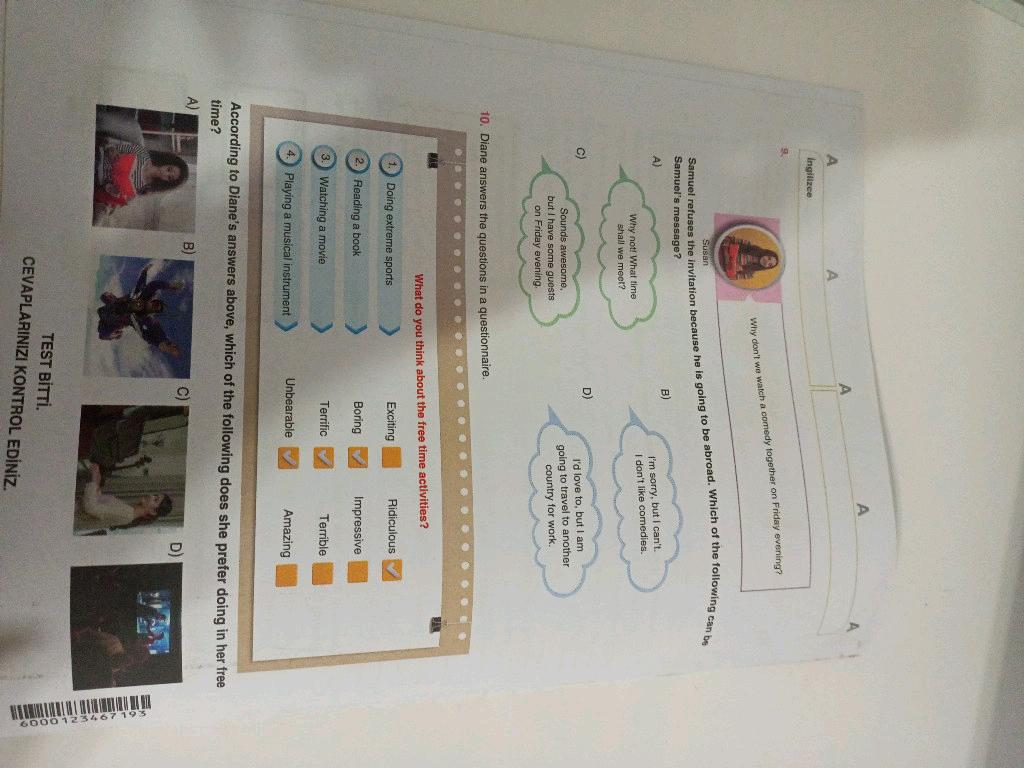
Question 9 Analysis:
The question asks for Samuel’s refusal message based on the reason: “he is going to be abroad.”
- A) “Why not! What time shall we meet?” — Accepts the invitation; does not refuse.
- B) “I’m sorry, but I can’t. I don’t like comedies.” — Refuses due to personal dislike of movie genre, not because of being abroad.
- C) “Sounds awesome, but I have some guests on Friday evening.” — Refuses because of hosting guests at home.
- D) “I’d love to, but I am going to travel to another country for work.” — Refuses because traveling to another country directly means going abroad.
Question 10 Analysis:
According to Diane’s questionnaire responses, let us evaluate her attitude toward each activity:
- 1. Doing extreme sports: Marked “Ridiculous” (Negative)
- 2. Reading a book: Marked “Boring” (Negative)
- 3. Watching a movie: Marked “Terrific” (Positive: meaning wonderful / excellent)
- 4. Playing a musical instrument: Marked “Unbearable” (Negative)
Diane only has a positive attitude toward watching a movie (terrific), which corresponds to the person watching a screen in the dark in image D.
- A) Shows reading a book (boring).
- B) Shows extreme sports (ridiculous).
- C) Shows playing a musical instrument (unbearable).
- D) Shows watching a movie/TV in a cinema setting (terrific).
 FINAL ANSWER:
- Question 9: D) I’d love to, but I am going to travel to another country for work.
- Question 10: D) Watching a movie
 EXAM INSIGHT / PITFALL: Be careful with false friends: “Terrific” is strongly positive (harika, muhteşem), whereas “Terrible” is negative (berbat). Students often confuse terrific with terrible.