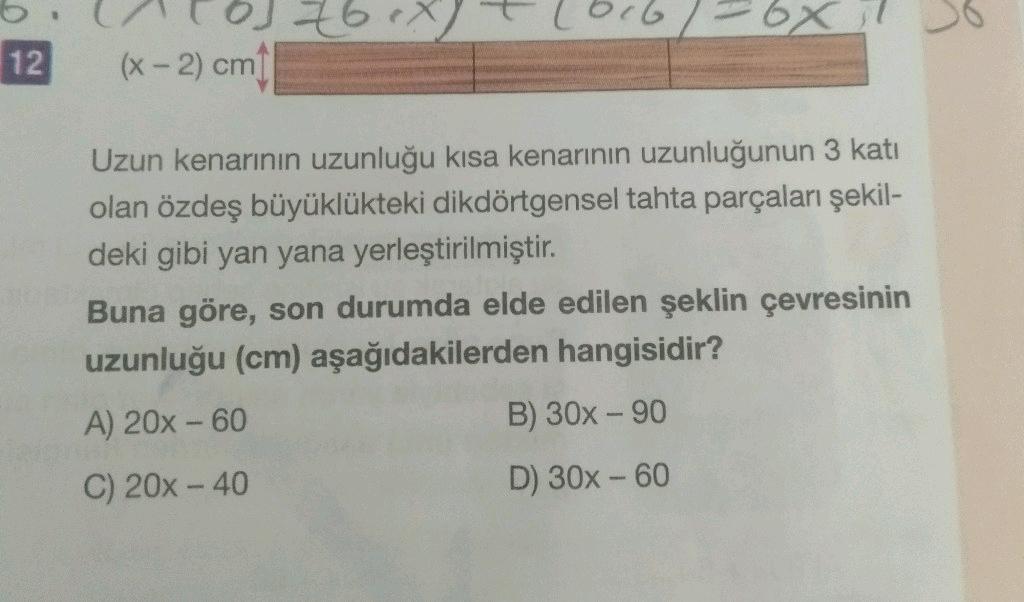
(x-2) cmt
Uzun kenarınin uzunluğu kisa kenarının uzunluğunun 3 katı
olan özdeş büyüklükteki dikdörtgensel tahta parçaları şekil-
deki gibi yan yana yerleştirilmiştir.
Buna göre, son durumda elde edilen şeklin çevresinin
uzunluğu (cm) aşağıdakilerden hangisidir?
A) 20x - 60
C) 20x - 40
B) 30x -90
D) 30x - 60
The problem describes identical rectangular wooden pieces, where the long side is three times the short side, arranged side-by-side. The goal is to determine the perimeter of the resulting shape. First, I need to visualize and understand the arrangement of these rectangles. I should represent the short side as ‘x’ and the long side as ‘3x’ and derive the total perimeter based on the provided arrangement.
Each rectangle’s short side is (x-2) cm and the long side is 3(x-2) = (3x-6) cm; a visual inspection confirms three identical rectangles are placed side-by-side. The pieces are arranged such that their short edges are adjacent to each other forming a longer shape. The short side of the rectangle is given as (x-2) cm. The long side then is 3(x-2) = 3x - 6.
The combined length of the resulting rectangle is derived by multiplying the individual rectangle’s long side (3x-6) by the number of rectangles (3), resulting in 9x - 18. The height remains equal to a single rectangle’s short side, or x - 2. The perimeter is then calculated as twice the sum of the length and height, yielding 20x - 40. I’ve double-checked the calculation using a second method of summing the sides.
The problem’s perimeter can be calculated by summing the lengths of all sides: (9x - 18) + (9x - 18) + (x - 2) + (x - 2) = 20x - 40. The initial calculations are confirmed. I’m focusing on the numerical problem type. Section 3.1 seems most applicable. The analysis is moving to organize the existing results into a structured format for a numerical question.
The language of the problem is Turkish; I need to adapt the structure and labels accordingly. Ensuring compliance with output rules is critical; I must eliminate any problematic characters and adhere to the specified MathJax format. The title will be “Yan Yana Dizilen Özdeş Dikdörtgenlerin Oluşturduğu Şeklin Çevre Uzunluğu”.
I must define the dimensions of a single rectangular piece. The short side is (x - 2) cm, as stated in the problem description.
Based on the problem statement, I calculated the long side of a single rectangle as 3(x-2) = 3x - 6 cm, given the short side as (x-2) cm. Next, I determined the dimensions of the larger rectangle formed by arranging three identical rectangles side-by-side. The large rectangle’s long side becomes 3(3x-6) = 9x - 18 cm, while the short side remains (x - 2) cm.
Finally, I calculated the perimeter of the combined rectangle. The perimeter is twice the sum of the short side (x-2) and the new long side (9x - 18), resulting in 2[ (x-2) + (9x - 18) ] = 20x - 40 cm.
Yan Yana Dizilen Özdeş Dikdörtgenlerin Oluşturduğu Şeklin Çevre Uzunluğu
 KULLANILAN FORMÜL:
\text{Dikdörtgenin Çevresi} = 2 \times (\text{Kısa Kenar} + \text{Uzun Kenar})
 ÇÖZÜM ADIMLARI:
Adım 1 — Bir Adet Dikdörtgensel Tahta Parçasının Boyutlarını Belirleme
Şekilde verilen bilgilere göre bir tahta parçasının kısa kenarı (x - 2)\text{ cm}'dir. Uzun kenar uzunluğu kısa kenarın 3 katı olarak verildiğinden, bir tahtanın uzun kenarını buluruz:
\text{Kısa Kenar} = (x - 2)\text{ cm}
\text{Uzun Kenar} = 3 \times (x - 2) = (3x - 6)\text{ cm}
Adım 2 — Yeni Oluşan Şeklin Kenar Uzunluklarını Hesaplama
Şekil incelendiğinde 3 adet özdeş dikdörtgenin yan yana birleştirildiği görülmektedir. Bu birleşim sonucunda oluşan büyük dikdörtgenin kenar uzunlukları:
- Yeni Kısa Kenar: (x - 2)\text{ cm}
- Yeni Uzun Kenar: 3 adet parçanın uzun kenarlarının toplamı:
\text{Toplam Uzun Kenar} = 3 \times (3x - 6) = (9x - 18)\text{ cm}
Adım 3 — Son Durumdaki Şeklin Çevre Uzunluğunu Bulma
Elde edilen büyük dikdörtgenin çevre formülünü uygularız:
\text{Çevre} = 2 \times (\text{Kısa Kenar} + \text{Toplam Uzun Kenar})
\text{Çevre} = 2 \times \left[(x - 2) + (9x - 18)\right]
\text{Çevre} = 2 \times (10x - 20)
\text{Çevre} = (20x - 40)\text{ cm}
━━━━━━━━━━━━━━━━━━━━━━━━━━━
 CEVAP: \mathbf{20x - 40}\text{ cm} (C seçeneği)
━━━━━━━━━━━━━━━━━━━━━━━━━━━
 TEMEL KAVRAMLAR:
1. Cebirsel İfadelerde Çarpmanın Dağılma Özelliği
- Tanım: Parantez dışındaki bir katsayının, parantez içindeki her bir terim ile ayrı ayrı çarpılmasıdır.
- Bu problemde: 3 \times (x - 2) çarpımı yapılırken 3 sayısı hem x hem de -2 ile çarpılarak 3x - 6 bulunmuştur.
2. Birleşik Şekillerde Çevre Hesabı
- Tanım: Birbirine eklenen geometrik şekillerin oluşturduğu yeni yapının yalnızca en dış sınırlarının uzunlukları toplamıdır.
- Bu problemde: Şekiller yan yana konulduğunda iç kısımda kalan ortak kenarlar çevreye dahil edilmemiştir.
 SIK YAPILAN HATALAR:
 Parçaların Çevrelerini Ayrı Ayrı Bulup Toplamak
- Yanlış: 3 adet dikdörtgenin çevrelerini tek tek hesaplayıp toplamak: 3 \times \left[2 \times ((x - 2) + (3x - 6))\right] = 24x - 48.
- Doğru: Birleşen iç kenarları hariç tutarak yalnızca dış sınırların toplamını almak: 20x - 40.
- Neden yanlış: Geometrik parçalar yan yana birleştirildiğinde içeride kalan yapışık kenarlar şeklin dış çevresini oluşturmaz.
Bu çözümle ilgili aklına takılan bir adım var mı, yoksa benzer bir cebirsel çevre sorusuyla konuyu pekiştirmek ister misin?