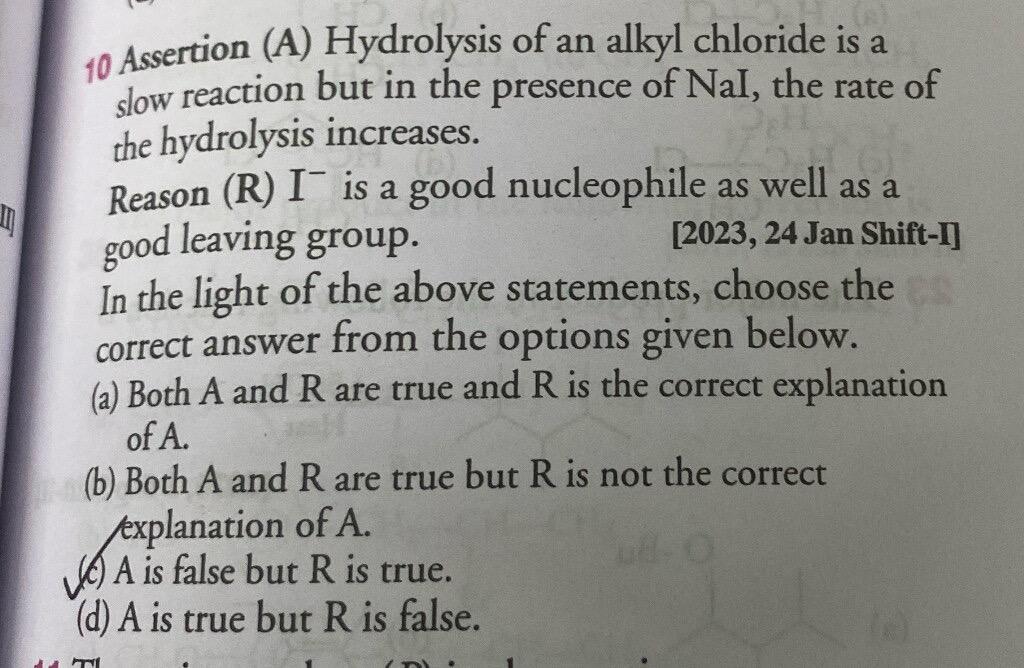
un Assertion (A) Hydrolysis of an alkyl chloride is a
dow reaction but in the presence of Nal, the rate of
the hydrolysis increases.
Reason (RT is a good nucleophile as well as a
[2023, 24 Jan Shift-I]
good leaving group.
In the light of the above statements, choose the
correct answer from the options given below.
(a) Both A and R are true andR is the correct explanation
of A.
(b) Both A and R are true but R is not the correct
explanation of A.
JA is false but R is true.
4) A is true but R is false.
if I- is a good nucleophile then it will go and attack the R+ instead of Oh- right
Assertion (A) Analysis:
The direct hydrolysis of an alkyl chloride (R\text{—Cl} + \text{OH}^- \rightarrow R\text{—OH} + \text{Cl}^-) is relatively slow because the \text{C—Cl} bond is strong and chloride (\text{Cl}^-) is a moderately poor leaving group. When a catalytic amount of \text{NaI} is added, the reaction rate significantly increases via a two-step pathway known as nucleophilic catalysis. Therefore, Assertion (A) is TRUE.
Reason (R) Analysis:
Iodide ion (\text{I}^-) has a large atomic radius and high polarizability, making it a powerful nucleophile that readily attacks R\text{—Cl} to displace \text{Cl}^-. At the same time, because the hydroiodic acid (\text{HI}) conjugate acid is extremely strong (\text{p}K_a \approx -10), \text{I}^- is also an exceptionally good leaving group. Hence, when hydroxide (\text{OH}^-) subsequently attacks the formed alkyl iodide (R\text{—I}), \text{I}^- leaves effortlessly, regenerating the catalyst. Therefore, Reason (R) is TRUE.
Connection between (A) and (R):
Because \text{I}^- possesses both traits simultaneously—attacking quickly in the first step and departing quickly in the second step—it lowers the overall activation energy of hydrolysis. Thus, Reason (R) is the correct explanation of Assertion (A).
Clarification to Your Doubt:
“If \text{I}^- is a good nucleophile, won’t it attack instead of \text{OH}^-?”
Yes, exactly! That is the secret to why the reaction speeds up:
\text{I}^-does attack first because it is a much better nucleophile than \text{H}_2\text{O} (and in many conditions, more polarizable than \text{OH}^-), rapidly forming R\text{—I}.
However, the reaction does not stop there. Since \text{I}^- is also a much better leaving group than \text{Cl}^-, the incoming \text{OH}^- easily attacks R\text{—I} to produce the final alcohol (R\text{—OH}), releasing \text{I}^- back into solution.
Because both steps together are faster than the single-step direct displacement of \text{Cl}^-, \text{I}^- acts as a homogeneous catalyst.
━━━━━━━━━━━━━━━━━━━━━━━━━━━ FINAL ANSWER:(a) Both A and R are true and R is the correct explanation of A.
━━━━━━━━━━━━━━━━━━━━━━━━━━━
KEY CONCEPTS:
Nucleophilic Catalysis: Acceleration of a nucleophilic substitution reaction by an added nucleophile that forms a reactive intermediate.
Dual Nature of \text{I}^-: Due to high polarizability, \text{I}^- acts both as a great nucleophile (kinetic speed of attack) and a stable, weak base leaving group (thermodynamic stability upon departure).
COMMON MISTAKES:
Incorrect Approach: Assuming that since \text{I}^- forms R\text{—I}, the hydrolysis cannot complete and R\text{—OH} will not form.
Correct Approach: Recognizing that R\text{—I} is only a short-lived intermediate; the superior leaving ability of \text{I}^- ensures rapid turnover to the final product R\text{—OH}.
Would you like to explore why alkyl fluorides behave differently under these conditions?
Yes, the iodide ion (\text{I}^-) is an extremely weak base. In fact, it is one of the weakest bases in organic and inorganic chemistry because its conjugate acid, hydroiodic acid (\text{HI}), is an exceptionally strong mineral acid with a \text{p}K_a \approx -10.
Key Scientific Factors:
Strength of Conjugate Acid (\text{HI}): According to acid-base principles, the stronger the acid, the weaker its conjugate base:
Because \text{HI} dissociates almost completely, \text{I}^- has practically no tendency to accept a proton (\text{H}^+) in aqueous solution.
Large Atomic Radius and Polarizability: The negative charge on the iodide ion is distributed over a very large electron cloud (5p valence shell). This low charge density provides high thermodynamic stability, meaning \text{I}^- does not need to share its electron pair with a proton.
Basicity vs. Nucleophilicity:
Basicity is a thermodynamic property measuring affinity for a proton (\text{H}^+).
Nucleophilicity is a kinetic property measuring the rate of attack on an electron-deficient carbon center.
Therefore, \text{I}^- can simultaneously be a very weak base and a very strong nucleophile (due to its high polarizability).
The Golden Rule for Leaving Groups:
A weaker base is always a better leaving group.
Because \text{I}^- is an extremely weak and stable base, it readily departs with its pair of electrons, making it one of the best leaving groups among halides.
Halide Ion
Conjugate Acid (\text{p}K_a)
Base Strength
Leaving Group Ability
Nucleophilicity (Protic Solvent)
\text{I}^-
\text{HI} (-10)
Weakest
Best
Strongest
\text{Br}^-
\text{HBr} (-9)
Weak
Very Good
Good
\text{Cl}^-
\text{HCl} (-7)
Moderate
Fair
Moderate
\text{F}^-
\text{HF} (+3.2)
Strongest
Poorest
Weakest
Would you like to explore why nucleophilicity and basicity show opposite trends for halides in protic vs. polar aprotic solvents?
Why \text{I}^- Is a Strong Nucleophile Despite Being a Weak Base
Basicity and nucleophilicity measure two fundamentally different chemical properties. Basicity is a thermodynamic property measuring how strongly a species binds to a tiny proton (\text{H}^+) at equilibrium. Nucleophilicity is a kinetic property measuring how rapidly a species donates electrons to an electrophilic carbon atom. Because carbon and hydrogen have very different electronic needs, an ion can be a weak base while remaining an outstanding nucleophile.
The Three Reasons \text{I}^- Excels as a Nucleophile:
1. High Polarizability (“Soft” Electron Cloud):
The iodide ion has electrons in the large 5p orbital, far from the nucleus. This massive electron cloud is easily distorted (polarizable). When approaching a partially positive carbon (\text{C}^{\delta+}), the electron cloud stretches toward the carbon’s empty \sigma^* antibonding orbital from a distance, initiating bonding early and drastically lowering the activation energy (E_a).
2. Weak Solvation Shell in Protic Solvents:
In water or alcohol, small, charge-dense ions (like \text{F}^- or \text{OH}^-) are tightly trapped inside a rigid cage of hydrogen bonds. They must spend considerable energy breaking these solvent cages before attacking. Because \text{I}^- has low charge density, solvent molecules interact with it weakly, leaving it free to attack the carbon center immediately.
3. Hard-Soft Acid-Base (HSAB) Theory:
A proton (\text{H}^+) is extremely small with high charge density (hard acid). It strongly prefers small, concentrated electron donors like \text{OH}^- or \text{F}^-.
A carbon atom in an alkyl halide is larger and more polarizable (soft electrophile). It forms orbital overlap far better with large, polarizable electron donors like \text{I}^- (soft nucleophile).
Basicity vs. Nucleophilicity Comparison
Property
Basicity
Nucleophilicity
Target Center
Proton (\text{H}^+)
Carbon (\text{C}^{\delta+})
Measured By
Equilibrium constant (K_a / \text{p}K_a)
Reaction rate constant (k)
Domain
Thermodynamic (Stability of the bond formed)
Kinetic (Speed of orbital overlap)
Favored By
High charge density, small size (\text{OH}^-, \text{F}^-)
High polarizability, weak solvation (\text{I}^-, \text{RS}^-)
Iodide Behavior
Extremely Weak (\text{HI} is a strong acid)
Exceptionally Strong (Rapid attack on carbon)
Practical Takeaway:
Think of a proton (\text{H}^+) as a tiny lock that only small, dense keys can fit into firmly (basicity). In contrast, the carbon center is a large target in an obstacle course; a big, flexible, fast-moving runner (\text{I}^-) reaches it first without getting tangled up in solvent water molecules (nucleophilicity).
Would you like to see how changing the solvent from protic (like water) to polar aprotic (like acetone in the Finkelstein reaction) affects this behavior?
 FORMULAS & RULES USED:
 STEP-BY-STEP SOLUTION & OPTION ANALYSIS:
 FINAL ANSWER: (a) Both A and R are true and R is the correct explanation of A.
 KEY CONCEPTS:
 COMMON MISTAKES:
 Incorrect Approach: Assuming that since
 Key Scientific Factors: