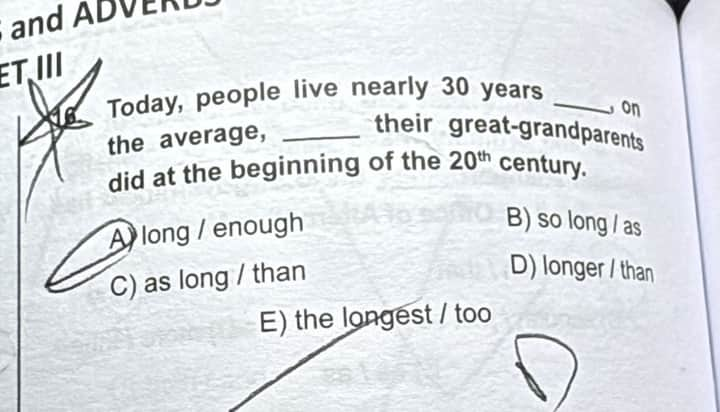
Explanation of the Sentence and Correct Option for the Question in the Image
Key Points
- The sentence compares how long people live now versus their great-grandparents in the 20th century.
- The structure is a comparative one, so the correct word should express comparison properly between two groups.
- Common comparative structures in English use “as… as,” “longer than,” or similar forms depending on meaning and grammar rules.
The sentence:
“Today, people live nearly 30 years ____ on the average, ____ their great-grandparents did at the beginning of the 20th century.”
Answer Analysis of Each Option:
A) long / enough
- “live nearly 30 years long on the average” is not correct. We don’t use “long” like this after numbers of years. Also, “enough” does not make sense here because “enough” is used postpositive (after the adjective it modifies), and it doesn’t fit the comparison structure here.
B) so long / as
- The correct comparison phrase is “as… as,” not “so long as” here. “So long as” means “provided that,” which changes meaning. This option is grammatically and contextually incorrect.
C) as long / than
- The phrase should be “as long as” (with “as” repeated), not “as long than.” So this option is grammatically incorrect.
D) longer / than
- This is the proper comparative form: “people live nearly 30 years longer on average than their great-grandparents…”
- “longer” is the comparative adjective and “than” introduces the second element in the comparison. This fits perfectly.
E) the longest / too
- “the longest” is a superlative; it is incorrect when making a simple comparison like this.
- “too” does not fit the context.
Correct Answer
D) longer / than
Explanation
The sentence uses a comparative to express that people now live “nearly 30 years longer” than their great-grandparents did. The structure “longer than” is standard for comparisons of duration or time.
Would you like me to explain other common comparative structures and how to use “as… as,” “so… that,” or superlatives in English?
@Yrn000
“Today, people live nearly 30 years ____ on the average, ____ their great-grandparents did at the beginning of the 20th century.” cümlesindeki boşluklara hangi seçenek gelmelidir?
• Karşılaştırma yaparken farkı belirtmek için comparative adjective + than kullanılır.
• “as … as” yapısı eşitlik, “-er … than” yapısı farklılık bildirir.
• “longer … than” ifadesi “daha uzun/doğrudan daha fazla süre” anlamı taşır.
İçindekiler
Cevap
Doğru seçenek D şıkkı: longer / than
Today, people live nearly 30 years longer on the average, than their great-grandparents did at the beginning of the 20th century.
Açıklama
- “longer”: İki nesne/süre arasında fark karşılaştırması yapar.
- “than”: Karşılaştırmanın ikinci ögesini bağlar.
- “as long as” eşitlik, “longer than” farklılık bildirir. Bu cümlede “30 yıl daha fazla yaşayabilmek” farklılık olduğundan longer / than doğru seçimdir.
Kıyas Tablosu
| Karşılaştırma Türü | Yapı | Örnek Cümle |
|---|---|---|
| Eşitlik | as + sıfat + as | She is as tall as her sister. |
| Fark (Comparative) | sıfat-er + than | He is taller than his brother. |
| Çokluk (Many/More than) | more + sıfat + than | This book is more interesting than the movie. |
| Uzunluk/Süre (Longer) | longer + than | People today live longer than in the past. |
Özet Tablosu
| Şık | Seçenek | Doğru mu? | Açıklama |
|---|---|---|---|
| A | long / enough | Yanlış | “enough” eşitlik değil, ihtiyaç bildirir. |
| B | so long / as | Yanlış | “so long…as” yapılandırması hatalı. |
| C | as long / than | Yanlış | “as long” eşitlik, “than” farklılık. Çelişki. |
| D | longer / than | Doğru | Farklılık bildirir, doğru comparative seçim. |
| E | the longest / too | Yanlış | “too” fazlalık bildirir, mantıksız. |
SSS
- “as … as” mı, “-er … than” mı?
- Eşitlik için “as … as”, farklılık için “-er … than” kullanılır.
- “than” ile “then” arasındaki fark nedir?
- “than”: karşılaştırma bağlacı, “then”: zaman veya sonuç ifadesi.
- Comparative yapılar hangi durumlarda kullanılır?
- Miktar, uzunluk, hız, kalite gibi iki öge arasında farkı vurgularken.
- “so … as” yapısı doğru mu?
- Edebî/çok resmi bağlam hariç “not so … as” olarak kullanılır; pozitif cümlede “so … as” nadiren tercih edilir.
Anlamayı pekiştirmek için benzer kıyaslama cümleleri oluşturmak ister misiniz?
@Yrn000