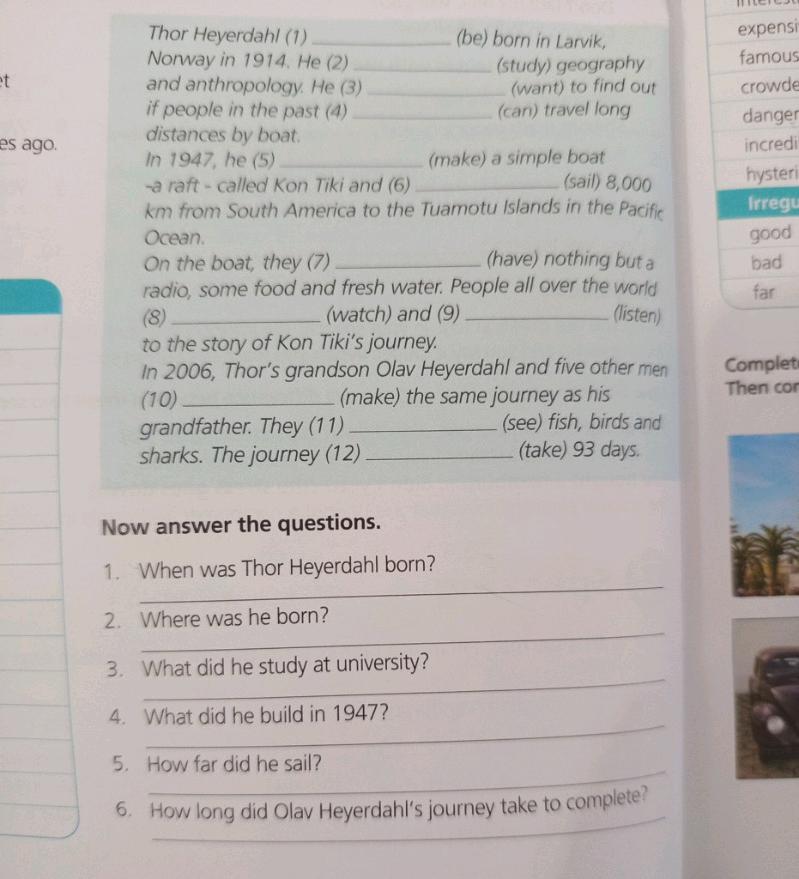
Thor Heyerdahl (1) ____________________ (be) born in Larvik, Norway in 1914. He (2) ____________________ (study) geography and anthropology. He (3) ____________________ (want) to find out if people in the past (4) ____________________ (can) travel long distances by boat.
In 1947, he (5) ____________________ (make) a simple boat -a raft- called Kon Tiki and (6) ____________________ (sail) 8,000 km from South America to the Tuamotu Islands in the Pacific Ocean.
On the boat, they (7) ____________________ (have) nothing but a radio, some food and fresh water. People all over the world (8) ____________________ (watch) and (9) ____________________ (listen) to the story of Kon Tiki’s journey.
In 2006, Thor’s grandson Olav Heyerdahl and five other men (10) ____________________ (make) the same journey as his grandfather. They (11) ____________________ (see) fish, birds and sharks. The journey (12) ____________________ (take) 93 days.
Now answer the questions.
- When was Thor Heyerdahl born?
- Where was he born?
- What did he study at university?
- What did he build in 1947?
- How far did he sail?
- How long did Olav Heyerdahl’s journey take to complete?
Past Simple Tense and Reading Comprehension: Thor Heyerdahl
 KEY FORMULA / RULE: In English, the Past Simple tense is used to describe completed actions in the past. Regular verbs form the past simple by adding -ed (e.g., study \rightarrow studied, sail \rightarrow sailed), while irregular verbs have unique past forms (e.g., be \rightarrow was/were, make \rightarrow made, see \rightarrow saw, take \rightarrow took).
 SOLUTION STEPS
Part 1 — Filling in the Blanks (Past Simple):
- (1) was: The subject Thor Heyerdahl is singular third-person, so the past form of be is was.
- (2) studied: The verb study ends in a consonant + y, which changes to studied.
- (3) wanted: Regular verb taking -ed \rightarrow wanted.
- (4) could: The past form of the modal verb can is could.
- (5) made: Irregular verb (make \rightarrow made).
- (6) sailed: Regular verb taking -ed \rightarrow sailed.
- (7) had: Irregular verb (have \rightarrow had).
- (8) watched: Regular verb taking -ed \rightarrow watched.
- (9) listened: Regular verb taking -ed \rightarrow listened.
- (10) made: Irregular verb (make \rightarrow made).
- (11) saw: Irregular verb (see \rightarrow saw).
- (12) took: Irregular verb (take \rightarrow took).
Part 2 — Reading Comprehension Questions:
- When was Thor Heyerdahl born?
- Answer: He was born in 1914.
- Where was he born?
- Answer: He was born in Larvik, Norway.
- What did he study at university?
- Answer: He studied geography and anthropology.
- What did he build in 1947?
- Answer: He built a simple boat (a raft) called Kon Tiki.
- How far did he sail?
- Answer: He sailed 8,000 km.
- How long did Olav Heyerdahl’s journey take to complete?
 EXAM INSIGHT / PITFALL: When answering questions beginning with did (e.g., “What did he study?”), always return the main verb to its base form in the question, but conjugate it back into the past tense in full-sentence answers (“He studied…”).