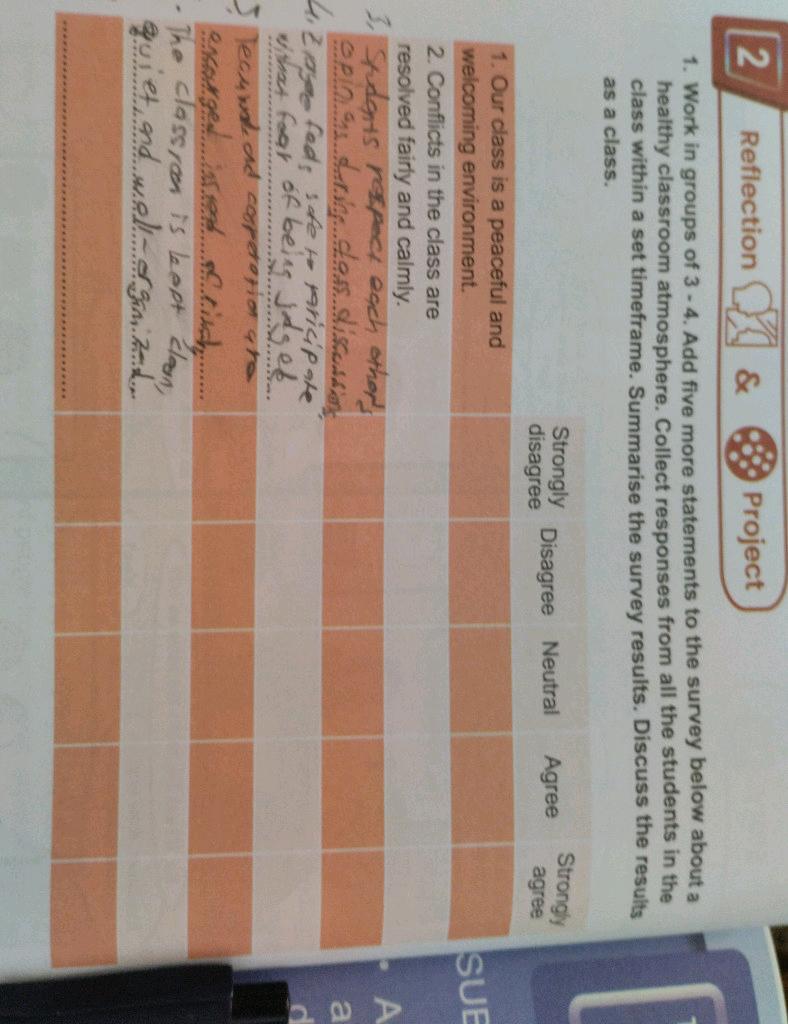
Designing a Classroom Atmosphere Survey
A healthy classroom atmosphere is built upon mutual respect, emotional safety, effective communication, and active collaboration. To conduct a comprehensive survey, statements should be clear, measurable, and focused on student well-being and productivity.
 5 Additional Statements for the Survey
Here are five statements to complete your classroom atmosphere survey:
-
Statement 6 (Active Listening & Teacher Support):
“Students and teachers listen to one another attentively without unnecessary interruptions.”
(Focus: Promotes constructive dialogue and ensures everyone feels heard.)
-
Statement 7 (Inclusivity & Belonging):
“No student is intentionally excluded from group activities, discussions, or social interactions.”
(Focus: Ensures equity, empathy, and social inclusion.)
-
Statement 8 (Constructive Feedback):
“Mistakes are treated as learning opportunities rather than reasons for criticism or ridicule.”
(Focus: Builds academic confidence and a growth mindset.)
-
Statement 9 (Shared Responsibility):
“All students take shared responsibility for keeping the classroom tidy, organized, and focused on learning.”
(Focus: Enhances personal accountability and respect for shared spaces.)
-
Statement 10 (Praise and Encouragement):
“Classmates celebrate each other’s successes and encourage one another during challenging tasks.”
(Focus: Fosters peer motivation and team spirit.)
 Step-by-Step Implementation Guide
To carry out the group activity effectively, follow this framework:
| Phase |
Action Steps |
| 1. Data Collection |
Use a Likert scale for each item: (1) Strongly Disagree, (2) Disagree, (3) Neutral, (4) Agree, (5) Strongly Agree. Distribute via slips of paper or a digital form. |
| 2. Summarizing Results |
Calculate the average score for each statement: $$\text{Average Score} = \frac{\text{Sum of all ratings}}{\text{Total number of respondents}}$$ Identify the top 2 highest-scoring areas (strengths) and the 2 lowest-scoring areas (areas for improvement). |
| 3. Class Discussion |
Present findings using clear visuals (e.g., a simple bar chart). Conclude by agreeing on two actionable class rules to address the lowest-scoring areas. |
Would you like to design a sample tally chart or a set of discussion questions to guide your class presentation?