ب
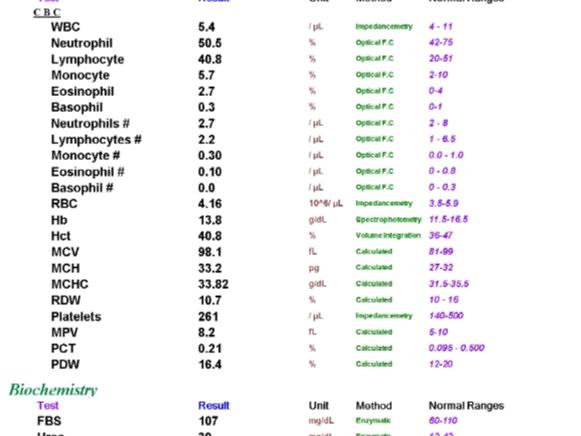
Test Result Unit Method Normal Ranges
WBC 5.4 µL Impedancemetry 4-11
Neutrophil 50.5 % Optical P.C 42-75
Lymphocyte 40.8 % Optical P.C 20-51
Monocyte 5.7 % Optical P.C 2-10
Eosinophil 2.7 % Optical P.C 0-4
Basophil 0.3 % Optical P.C 0-1
Monocyte # 0.30 µL Optical P.C 0.0-1.0
Hb 13.8 g/dL Spectrophotometry 11.5-16.5
Hct 40.8 % Volume Integration 36-47
MCV 98.1 fL Calculated 81-99
MCH 33.2 pg Calculated 27-32
MCHC 33.82 g/dL Calculated 31.5-35.5
RDW 10.7 % Calculated 10-16
Platelets 261 µL Impedancemetry 140-500
MPV 8.2 fL Calculated 5-10
PCT 0.21 % Calculated 0.095-0.500
PDW 16.4 % Calculated 12-20
Biochemistry
Test Result Unit Method Normal Ranges
FBS 107 mg/dL Enzymatic 60-110ام
Complete Blood Count (CBC) and Biochemistry Test Result Interpretation
Key Takeaways
- Overall Status: The majority of blood counts, including White Blood Cells (WBC), Red Blood Cells (RBC), Hemoglobin (Hb), and Platelets, fall within standard reference intervals.
- Red Blood Cell Indices: MCH (Mean Corpuscular Hemoglobin) is slightly elevated at 33.2\text{ pg} (reference: 27\text{–}32\text{ pg}), while MCV is near the upper limit at 98.1\text{ fL} (reference: 81\text{–}99\text{ fL}).
- Fasting Blood Sugar (FBS): Measured at 107\text{ mg/dL}, which is within this laboratory’s reference range (60\text{–}110\text{ mg/dL}), though borderline by international pre-diabetes screening criteria (100\text{–}125\text{ mg/dL}).
Table of Contents
- White Blood Cell (WBC) & Differential Analysis
- Red Blood Cell (RBC) & Anemia Indices
- Platelet Parameters
- Biochemistry (FBS) Overview
- Summary Table
- Frequently Asked Questions
White Blood Cell (WBC) & Differential Analysis
The total White Blood Cell (WBC) count stands at 5.4\times 10^3\text{ /}\mu\text{L}, comfortably within the standard reference range of 4.0\text{–}11.0\times 10^3\text{ /}\mu\text{L}. This indicates normal immune cellularity without signs of acute leukocytosis or leukopenia.
- Neutrophils (50.5\% / 2.7\times 10^3\text{ /}\mu\text{L}): Normal primary defense against bacterial infections.
- Lymphocytes (40.8\% / 2.2\times 10^3\text{ /}\mu\text{L}): Normal viral and adaptive immune response levels.
- Monocytes (5.7\% / 0.30\times 10^3\text{ /}\mu\text{L}): Normal phagocytic capacity.
- Eosinophils (2.7\% / 0.10\times 10^3\text{ /}\mu\text{L}): Normal allergic and parasitic defense profile.
- Basophils (0.3\% / 0.0\times 10^3\text{ /}\mu\text{L}): Normal baseline inflammatory marker.
 Clinical Tip: Differential percentages should always be evaluated alongside absolute counts (
#), which reflect true circulating cell numbers accurately.
Red Blood Cell (RBC) & Anemia Indices
The oxygen-carrying capacity of the blood is well preserved:
- RBC Count: 4.16\times 10^6\text{ /}\mu\text{L} (Reference: 3.8\text{–}5.9\times 10^6\text{ /}\mu\text{L})
- Hemoglobin (Hb): 13.8\text{ g/dL} (Reference: 11.5\text{–}16.5\text{ g/dL})
- Hematocrit (Hct): 40.8\% (Reference: 36\text{–}47\%)
Detailed Erythrocyte Constants:
- MCV (98.1\text{ fL}): Indicates average red blood cell volume. While within the normal range (81\text{–}99\text{ fL}), it is located at the higher end.
- MCH (33.2\text{ pg}): Represents the average mass of hemoglobin per red cell. At 33.2\text{ pg}, it is marginally above the upper reference limit of 32.0\text{ pg}.
- MCHC (33.82\text{ g/dL}): Normal concentration (31.5\text{–}35.5\text{ g/dL}).
- RDW (10.7\%): Normal size variation across the erythrocyte population (10\text{–}16\%), ruling out significant anisocytosis.
 Note on Elevated MCH: A mildly isolated high MCH paired with high-normal MCV is frequently benign and often associated with dietary factors (such as Vitamin B12 or Folate status) or individual biological baseline.
Platelet Parameters
Platelet indices indicate normal hemostatic and clotting reserve:
- Platelet Count: 261\times 10^3\text{ /}\mu\text{L} (Reference: 140\text{–}500\times 10^3\text{ /}\mu\text{L})
- MPV (Mean Platelet Volume): 8.2\text{ fL} (Reference: 5.0\text{–}10.0\text{ fL})
- PCT (Plateletcrit): 0.21\% (Reference: 0.095\text{–}0.500\%)
- PDW: 16.4\% (Reference: 12.0\text{–}20.0\%)
Biochemistry (FBS) Overview
- Fasting Blood Sugar (FBS): 107\text{ mg/dL}
- Lab Reference Range: 60\text{–}110\text{ mg/dL} (Reported as Normal)
- Standard Guidelines (e.g., ADA): Fasting plasma glucose between 100\text{ mg/dL} and 125\text{ mg/dL} is classified as impaired fasting glucose (borderline).
Summary Table
| Category |
Key Marker |
Result |
Reference Interval |
Status |
| Immune System |
WBC |
5.4\times 10^3\text{ /}\mu\text{L} |
4.0\text{–}11.0\times 10^3\text{ /}\mu\text{L} |
Normal |
| Oxygen Transport |
Hemoglobin (Hb) |
13.8\text{ g/dL} |
11.5\text{–}16.5\text{ g/dL} |
Normal |
| Cell Size |
MCV |
98.1\text{ fL} |
81.0\text{–}99.0\text{ fL} |
Normal (Upper limit) |
| Hemoglobin / Cell |
MCH |
33.2\text{ pg} |
27.0\text{–}32.0\text{ pg} |
Borderline High |
| Clotting Function |
Platelets |
261\times 10^3\text{ /}\mu\text{L} |
140\text{–}500\times 10^3\text{ /}\mu\text{L} |
Normal |
| Metabolism |
FBS |
107\text{ mg/dL} |
60\text{–}110\text{ mg/dL} |
Normal (Borderline standard) |
Frequently Asked Questions
1. Is a slightly high MCH value dangerous?
No. An isolated MCH elevation of 33.2\text{ pg} alongside normal hemoglobin and red cell count is generally not clinically critical, but it may prompt a physician to check Vitamin B12 or Folic acid levels.
2. Does an FBS of 107\text{ mg/dL} mean diabetes?
An isolated reading of 107\text{ mg/dL} does not diagnose diabetes. A follow-up test such as an HbA1c (glycated hemoglobin) or a repeated fasting glucose test is commonly used to confirm metabolic health.
3. When should a healthcare provider be consulted?
Always share complete laboratory panels with your prescribing physician for evaluation alongside your clinical history, lifestyle, and physical examination.
Would you like me to explain the specific roles of Vitamin B12 / Folate in red blood cell indices, or break down the HbA1c test for blood sugar evaluation?