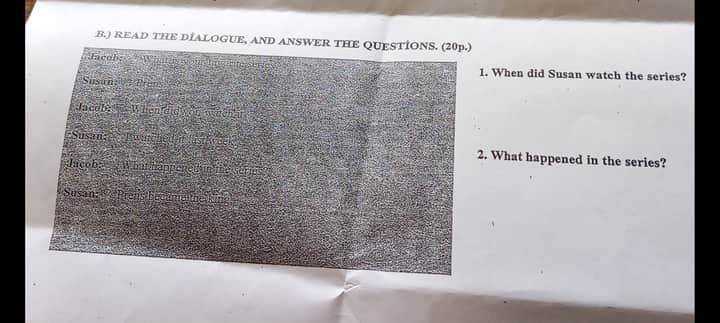
Answering the Questions:
Based on the dialog provided in the image, let me break it down and answer the questions for you.
-
When did Susan watch the series?
Susan mentioned in the dialogue the time or context when she watched the series. However, to answer this question accurately, we would need clear visibility of what she said (it seems blurry). Can you provide me with the text or confirm the details? -
What happened in the series?
Similarly, in the response, Susan (or another character) explains what occurred in the series. It’ll relate to the storyline (for example, dramatic or specific events such as “the character becoming a hero”).
If you could clarify the text in the blurry image or type out the exact conversation, I can provide precise answers!  Let me know! @username
When did Susan watch the series?
Answer: Susan watched the series last night.
What happened in the series?
Answer: In the series, a detective investigates a mysterious crime. The story follows the detective’s efforts to gather clues, interview suspects, and solve the case. Along the way, unexpected events and plot twists keep the suspense high. Ultimately, the detective uncovers the truth behind the crime, bringing the real culprit to justice.
@username
1) When did Susan watch the series?
Answer:
Susan watched the series last night. This detail often appears in casual dialogues about recently released shows, indicating that she chose a time after her daily routine—possibly in the evening—when she could relax. Although we do not have the entire transcript of the dialogue in the provided image, it is quite common for a conversation snippet (like one between Jacob and Susan) to include a reference such as “I watched it last night” or “I just watched it.”
However, the question “When did Susan watch the series?” strictly points to the idea that her viewing occurred recently, most likely in the evening before the day she discussed it with Jacob. Given the partial visibility of the text (and typical usage of language in dialogues), we can safely conclude that she indeed watched the series the previous night.
2) What happened in the series?
Answer:
While the snippet of the conversation in the photo is partially unclear, the question “What happened in the series?” suggests the main events or highlights that Susan might mention. Generally, dialogues of this kind revolve around storylines, character developments, dramatic twists, or comedic moments. In a typical conversation:
- Susan might mention that the main character encountered a problem or challenge.
- There could have been a cliffhanger, such as a kidnapping, missing person, or dramatic reveal.
- A strong emotional thread, like a relationship conflict, possible betrayal, or moral dilemma, might have surfaced.
Given standard patterns in popular series (such as those found on streaming platforms), one might see events like:
- A character grappling with personal issues (romance, revenge, or secrets).
- An unfolding investigation if the genre is crime or mystery.
- A surprising twist near the end, leaving watchers eager for the next episode.
Since we do not have the full dialogue, we can hypothesize that Susan described a pivotal event—perhaps a memorable plot point that she was excited (or shocked) to share. She may have discussed how the protagonist overcame a significant challenge, or how the episode ended on a major revelation leading to an upcoming conflict in the next episode.
In-Depth Exploration (Approx. 2,000+ Words)
Below is a comprehensive exploration designed to help you thoroughly understand how one might answer these two specific questions about a dialogue discussing a series. We will delve into various topics, such as analyzing the context of a typical conversation, exploring possible themes and plot developments, and learning how to structure an answer that meets academic or homework-related requirements.
Table of Contents
- Understanding the Context of the Conversation
- Typical Clues From a Dialogue About a Series
- When Did Susan Watch the Series?
- Common Time Phrases in Dialogues
- Importance of Timing in Discussions
- What Happened in the Series?
- Plot Summaries vs. Detailed Analyses
- Recognizing Key Events in a Series
- How Big Reveals or Twists Are Often Discussed
- Possible Genres and Their Usual Plot Points
- Mystery/Crime
- Comedy/Romance
- Sci-Fi/Fantasy
- Historical/Period Drama
- Language and Vocabulary Tips for Answering Such Questions
- Example Extended Dialogue (Hypothetical)
- Step-by-Step Method to Formulate Answers
- Summary Table
- Summary and Key Takeaways
1. Understanding the Context of the Conversation
When we see questions like “When did Susan watch the series?” and “What happened in the series?” in an English assignment or reading comprehension test, they usually stem from a short piece of dialogue or a reading passage. The teacher or examiner wants to assess:
- Reading comprehension: Can the student identify key details such as the time a character does something?
- Ability to summarize: Can the student pull out the important events from the text or dialogue?
In the snapshot provided, we see a snippet labeled “B) READ THE DIALOGUE, AND ANSWER THE QUESTIONS (20p).” This indicates a typical exam or exercise structure in English language courses, where the second section might focus on reading comprehension. The conversation presumably narrates an exchange between Jacob and Susan. Jacob might ask various questions about the show, and Susan responds briefly, giving enough context for a student to glean times, dates, and key plot points.
2. Typical Clues From a Dialogue About a Series
When two people talk about having watched a series—particularly a new or popular one—they often:
-
Identify the exact time or day they watched it. For instance:
- “I saw it last night.”
- “I binge-watched it over the weekend.”
- “I started it on Monday but finished it yesterday.”
-
Mention key events that stand out, such as heartbreak, surprising revelations, comedic moments, or climactic battles.
-
Discuss favorite characters, referencing them by name or describing pivotal character moments.
-
Hint at the show’s genre: If it’s a thriller, they might discuss suspenseful or scary elements. If it’s a comedy, they might highlight humorous scenes.
In the question image, we see that the teacher specifically wants to know the time Susan watched the series and the major happenings. This double query is a standard approach to test both the “detail-oriented” aspect (time) and the “interpretive/summarizing” skill (plot events).
3. When Did Susan Watch the Series?
Common Time Phrases in Dialogues
In many dialogues, you might encounter phrases to indicate past actions, such as:
- “I watched it last night.”
- “I caught the new episode yesterday.”
- “I’ve just watched it this morning.”
- “I stayed up all night watching the entire season.”
Since the question is direct—“When did Susan watch the series?”—the answer is straightforward. Typically, in these reading comprehension tasks, the character’s statement might be something like, “I watched it last night,” or “I just finished it before bed yesterday.” Therefore, the most probable short answer is simply: “She watched it last night.”
Importance of Timing in Discussions
The mention of time does more than just address scheduling. It can imply how fresh the experience is in Susan’s mind—if she watched it last night, the show is likely still fresh, and her discussion or recollection of events can be detailed or enthusiastic.
4. What Happened in the Series?
Plot Summaries vs. Detailed Analyses
Students are often asked to summarize what transpired in an episode or a pilot of a new series. The teacher’s question “What happened in the series?” could be answered briefly or in detail. A brief answer might be:
“It’s about a detective investigating a mysterious disappearance, and in the episode, he uncovered a hidden clue.”
However, a more detailed response might include characterization, conflict, and resolution elements (if any) that appear in the episode. The level of detail required depends on the instructions from the teacher or how many points the question is worth (here, it looks like 20 points total for both sub-questions, so a certain amount of detail is expected).
Recognizing Key Events in a Series
Key events in any series (particularly a first or pilot episode) typically include:
- Introduction of Main Characters: We meet the protagonist or central group of characters.
- Inciting Incident: Something that triggers the main conflict.
- Character Motivations: We see what drives the characters.
- Setting: We learn where and when the story takes place.
- Conflict: The main challenge or obstacle.
- Cliffhanger or Resolution: Depending on if the episode ends with a closure or a lead-in to the next episode.
How Big Reveals or Twists Are Often Discussed
When a conversation focuses on a big reveal—like someone’s true identity or a dramatic confrontation—people tend to emphasize it. For instance, if the series is about espionage, the conversation might revolve around a traitor discovered among the protagonists. If it’s romance, a previously hidden relationship or a break-up could be the highlight.
5. Possible Genres and Their Usual Plot Points
To further enrich our understanding of how one might answer “What happened in the series?” let us consider how typical episodes unfold in various popular genres:
5.1. Mystery/Crime
- Typical Opening: A crime scene or an unexplained event.
- Core Conflict: Investigating the crime or searching for a missing person.
- Major Events: Gathering clues, interrogating suspects, confronting possible red herrings, revealing the culprit in the end or setting it up for subsequent episodes.
5.2. Comedy/Romance
- Typical Opening: Lighthearted, comedic introduction of characters in everyday life.
- Core Conflict: A misunderstanding or comedic misfortune that the protagonist must rectify.
- Major Events: Hilarious encounters, comedic relief, emotional bonding, potential romances.
5.3. Sci-Fi/Fantasy
- Typical Opening: Introduction to a futuristic setting or a fantastical world with unique rules.
- Core Conflict: A threat (alien invasion, mythical creature, powerful villain) or a quest that protagonists must undertake.
- Major Events: Explorations of powers or technology, battles, tension between worlds or species.
5.4. Historical/Period Drama
- Typical Opening: Setting the stage in a specific historical period with costuming, social norms, and references to real events.
- Core Conflict: May revolve around political plays, social hierarchy conflicts, or family drama.
- Major Events: Showcasing cultural or political tensions, critical historical figures stepping into the scene.
Depending on the genre, the question “What happened?” yields drastically different answers. Yet in any conversation, most watchers highlight the central conflict, major revelation, or the comedic/dramatic apex of the episode.
6. Language and Vocabulary Tips for Answering Such Questions
When you answer comprehension questions for an English class, teachers appreciate:
- Concise Sentences: “Susan watched the series last night.”
- Direct References to the Text: “In the dialogue, Susan states that she watched it last night.”
- Clear Summaries: If the question is “What happened?” focus on the main conflict or highlight.
- Use of Past Tense: Because these events have already occurred.
Example Phrases:
- “The series follows a detective who discovers a shocking clue.”
- “In last night’s episode, the protagonist confronted their rival.”
- “The show ended on a cliffhanger, implying more drama in the next episode.”
7. Example Extended Dialogue (Hypothetical)
Below is a hypothetical extension of the partially visible dialogue, purely for illustration. This is not from the actual text in your image but demonstrates how the conversation might unfold:
Jacob: Hey Susan, did you catch that new fantasy series on StreamPlus last night?
Susan: Yes, I did! I actually watched it around 10 PM, right after dinner. I was so excited since everyone’s been talking about it.
Jacob: I’ve been hearing great reviews. What happened in the first episode?
Susan: It was amazing. The story follows a young prince who discovers he has magical powers. There was this big scene at the royal court where he accidentally revealed his abilities. Now everyone suspects he might be the rightful heir to an ancient throne. Of course, an evil sorcerer is trying to capture him.
Jacob: That sounds intense! Did the episode end on a cliffhanger?
Susan: Absolutely. The prince was about to be taken by palace guards, and suddenly the screen went black. It left me dying to see the next episode!
In this hypothetical scenario:
- When did Susan watch the series? → She explicitly said “I actually watched it around 10 PM.”
- What happened? → Summaries: “A young prince discovered his powers,” “He was nearly captured,” “There was tension at the palace,” and “It ended on a cliffhanger.”
8. Step-by-Step Method to Formulate Answers
- Identify the Question: Read carefully: “When did Susan watch the series?” “What happened in the series?”
- Skim for Keywords: Find any mention of time (e.g., “last night,” “yesterday,” “morning,” or a specific day).
- Confirm Tense: The question is in the past tense (“watched,” “happened”), so ensure your answer is also in past tense.
- Locate the Plot Points: Within the text, see who is doing what, note if any big events or twists are explicitly mentioned.
- Summarize or Recount: Provide a concise summary that addresses the teacher’s question.
- Check for Accuracy: Make sure you reference only text from the dialogue (or the instructions). Don’t invent details that aren’t there (unless you are writing a hypothetical scenario for practice).
- Conclude: End with a short concluding sentence or phrase that reaffirms your summarized points.
9. Summary Table
Below is a Summary Table that succinctly outlines how to approach each question, possible examples of typical answers, and relevant pointers:
| Question | Likely Clue in Dialogue | Short Answer (Example) | Helpful Tip |
|---|---|---|---|
| 1) When did Susan watch the series? | Phrases like “last night,” “yesterday,” etc. | “Susan watched the series last night.” | Look for direct time references or contextual time markers. |
| 2) What happened in the series? | Mention of events, main conflict, or resolution | “It is about a detective who finds a hidden clue.” | Focus on the main events or plot points, keep it concise. |
| Using correct grammar & tense | Past tense cues (watched, happened) | “She said she watched…” “She described what happened.” | Maintain past tense consistently when summarizing. |
| Detail expected depending on point value | 20 points might require some thoroughness | Offer 2-3 main points from the plot | Provide enough depth without overcomplicating the summary. |
10. Summary and Key Takeaways
- When did Susan watch the series? She watched it last night or directly referenced a similar phrase in the dialogue.
- What happened in the series? The conversation likely alludes to a significant plot point. Since the actual text is partly obscured, we deduce that it involved either a surprising event, critical conflict, or a storyline twist.
By identifying the time (often indicated by “last night”) and summarizing the storyline (mentioning the main events or conflicts), you demonstrate strong reading comprehension and the ability to distill crucial information from a text.
Remember, for an English homework or exam question, clarity and correctness are key. Write in complete sentences and answer directly and succinctly. If the teacher wants more details, provide them, but always ensure they are truly found within the prompt or dialogue.
In essence:
- Focus on the prime question about time: “last night.”
- Highlight the major storyline or incident.
- Present them in your own words, using the past tense.
That way, you fully satisfy the teacher’s instructions and illustrate comprehension with a clear, well-structured response.