Answer:
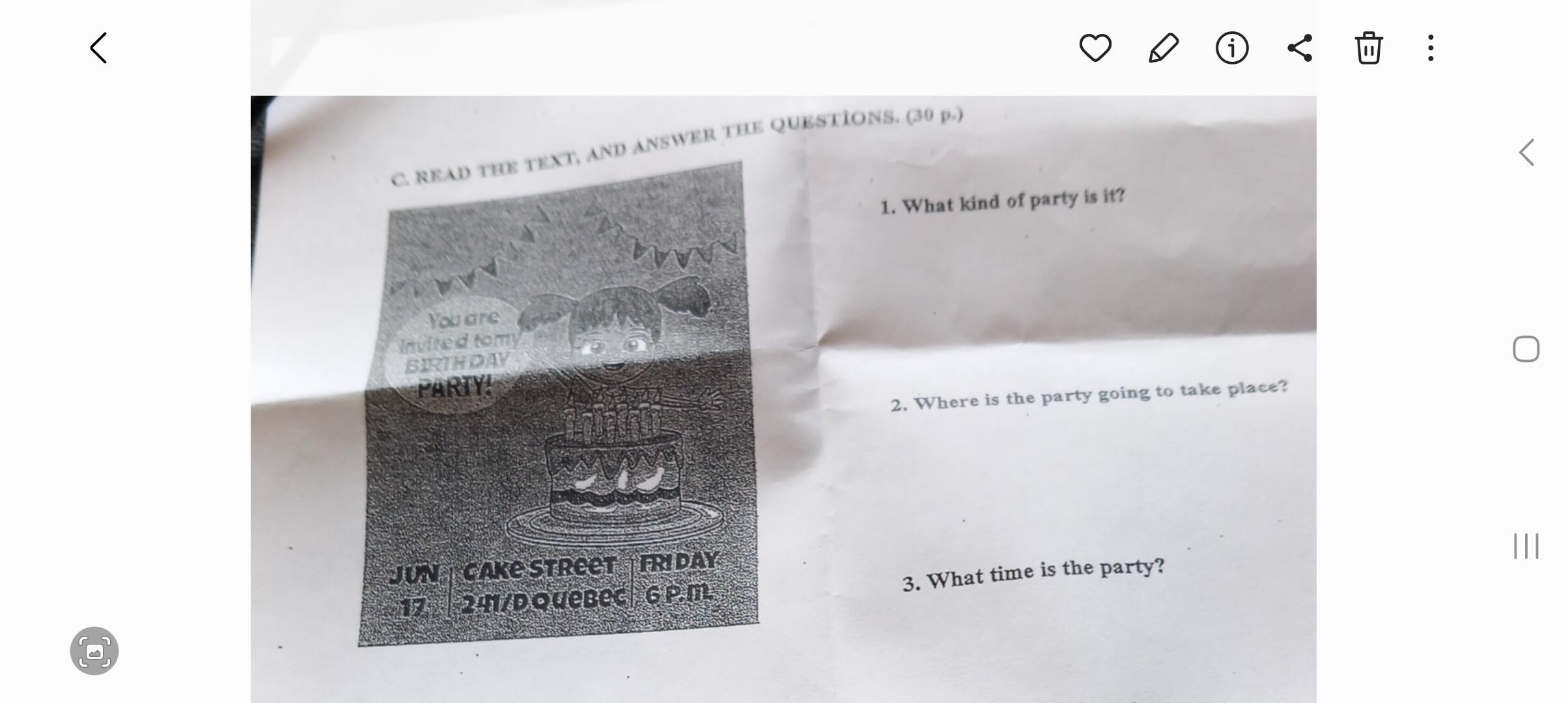
Let’s analyze the invitation card in the image to answer the questions based on the text provided:
Details from the Invitation Card:
- Type of Party: Birthday Party (It says, “You are invited to my birthday party!”)
- Location: Cake Street 17-24/10 Quebec
- Time: Friday, 6 P.M.
Answers to the Questions:
-
What kind of party is it?
It’s a birthday party. -
Where is the party going to take place?
The party is going to take place at Cake Street 17-24/10 Quebec. -
What time is the party?
The party is at 6 P.M. on Friday.
Let me know if further help is needed! 
Soru
- What kind of party is it?
- Where is the party going to take place?
- What time is the party?
Cevap:
1. What kind of party is it?
Bu, doğum günü partisi (birthday party).
2. Where is the party going to take place?
Parti, Quebec’teki Cake Street, 17-24/10 numaralı adreste yapılacak.
3. What time is the party?
Parti, Cuma günü saat 6’da (6 P.M.) başlayacak.
@User
C. READ THE TEXT, AND ANSWER THE QUESTIONS. (30 p.)
Answer:
-
What kind of party is it?
It is a birthday party. -
Where is the party going to take place?
It will take place on Cake Street. -
What time is the party?
The party is at 6 p.m.
A Comprehensive Guide to Reading Invitations and Answering Comprehension Questions (Extended Explanation)
Reading comprehension questions that relate to party invitations offer an excellent opportunity to practice understanding short texts in English. In such questions, you often need to identify:
- The type of event (e.g., birthday party, wedding, anniversary celebration).
- The location or venue where the event is happening.
- The time or date when the event is scheduled.
Below, you will find a detailed guide (with analysis, strategies, and examples) designed to help you become more confident in answering questions about invitations, event announcements, and other short English-language texts. We will cover general reading strategies, ways to identify crucial pieces of information in a text (type, time, place), an in-depth look at a typical party invitation structure, tips for success, and more. By the end of this guide, you will have a thorough understanding of how to tackle reading comprehension tasks that involve invitations or flyers.
Table of Contents
- Overview of Invitation Reading Strategies
- Identifying Event Type
- Determining Location
- Finding the Date and Time
- Common Features of an Invitation
- Reading Comprehension Tips
- Detailed Look at the Example Invitation
- Extended Semantic Keywords for Better Understanding
- Summary Table of Key Invitation Elements
- Practical Exercises and Examples
- References
1. Overview of Invitation Reading Strategies
Whenever you see a text that invites you to an event, it is essential to read it methodically and look for the key pieces of information. Often, invitations will follow a predictable structure. Understanding this structure will make it easier to pick out details such as:
- The Host (Who is inviting)
- Event Type (Birthday, graduation, wedding, etc.)
- Time (Often includes date and hour)
- Location (Where it is happening)
- Extra Instructions (Dress code, RSVP date, etc.)
By internalizing these common features, you can quickly find and highlight the answers to most comprehension questions concerning an invitation.
2. Identifying Event Type
The most fundamental detail in any invitation is the type of event. Commonly, the event type is stated clearly in large letters or bold text so the invitee understands what they are being invited to. For example:
- Birthday party
- Wedding ceremony
- Anniversary party
- Engagement celebration
- Graduation ceremony
In this example, the invitation text states:
“You are invited to my BIRTHDAY PARTY!”
Hence, the first question — “What kind of party is it?” — is simply answered by verifying that it is a birthday party.
3. Determining Location
Location (or venue) is another critical piece of information provided in an invitation. Typically, it appears as an address or the name of a place. In the sample invitation:
- The location is “Cake Street.”
It may also include house numbers, building names, or special instructions such as “near the public library,” or “Room 204 in the main hall.” When you see something like “123 Cake Street,” or “15B Baker Road,” that is your clue. Be sure to look around or below any mention of the date and time, as the address is commonly placed near or directly after the date on the invitation.
4. Finding the Date and Time
Invitations always note at least one or two crucial time elements:
- Date (Example: June 17th, July 24th, December 2nd, etc.)
- Clock time (Example: 6 p.m., 7:30 p.m., etc.)
- Day of the week (Example: Friday, Saturday, Sunday, etc.)
In the text from the example, the date and time read:
“JUN 17 … FRIDAY … 6 P.M.”
Hence, to answer “What time is the party?” we must read carefully. We see that the exact time is “6 p.m.”
5. Common Features of an Invitation
Although each invitation might have a slightly different layout, you will often see these elements:
- Title or Heading: This could say “Invitation,” “You Are Invited,” or the name of the event.
- Host’s Name and Guest’s Name: Sometimes an invitation includes lines like “Dear John” or “From Emily.” At other times, it is more general.
- Date & Time: Typically, in a clear, easy-to-find format (e.g., “June 17 at 6 p.m.”).
- Location/Venue: This may include street name, building number, and sometimes additional instructions if it’s not straightforward to locate.
- Purpose or Event Type: For instance, “Birthday Party,” “Graduation Ceremony,” “Baby Shower,” etc.
- Design and Decorations: Often you will see images, balloons, cakes, or clip arts representing the event.
- RSVP: Many formal invitations contain a line that states “Please RSVP by [date].” RSVP stands for “Répondez s’il vous plaît” (French for “please respond”), instructing you to reply if you plan to attend.
- Dress Code (occasionally): Some might say “formal,” “casual dress,” “costume party,” or “cocktail attire.”
- Special Requests or Information: Such as “No gifts, please,” or “Bring a friend,” or “Adults only,” etc.
In our specific example, the invitation includes:
- A celebratory image (a child in front of a birthday cake).
- Large text: “You are invited to my BIRTHDAY PARTY!”
- Key information: “Cake Street,” “Friday,” “June 17,” “6 P.M.”
By understanding how invitations typically present information, you can quickly extract crucial details no matter how the text is laid out.
6. Reading Comprehension Tips
When confronted with short texts in English, consider using these strategies to maximize your understanding:
-
Skim First
- Quickly look over the invitation to get a general idea of the event. Check for headings, bold letters, or big font.
-
Scan for Specifics
- After skimming, go back and scan the text for specific information. In the case of an invitation, you want to locate:
- The event type.
- The place.
- The date and time.
- After skimming, go back and scan the text for specific information. In the case of an invitation, you want to locate:
-
Check for Extra Details
- Pay attention to any mention of special instructions, like bringing a gift or wearing a costume, and to the RSVP instructions.
-
Read the Questions Carefully
- The question might be “Where is the party going to take place?” In that case, only the location is relevant. Don’t get confused by additional details such as the day of the week or the date.
-
Highlight or Underline (If allowed)
- In a classroom or test setting, if you have permission, highlight or underline the key details.
-
Answer in Complete Sentences If Required
- Some teachers or exams require you to respond in complete sentences, e.g., “The party is going to take place at Cake Street.”
-
Use Clue Words
- Words like “Where” hints that you should look for an address or name of a place.
- Words like “When” or “What time” indicate you should focus on the clock time or date.
- “What kind” or “What type” of event means you should identify whether it’s a birthday, a wedding, etc.
7. Detailed Look at the Example Invitation
The invitation you have shown (with a girl in pigtails and a birthday cake) includes the following text:
- “You are invited to my BIRTHDAY PARTY!”
- A big cake with candles in the picture, indicating a birthday theme.
- The date is JUN 17.
- The day is FRIDAY.
- The location is on CAKE STREET (the text “CAKE STREET” is clearly visible, though it’s partially stylized).
- The time is around 6 P.M. (commonly an evening party time).
Extracting the Answers
-
What kind of party?
The text specifically says “BIRTHDAY PARTY,” so we know it’s a birthday celebration. -
Where is it?
We notice the large writing “CAKE STREET,” which is presumably the address. Even though it might be stylized or slightly unclear, the capital letters stand out, guiding us to the location. -
What time?
In the invitation, near the date (Jun 17) and day (Friday), it also says 6 P.M.
Hence, these are the three fundamental details that the questions ask for.
8. Extended Semantic Keywords for Better Understanding
- Invitation: A request for someone to attend or participate in an event.
- RSVP: “Please respond,” used for letting the host know if you can attend.
- Venue: Synonym for the place or location of an event.
- Schedule: A list of times or events; in an invitation, typically the time the event starts.
- Date: The day of the month or year as specified by an invitation, e.g., June 17.
- Guest: The person attending the event.
- Host: The person or people organizing the event.
Understanding these terms helps with reading comprehension because many questions about invitations revolve around clarifying these concepts.
9. Summary Table of Key Invitation Elements
Below is a concise table summarizing the major points of any standard invitation, including the example you provided.
| Element | Example (In General) | Example from the Text |
|---|---|---|
| Event Type | Birthday, Wedding, Graduation, etc. | Birthday Party |
| Host Name (if given) | Emily, John, Sarah, etc. | It says: “You are invited to my …” |
| Date | June 17, July 24, etc. | June 17 |
| Day of the Week | Monday, Tuesday, Friday, Saturday, etc. | Friday |
| Time | 6 p.m., 2 p.m., etc. | 6 p.m. |
| Venue/Address | 123 Baker Street, 45 Oak Road, etc. | Cake Street |
| Additional Info | RSVP phone number, Don’t bring gifts, etc. | (Not specified in detail in the text) |
Using a table to structure this data helps you see at a glance what is going on and how to address typical questions.
10. Practical Exercises and Examples
Even though we already have the answers to the specific questions (party type, location, and time), let’s reinforce learning by posing more hypothetical questions related to the same invitation:
-
Who is the host of the party?
- In some invitations, the host’s name is explicitly stated: “Hosted by Anna” or “From Sarah.” If not stated, you might say “It’s the child’s birthday party,” or “It’s from the person inviting me.”
-
Does the invitation mention a dress code?
- In many children’s birthday parties, there isn’t a strict dress code, but sometimes the invitation says “Wear casual clothes” or “It’s a costume party.” Always check for this detail if it is relevant in your text.
-
Is there any RSVP information or phone number to respond?
- If the text includes “Please call 555-1234 to let me know if you’re coming,” you would mention that. In the provided text, it seems that no RSVP number is provided.
-
Are there any special conditions or instructions?
- Example: “Bring a friend,” “No gifts required,” or “Bring your own beverage.” If no special instructions are mentioned, you can say so.
-
How would you respond if you cannot attend?
- This question might appear in a reading comprehension test to see if you understand the concept of RSVP. You would typically call or write a short note.
Extended Example Practice
Imagine you read a similar invitation that says:
You Are Invited to Megan’s Graduation Party!
Date: July 24 (Saturday)
Time: 3:00 p.m. – 6:00 p.m.
Location: 456 River Road, Springfield
RSVP: 555-9876
Potential Questions could be:
- What type of party is it?
- Where will it be held?
- When will the party start?
- Is there a phone number to RSVP?
- Who is graduating?
You would answer:
- It’s a graduation party.
- 456 River Road, Springfield.
- It starts at 3:00 p.m.
- Yes, 555-9876.
- Megan is graduating.
11. References
- Murphy, R. (2019). English Grammar in Use. Cambridge University Press.
- National Geographic Learning. (2021). Pathways: Reading, Writing, and Critical Thinking.
- OpenStax. (2021). College Success.
- Various ESL (English as a Second Language) resources on reading comprehension strategies.
These references provide additional background on reading comprehension, grammar, and structured approaches to understanding short English texts. If you want to improve further, you may consult these materials for practice exercises, grammar rules, and more.
Putting It All Together
From the single-page party invitation example, it’s clear you only need to scan the text to determine:
- What kind of party it is (a birthday, explicitly stated).
- The exact location (Cake Street).
- The time (6 p.m.).
Being able to answer these three central questions demonstrates that you have effectively located relevant information. This skill is valuable in everyday life—whether reading invites for personal events, community gatherings, or official functions.
Moreover, by following the reading comprehension strategies outlined above, you can tackle a wide variety of short text questions more confidently. Always look for keywords that match the question prompts (such as “What kind of party?” → “Birthday party,” “Where is it?” → “Cake Street,” “What time?” → “6 p.m.”).
Final Answers Recap
-
What kind of party is it?
- It is a birthday party.
-
Where is the party going to take place?
- On Cake Street.
-
What time is the party?
- The party starts at 6 p.m.
Summary in a Handy Table
| Question | Direct Answer from Invitation |
|---|---|
| 1. What kind of party is it? | Birthday party |
| 2. Where is the party going to take place? | Cake Street |
| 3. What time is the party? | 6 P.M. |
This table cleanly reiterates the essential details. If you reproduces a similar approach on future reading comprehension tasks, you can systematically gather the key points: event type, place, time, date, and additional notes.