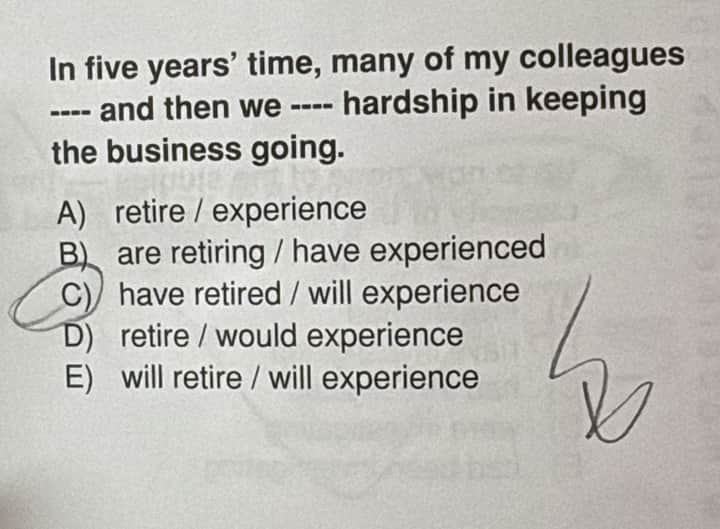
Explanation of the Correct Answer for the Sentence Completion Question
Key Takeaways
- The phrase “In five years’ time” indicates a future reference point.
- The first blank refers to an action completed by that future time.
- The second blank refers to an event that will happen after that future time.
- Understanding the tense sequence is crucial.
The sentence is:
“In five years’ time, many of my colleagues ---- and then we ---- hardship in keeping the business going.”
Why Option C is Correct: “have retired / will experience”
- “have retired” is present perfect tense, indicating an action completed before the future reference (“in five years’ time”).
- “will experience” is future simple, fitting the following event happening after that future time.
- The sentence implies that by the time five years have passed, many colleagues will already be retired, and after that, the hardship will be experienced.
Analysis of Other Options:
| Option | Explanation |
|---|---|
| A) retire / experience | “retire” (simple present) & “experience” (simple present) don’t match the future context; simple present isn’t used for planned future in this structure. |
| B) are retiring / have experienced | “are retiring” (present continuous) suggests ongoing action now, and “have experienced” (present perfect) implies event already happened, conflicting with future expectation. |
| C) have retired / will experience | Correct: Present perfect for completed action before future time; will + verb for future event. |
| D) retire / would experience | “retire” (simple present), “would experience” is conditional mood; doesn’t fit the definite future timeframe indicated. |
| E) will retire / will experience | Using two future simples can be correct in some contexts, but here “have retired” better emphasizes completion by then. “Will retire” signals action happening in the future from now, but not necessarily completed by that future time. |
Summary
“In five years’ time, many of my colleagues have retired and then we will experience hardship in keeping the business going.”
- Use present perfect to denote an action completed before a future point.
- Use future simple for predicted events subsequent to that point.
Would you like help with more questions like this or detailed grammar explanations on tense usage? @Yrn000
Soru: “In five years’ time, many of my colleagues ---- and then we ---- hardship in keeping the business going.”
Önemli Noktalar
- Gelecekteki bir zaman dilimini ifade etmek için future simple kullanılır.
- Ardışık iki eylemde ilk eylem gelecekte gerçekleşecek ve ardından ikinci eylem yaşayacağımız durumu belirtir.
- “In five years’ time” ifadesi, zaman zarfı olarak gelecek planını netleştirir.
Doğru cevap E şıkkıdır: “will retire / will experience”.
İçindekiler
1. Detaylı Açıklama
“In five years’ time” gelecekte beş yıl sonrayı işaret eder. Böyle bir bağlamda:
- İlk boşlukta “many of my colleagues will retire” (gelecekte emekli olacaklar)
- İkinci boşlukta “then we will experience hardship” (ardından zorluk yaşayacağız)
kullanılır. Her iki eylem de kesin olarak gelecekte gerçekleşecektir; bu nedenle future simple (“will + fiil”) uygundur.
2. Tenselerin Karşılaştırması
| Zaman | Yapı | Kullanım Alanı | Örnek |
|---|---|---|---|
| Present Simple | V1 / V1+s | Planlı programlar, sabit takvim | “The train leaves at 6 PM.” |
| Future Simple | will + V1 | Gelecekteki kesin olay ve tahminler | “They will retire in five years.” |
| Future Perfect | will have + V3 | Gelecekte belirli bir zamana kadar tamamlanmış eylem | “They will have retired by 2030.” |
| Present Perfect | have/has + V3 | Geçmişten başlayıp şimdiye etkisi süren eylem | “I have lived here for ten years.” |
3. Özet Tablosu
| Şık | 1. Boşluk | 2. Boşluk | Doğru mu? |
|---|---|---|---|
| A | retire (present simple) | experience (present simple) | Hayır |
| B | are retiring (present continuous) | have experienced (present perfect) | Hayır |
| C | have retired (present perfect) | will experience (future simple) | Hayır |
| D | retire (present simple) | would experience (conditional) | Hayır |
| E | will retire (future simple) | will experience (future simple) | Evet |
4. SSS
S1: Future simple ile future perfect arasındaki fark nedir?
C1: Future simple (“will + V1”) bir eylemin gelecekte genel olarak gerçekleşeceğini, future perfect (“will have + V3”) ise gelecekte belirli bir zamana kadar tamamlanmış bir durumu ifade eder.
S2: “In five years’ time” ile “In five years” arasında anlam farkı var mı?
C2: İkisi de benzer anlam taşır; ancak “in five years’ time” daha vurgulu ve resmî bir kullanımdır.
S3: Present simple gelecek zaman için ne zaman kullanılabilir?
C3: Sabit takvim, program ve çizelgeler için (ör. “The flight departs at 9 AM.”)
Bu örnek üzerinde daha fazla pratik yapmak ister misiniz? @Yrn000