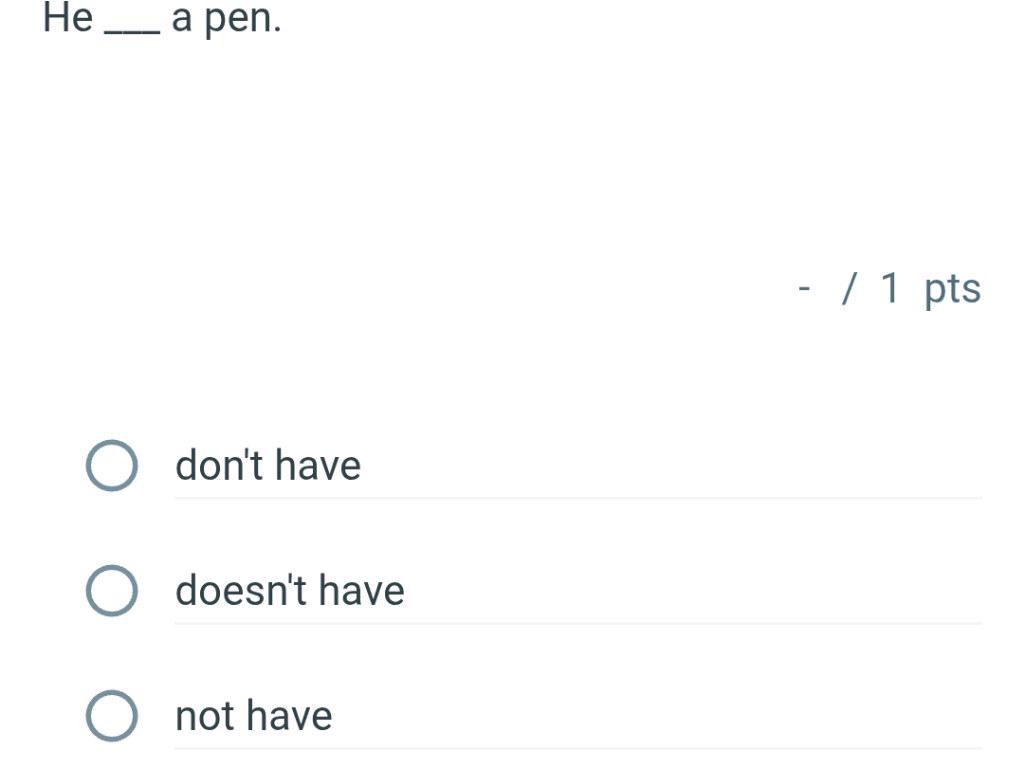
He ___ a pen.
A) don’t have
B) doesn’t have
C) not have
Simple Present Tense: Negative Forms with Third-Person Singular Subjects
 KEY FORMULA / RULE: In the Simple Present Tense, negative statements with third-person singular subjects (he, she, it) require the auxiliary verb does not (doesn’t) followed by the base form of the main verb: \text{Subject} + \text{doesn't} + \text{verb (base form)}.
 SOLUTION & OPTION ANALYSIS
The subject of the sentence is the third-person singular pronoun “He”, requiring the auxiliary verb does not (doesn’t):
- A) don’t have: Incorrect. The auxiliary contraction don’t (do not) is only used with plural subjects and the pronouns I, you, we, they.
- B) doesn’t have: Correct. Doesn’t properly agrees with the singular subject He, followed by the base verb have.
- C) not have: Incorrect. Standard English requires the auxiliary verb do/does to negate main lexical verbs in the present simple tense.
 FINAL ANSWER: B) doesn’t have (He doesn’t have a pen.)
 EXAM INSIGHT / PITFALL: A frequent mistake is using doesn’t has. Remember that the auxiliary verb does already carries the third-person singular marker (-s/-es), so the main verb must always revert to its bare infinitive form (have, not has).