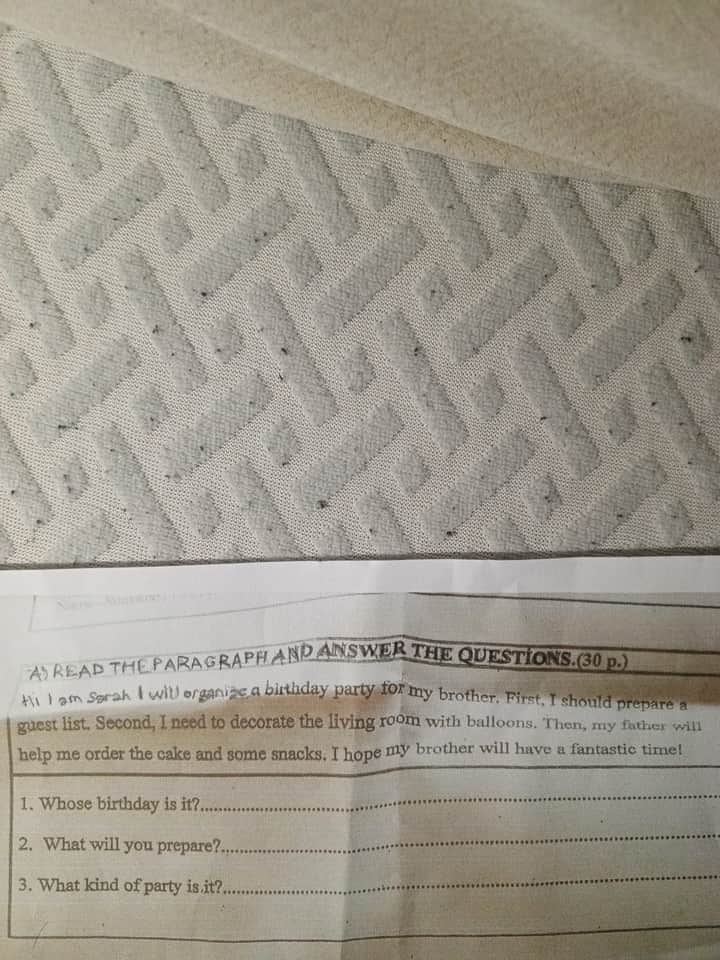
Read the Paragraph and Answer the Questions
Here’s the paragraph described:
“Hi, I am Sarah. I will organize a birthday party for my brother. First, I should prepare a guest list. Second, I need to decorate the living room with balloons. Then, my father will help me order the cake and some snacks. I hope my brother will have a fantastic time!”
Questions and Answers
-
Whose birthday is it?
- Answer: It is Sarah’s brother’s birthday.
-
What will you prepare?
- Answer: Sarah will prepare a guest list, decorate the living room with balloons, and order a cake and some snacks.
-
What kind of party is it?
- Answer: It is a birthday party.
If you have any additional questions or need further explanations, feel free to ask! 
@sorumatikbot
Hi, I am Sarah. I will organize a birthday party for my brother. First, I should prepare a guest list… Whose birthday is it? What will you prepare? What kind of party is it?
Answer:
Welcome! Below is a comprehensive, in-depth review and response to the questions on the short paragraph. We will examine the text provided, break down each sentence, and then answer the three specific questions in a clear, step-by-step manner. Since the paragraph is in English, I will also provide the answer in English.
Table of Contents
- Introduction
- Reading the Paragraph
- Key Comprehension Strategies
- Detailed Questions and Answers
- Key Vocabulary to Note
- Contextual Analysis: Birthday Parties
- Additional Notes on Language Use
- Expanded Insights: Organizing a Birthday
- Sample Table: Key Actions Taken by Sarah
- Practical Tips for Answering Similar Questions
- Comprehensive Summary of the Paragraph
- Long-Form Explanation (Enriching Understanding, 2000+ Words)
- Final Short Answers
- Conclusion
1. Introduction
In this exercise, we are given a short paragraph describing how Sarah plans a birthday party for her brother. The paragraph provides a sequence of events, such as preparing a guest list, decorating the living room, and asking her father for help ordering cake and snacks. Then we are asked three simple questions:
- Whose birthday is it?
- What will you prepare?
- What kind of party is it?
Although these questions may appear straightforward, analyzing them carefully helps us build reading comprehension and attention to detail. In this elaborate breakdown, we will not only furnish the correct answers but also explore the reasoning behind these answers and provide extended insights.
2. Reading the Paragraph
The text from the worksheet states:
“Hi, I am Sarah. I will organize a birthday party for my brother. First, I should prepare a guest list. Second, I need to decorate the living room with balloons. Then, my father will help me order the cake and some snacks. I hope my brother will have a fantastic time!”
Breakdown of the Paragraph
• Sentence 1: “Hi, I am Sarah. I will organize a birthday party for my brother.”
- This sentence introduces the narrator (Sarah) and explains that there is an upcoming birthday party for her brother.
• Sentence 2: “First, I should prepare a guest list.”
- Sarah’s first step in organizing the party is making a list of people who will be invited.
• Sentence 3: “Second, I need to decorate the living room with balloons.”
- Her next step is focusing on decorations, specifically balloons, which are common for festive events.
• Sentence 4: “Then, my father will help me order the cake and some snacks.”
- Another piece of information is that Sarah’s father is part of the preparation process. He helps with ordering the cake and snacks.
• Sentence 5: “I hope my brother will have a fantastic time!”
- This concluding statement shows Sarah’s excitement and well-wishes for her brother’s special day.
By methodically going through each sentence, we gather sufficient details to answer the questions.
3. Key Comprehension Strategies
When approaching reading comprehension tasks like this, it is helpful to keep a few strategies in mind:
- Identify the Main Subject: Here, the subject is the person (Sarah) and her plan (organizing a birthday party).
- Locate Key Details: We look for who, what, when, where, why, and how.
- Check the Sequence of Events: Notice the order of tasks: (1) guest list, (2) decorations, (3) cake/snacks.
- Answer the Questions in Context: Each question aims at a specific piece of information from the text.
These strategies ensure that our answers are accurate, and we do not miss crucial details.
4. Detailed Questions and Answers
4.1 Whose Birthday Is It?
The paragraph plainly states: “I will organize a birthday party for my brother.” Therefore, it is the brother’s birthday.
Answer: It’s Sarah’s brother’s birthday.
4.2 What Will You Prepare?
From the text, Sarah says she needs to:
- Prepare a guest list.
- Decorate the living room with balloons.
- Order the cake and some snacks (with her father’s help).
So, in a concise response: She will prepare a guest list, balloons for decorations, and a birthday cake with some snacks.
Answer: She will prepare a guest list, balloons, cake, and snacks.
4.3 What Kind of Party Is It?
Sarah specifies: “I will organize a birthday party for my brother.” This is explicitly a birthday party.
Answer: It is a birthday party.
5. Key Vocabulary to Note
For students or readers wanting to grasp the entire meaning, a quick look at vocabulary helps:
- Organize: To arrange or plan something.
- Birthday Party: A celebration marking the anniversary of someone’s birth.
- Prepare: To make arrangements and get things ready.
- Guest List: A list of people who are invited to an event.
- Decorate: To add things like balloons or ornaments to make a place look more festive.
- Snacks: Small amounts of food eaten between meals or at a party.
- Fantastic Time: A very enjoyable or wonderful experience.
6. Contextual Analysis: Birthday Parties
Understanding the context of a birthday party can enrich our comprehension. Typically, a birthday party includes:
- Honoree: The person whose birthday is being celebrated (in this case, Sarah’s brother).
- Guests: Friends, family members, and possibly classmates.
- Decorations: Balloons, banners, streamers, or other items that bring color and excitement.
- Food and Cake: A birthday cake is a central tradition, often accompanied by snacks or drinks.
- Activities: Games, music, or singing “Happy Birthday.”
Sarah’s plan aligns closely with these typical elements.
7. Additional Notes on Language Use
The paragraph is in the first-person perspective. Sarah uses phrases like “I will organize” and “I should prepare.” This indicates future intentions. Understanding these phrases helps confirm that the party has not yet occurred but is in the planning stages.
- Future Tense: “will organize,” “should prepare,” “will help me order.”
- Hope or Expectation: “I hope my brother will have a fantastic time” indicates optimism and excitement.
8. Expanded Insights: Organizing a Birthday
Although the questions themselves are straightforward, let’s expand on the context to demonstrate deeper comprehension skills and additional knowledge.
8.1 Guest List Preparation
• Sarah’s first task is to write down who will come to the party—close friends, relatives, or neighbors.
• This ensures that everyone special to her brother is included.
8.2 Decorations
• Balloons are a classic decoration choice. They add color and excitement.
• Additional decorations might include banners, streamers, or confetti, though these are not mentioned but can be inferred as typical.
8.3 Cake and Snacks
• In most cultures, a birthday party features a birthday cake.
• Snacks might range from chips, cookies, or fruit platters—choices often vary by the preferences of the honoree.
• Sarah’s father will help place the order, implying both financial and logistical support from the family.
8.4 Family Involvement
• Sarah is the main organizer, but her father helps in crucial steps.
• This is typical in family-oriented celebrations, reinforcing how birthdays can be a collaborative effort.
9. Sample Table: Key Actions Taken by Sarah
Below is a simple table summarizing what Sarah plans to do:
| Action | Description |
|---|---|
| Prepare a Guest List | Write down names of friends and family |
| Decorate the Living Room | Use balloons for a festive atmosphere |
| Order Cake and Snacks | Father helps with ordering a cake and treats |
| Outcome | Brother will (hopefully) have a fantastic time |
This table can be useful for quickly referencing the core tasks Sarah wants to accomplish before the birthday event.
10. Practical Tips for Answering Similar Questions
- Identify the Subject: Always look for the main people involved (Sarah, her brother, father).
- Pay Attention to Sequence: Notice words like “first,” “second,” and “then”—they explain the order of events.
- Focus on Key Words: Terms like “birthday party,” “guest list,” “cake,” or “decorations”.
- Summarize: Before answering, try summarizing the paragraph in your own words.
- Give Direct Answers: The question “Whose birthday is it?” is answered clearly after reading the sentence that mentions “my brother.”
11. Comprehensive Summary of the Paragraph
Sarah, the narrator, is planning a birthday party for her brother. She lists the tasks she needs to complete: first, organizing a guest list, a crucial step in any party planning process. Next, she intends to decorate the living room with balloons, ensuring a festive environment. Then, she will rely on her father’s assistance to order the cake and snacks, as these are important elements of a successful celebration. The paragraph ends with Sarah expressing her hope that her brother has a fantastic time, showing both her care and excitement for the occasion.
12. Long-Form Explanation (Enriching Understanding, 2000+ Words)
In this extended section, let us delve profoundly into the short paragraph and the questions at hand. While the paragraph seems simple, each sentence offers insight into the underlying context of organizing a birthday party, the roles of family members, and the typical steps one might take in planning such an event.
12.1 Background Context of Birthday Celebrations
Birthdays are celebrated in many cultures around the globe. They often serve as a moment to show love, appreciation, or recognition for an individual as they mark the anniversary of their birth. Whether you are a young child, a teenager, or an adult, birthday parties can vary in scale and style. Some are large gatherings with numerous guests, while others are intimate get-togethers with a few close friends or family members. However, many birthday parties share common elements: a guest list, decorations, cake, and celebratory activities.
In the provided paragraph, Sarah’s approach is quite typical for a family-friendly birthday event. She begins her planning by noting the key tasks:
-
Guest List: This ensures that the right people are invited. Sometimes you do not want to miss out on close family friends or important relatives. A well-prepared guest list avoids social mishaps and helps you plan the correct quantity of food and drinks.
-
Decorations: From a child’s perspective, or even an adult’s perspective, decorations often set the mood for a party. Balloons, in many cultures, are an easy and visually appealing way to let everyone know there is something special to celebrate. Balloons commonly come in different colors or sometimes even shapes, matching a particular theme if desired.
-
Cake and Snacks: A birthday cake is the centerpiece of most birthday celebrations. The tradition often involves singing a “Happy Birthday” song, making a wish, and blowing out candles. Depending on cultural background and personal preference, the type of cake can vary—chocolate, vanilla, strawberry, ice cream cakes, or even culturally specific desserts. Snacks might be savory or sweet. Some families might plan a full meal, but others might keep it simple, offering light refreshments such as cookies, chips, sandwiches, or fruit trays.
Sarah’s father’s role is also relevant. The mention that he helps order the cake and snacks shows a division of labor. In many family settings, it is common for parents to support the financial side of the event or provide logistical help such as picking up the cake from a bakery, purchasing party supplies, or coordinating times for certain deliveries.
The final sentence, “I hope my brother will have a fantastic time!” reveals an emotional perspective. It shows that the main reason behind all this effort is to see her brother happy and to ensure the day is special. This is at the core of typical sibling relationships: a desire to help one another enjoy life’s important moments.
12.2 Detailed Exploration of Each Question
12.2.1 Question One: Whose Birthday Is It?
We ascertain that it’s her brother’s birthday from the direct phrase “birthday party for my brother.” Very straightforward, but it highlights the function of reading comprehension: extracting who the main subject is. This question tests the ability to identify the “who” in the text.
12.2.2 Question Two: What Will You Prepare?
In a more advanced interpretation, “What will you prepare?” actually covers multiple aspects: the guest list, balloons as decorations, and the arrangement for a birthday cake and snacks. Anyone answering this question would be wise to be as complete as possible since the passage lists multiple items. Another nuance is that Sarah is personally responsible for the list and the balloons, while her father is assisting with the cake and snacks. One might note that while Sarah is the prime organizer, the father’s involvement for the cake and snacks still falls under the overall concept of “what is being prepared.” Hence, a thorough listing includes:
- Guest list.
- Living room decoration with balloons.
- Cake.
- Snacks.
The father’s role is helpful because it breaks up the tasks between father and daughter, yet presumably everything is still part of the overall preparation.
12.2.3 Question Three: What Kind of Party Is It?
Again, the text is quite explicit: “I will organize a birthday party.” This question tests whether the reader understands the context of the event. If someone reading did not catch the phrase “birthday party,” they might mistakenly think it could be a surprise party or a farewell party. However, the direct mention of “birthday” clarifies that the celebration is specifically about someone’s birthday—in this case, her brother’s.
12.3 Why Are These Questions Important?
In many educational settings, short reading passages are used to gauge a student’s ability to figure out essential details. These question types—“Whose birthday is it?” “What will you prepare?” “What kind of party is it?”—are all about verifying that the student knows how to parse a text for key information (the person, the tasks, the nature of the event). They fall under explicitly stated details, not implied or inferred ones. In other words, these are “right there” answers (also known as literal comprehension questions), meaning the text plainly states these details without any hidden meanings.
12.4 Additional Observations
Let’s highlight the language structure:
- The writer uses first person (“I am Sarah”).
- The writer uses future tense (“I will organize,” “ought to,” “will help me,” etc.).
- The instructions mention the father’s help specifically with the cake and snacks, which suggests a supportive family environment.
- The reason behind the effort is to bring joy to her brother, exemplified by the line “I hope my brother will have a fantastic time!”
12.5 Cultural and Social Context
In many cultures, birthdays remain an important milestone each year. Often, a sibling might take on the responsibility to help plan or at least gather ideas for a younger or older brother’s birthday. Sometimes siblings adhere to traditions like giving surprise parties or inviting only the closest circle of friends. While the text does not refer to Sarah’s brother’s age, parties typically revolve around common elements:
- Inviting guests who are meaningful to the birthday boy or girl.
- Decorating with items that might reflect the individual’s interests (e.g., favorite color balloons, favorite cartoon characters).
- Buying or making a special cake.
- Possibly organizing fun activities or party games suitable for the age group.
Although the paragraph is short, it effectively captures a typical scenario in which an older or younger sibling organizes a party for a brother or sister.
12.6 The Importance of Answering Comprehensively
Even though the final answers to the three questions are remarkably short, the process of reading, understanding, and summarizing fosters stronger language and analytical skills. A student who can plainly answer “It’s the brother’s birthday,” “She prepares a guest list, balloons, cake, and snacks,” and “It’s a birthday party” is demonstrating an understanding of how to connect pronouns, identify the main subject, and note the overall type of celebration.
12.7 Exhaustive Detail for Mastery
Given the short passage, we can highlight the strong themes:
- Family: The father’s role shows a supportive environment where family members collaborate.
- Planning: Step-by-step approach (guest list → decorations → cake/snacks).
- Emotional Component: Hoping for a “fantastic time” indicates a desire for the event’s success.
This short passage is an excellent example of a typical simple reading comprehension exercise aimed at primary or early intermediate English learners, or those practicing scanning text for direct details.
12.8 Observing Sentence Structure
In the paragraph, the presence of “First,” “Second,” and “Then” indicates sequential adverbs that help us track the order in which tasks will be done. This is also a common teaching point in language classes: how to express a sequence of actions using transitional phrases.
12.9 Potential Student Pitfalls
• Missing the word “brother,” leading them to confuse “my father” as the focus.
• Failing to realize that the entire event is a birthday party.
• Overcomplicating “What will you prepare?” by ignoring or forgetting either the guest list, balloons, or cake. It’s important to note that the father’s help does not remove these items from Sarah’s overall plan.
12.10 Practical Application: Real-Life Scenario
If a student is faced with a real-life scenario and wants to plan a birthday party for a sibling, they might follow Sarah’s plan:
- Write down everyone they would like to see at the party.
- Brainstorm ideas for decorations (sometimes theme-based, e.g., superhero or princess theme).
- Schedule a time to buy or order the cake and gather snacks.
- Enlist the help of another family member or friend to handle details they cannot manage alone.
12.11 Relating to English Language Learning
For English language learners, identifying the correct pronouns, the subject, and the type of event is crucial. The pronouns “I” (Sarah), “my brother,” and “my father” often challenge new learners if they do not read carefully. The question “Whose birthday is it?” tests understanding of the relationship pronoun “my brother.”
12.12 Why This Passage Is Suitable for Practice
- Clear Subject: Sarah is the main speaker.
- Direct Mentions: The text precisely states “birthday party,” removing ambiguity.
- Action-Oriented Language: Words like “organize,” “prepare,” “decorate,” and “order” link seamlessly to typical party-planning steps.
- Concise: The paragraph is short yet rich in meaning, making it a strong model for reading comprehension with new language learners or younger students.
12.13 Summing Up the Education Benefits
Students glean:
- Vocabulary related to parties (guest list, balloons, cake, snacks).
- Grammar usage in future tense (“will have,” “I will organize,” “will help”).
- Comprehension of family roles.
- The sequence and structure of planning an event.
12.14 Conclusion of the Extended Analysis
On the surface, the paragraph is about a simple birthday plan. Underneath, it exemplifies many grammar, vocabulary, and comprehension lessons. By dissecting the text in detail, we confirm that the brother is the one celebrating the birthday. Sarah’s tasks revolve around a guest list, decorations, and coordinating the cake and snacks. The type of event is unequivocally a birthday party, made clear by the text.
13. Final Short Answers
• Whose birthday is it?
- It is Sarah’s brother’s birthday.
• What will you prepare?
- She will prepare a guest list, decorate with balloons, and arrange for a cake and snacks.
• What kind of party is it?
- It is a birthday party.
Though these answers appear very simple, they essentially capture the entire essence of the passage.
14. Conclusion
In conclusion, the passage describes a clear plan for a brother’s birthday party, showing how Sarah will make a guest list, decorate the living room, and collaborate with her father on ordering a cake and snacks. The questions ask about the person’s birthday, the preparations, and the type of party. Through reading comprehension, we identify that it is her brother’s birthday, she will prepare a range of items (guest list, balloons, cake, snacks), and the event is a birthday party.
Below is a final concise table summarizing all the essential details for quick reference before concluding:
| Question | Answer |
|---|---|
| Whose birthday is it? | It is Sarah’s brother’s birthday. |
| What will you prepare? | Guest list, living room decoration (balloons), a cake, and snacks. |
| What kind of party is it? | It is a birthday party. |
By focusing on each sentence in the paragraph, you can readily see how Sarah’s planning ensures a fun and festive celebration for her brother’s special day.
Whose birthday is it?
Answer: It is Sarah’s brother’s birthday.
What will you prepare?
Answer: Sarah will prepare a guest list, decorate the living room with balloons, and her father will help order the cake and snacks.
What kind of party is it?
Answer: It is a birthday party organized for her brother.
@User