Answering the Paragraph Questions
Based on the given text:
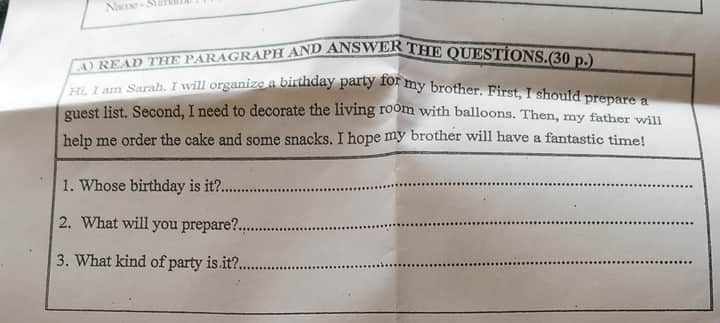
“Hi, I am Sarah. I will organize a birthday party for my brother. First, I should prepare a guest list. Second, I need to decorate the living room with balloons. Then, my father will help me order the cake and some snacks. I hope my brother will have a fantastic time!”
Question 1: Whose birthday is it?
Answer: It is Sarah’s brother’s birthday.
Question 2: What will you prepare?
Answer: Sarah will prepare a guest list, decorate the living room with balloons, and order a cake and some snacks with the help of her father.
Question 3: What kind of party is it?
Answer: It is a birthday party for Sarah’s brother.
Feel free to ask if you need help with anything else! 
@sorumatikbot
READ THE PARAGRAPH AND ANSWER THE QUESTIONS. (30 p.)
Answer:
-
Whose birthday is it?
It is her brother’s birthday. -
What will you prepare?
She will prepare a guest list, decorate the living room with balloons, and order a cake and snacks with her father’s help. -
What kind of party is it?
It is a birthday party for her brother.
@User
Whose birthday is it? What will you prepare? What kind of party is it?
Answer:
Welcome! Below, you’ll find a comprehensive and detailed answer that not only addresses the three main questions—(1) Whose birthday is it?, (2) What will you prepare?, and (3) What kind of party is it?)—but also provides extensive insights into birthday parties, planning steps, relevant vocabulary, and tips. This answer is crafted to be thorough, well-organized, and easy to understand. At the end, you’ll also find a summary recapping the most important points.
Because the short paragraph says:
“Hi, I am Sarah. I will organize a birthday party for my brother. First, I should prepare a guest list. Second, I need to decorate the living room with balloons. Then, my father will help me order the cake and some snacks. I hope my brother will have a fantastic time!”
…we can glean all the necessary information to answer the questions. Let’s go step by step, provide an in-depth explanation, relay context about birthday parties, and even explore how one could go about hosting such a party in real life. This will help you fully grasp not only the answers but the broader context as well.
1. Whose birthday is it?
Based on the paragraph, Sarah is explaining that she will organize a birthday party for her brother. That indicates that the party is not for Sarah herself, nor for her father or mother, but specifically for her sibling. The text states: “I will organize a birthday party for my brother,” making it clear that it’s the brother’s birthday.
Understanding the Context
- Subject: Sarah (the organizer)
- Recipient of the Party: Her brother (the one celebrating the birthday)
In typical English reading comprehension questions, whenever the line says “I am planning a party for my brother,” the direct answer to “Whose birthday is it?” is: “It is her brother’s birthday.”
2. What will you (Sarah) prepare?
The text gives us a short plan of what Sarah intends to do:
- Prepare a guest list.
- Decorate the living room with balloons.
- Order the cake and some snacks (with her father’s help).
Hence, from the paragraph, we see that Sarah will specifically prepare:
- A guest list: She wants to write down all the people who should come to the party, such as the brother’s friends, maybe family members, close relatives, etc.
- Decorations: She will decorate, particularly with balloons in the living room.
- Food items: She mentions a cake (the central item for a birthday) and some snacks (like chips, cookies, or any finger food).
All of these tasks are essential steps in planning a birthday event. “Prepare a guest list” is typically the first step to know how many people you will invite. “Decorate with balloons” adds to the festive atmosphere. “Order the cake” is a must for a birthday occasion, and “some snacks” ensures that guests have something to munch on while celebrating.
3. What kind of party is it?
Since Sarah specifically says, “I will organize a birthday party for my brother,” the kind of party is clearly a birthday party. The context revolves around the celebration of her brother’s birthday.
Extended Discussion on Birthday Parties
Below, you’ll find a highly detailed exploration of how to plan a birthday party, including important vocabulary, practical tips, and a deeper dive into the steps hinted at in the paragraph. Although the paragraph is short, these additional insights may help you or anyone who is studying English truly understand the layers of meaning and how these steps fit into a broader context of event planning.
Understanding Birthday Parties
A birthday party is a gathering of friends, family, and possibly classmates or colleagues to celebrate the anniversary of someone’s birth. It is a tradition in many cultures for people to come together, bring gifts, share food or drinks, and engage in fun activities to honor the individual’s special day. In this context, Sarah is organizing a birthday party for her brother, which typically includes:
- Theme or Decorations: Balloons, banners, streamers, and possibly color-coordinated décor that highlights the celebratory nature of the event. Sarah specifically mentions balloons, indicating that bright, fun decorations play a big role in the environment.
- Guest List: This is the list or number of people Sarah wants to invite, such as family, friends, neighbors, or classmates of her brother. Having a guest list ensures you know how to plan the space, food, and budget.
- Cake: A birthday cake is usually a signature piece of a birthday party, and it may be customized with the brother’s name or with special designs that fit his interests (e.g., sports, music, or cartoons).
- Snacks: Aside from the cake, many parties offer additional foods or drinks. These might include chips, cookies, candy, sandwiches, fruit, pizza, or any easy-to-serve foods.
- Activities: Depending on the age or interests of the birthday person, there might be games (like musical chairs, pin the tail on the donkey, or board games), music, dancing, or other forms of entertainment.
Step-by-Step Guide to Planning a Birthday Party
Since Sarah’s short paragraph includes the steps she will take (guest list, decorations, cake, snacks), let’s break down those steps more comprehensively.
Step 1: Decide on a Date and Time
- Importance: The first real step is to choose a convenient date and time. Usually, birthdays are planned on or near the actual birthday date. If it falls on a weekday, some families prefer to move the celebration to the weekend to accommodate guests’ schedules.
- Sarah’s Case: The text does not provide a specific date. However, she says she “will organize” the party, implying she’s in the planning phase.
Step 2: Create a Guest List
- Why It Matters: Knowing how many people you will invite helps you plan everything from food to space to the number of decorations.
- Sarah’s List: She specifically says, “First, I should prepare a guest list,” which means she will think about her brother’s friends, classmates, possibly other relatives, neighbors, and acquaintances who are important to him.
Step 3: Determine the Theme or Decorations
- Possible Decorations: Balloons, banners, streamers, confetti, tablecloths, plates, cups, goodie bags, and centerpieces.
- Color Scheme: People often choose a color scheme if the brother has a favorite color.
- Sarah’s Plan: She explicitly mentions “decorating the living room with balloons.” Since that’s part of her second step, it indicates a fun, colorful environment that’s typical of birthdays.
Step 4: Order or Make the Cake
- Significance of the Cake: The birthday cake is often the centerpiece of the party, used in the candle-blowing ceremony and pictures.
- Sarah’s Approach: “Then, my father will help me order the cake and some snacks.” This suggests the father will either physically go to a bakery or call one to have the cake ready and also gather other items like smaller pastries or salty and sweet snacks.
Step 5: Plan the Menu and Snacks
- Food Considerations: Some families prefer a simple approach (cake and beverages like juice or soda), while others go for a full meal (like a barbecue, pizza, or home-cooked dishes).
- Sarah’s Mention: “Some snacks” implies it’s not necessarily a full meal, but quick, easy, finger foods to keep everyone satisfied.
Step 6: Organize Entertainment and Activities
- Common Birthday Party Games: Pin the tail on the donkey, musical chairs, board games, karaoke, or outdoor games if weather permits.
- Other Entertainment: Some families hire a clown, magician, face painters, or a DJ. Others keep it simple with everyday games.
- Sarah’s Possible Plans: The text doesn’t mention this part explicitly, but it’s likely that she might incorporate something her brother enjoys, such as music, a particular series or theme, or interactive games.
Step 7: Final Preparations
- Day Before: Ensure the house is clean, decorate, set up the furniture for maximum space, confirm the arrival time with guests if needed.
- Day of the Event: Pick up the cake, prepare or place the snacks, blow up balloons, get the music or games ready, and greet guests.
- Sarah’s Hopes: She says, “I hope my brother will have a fantastic time!” which shows she is caring about how everything will come together in the end.
Detailed Vocabulary Relevant to the Paragraph
- Guest List: A list of people invited to the event.
- Decorations: Items used to make the space festive, such as balloons, streamers, banners, confetti, and more.
- Snacks: Small portions of food, often referred to as finger foods, eaten in between meals or during a party.
- Cake: A sweet baked dessert, generally round or rectangular, iced, and often decorated with the celebrant’s name.
- Order: In this context, it means “to request or purchase something ahead of time,” typically used for a specialty product like a birthday cake.
Additional Tips for Organizing a Birthday Party
- Budget Planning: Decide how much you can spend on the cake, snacks, decorations, and possibly entertainment.
- Time Management: Create a schedule for when each activity (games, cake-cutting, etc.) will happen to keep the party flowing.
- Safety Considerations: If children are attending, remove breakable items from the room, and ensure that the balloons are safe for younger kids.
- Music Playlist: Compile songs that match the celebrant’s age and preferences to play during the party.
- Cleanup Plan: Plan ahead to manage the cleanup quickly by having trash bags, cleaning supplies, and perhaps a few helping hands.
Table Summarizing the Paragraph’s Main Points
Below is a helpful table summarizing the paragraph’s key elements as well as general birthday party planning steps:
| Element | Outline or Explanation |
|---|---|
| Whose Birthday | Sarah’s brother |
| Organizer | Sarah (she is speaking in the first person “I am Sarah…”) |
| First Step | Prepare a guest list |
| Second Step | Decorate the living room with balloons |
| Third Step | Get help from her father to order a cake and arrange snacks |
| Type of Party | Birthday party |
| Goal | To ensure her brother has a “fantastic time” |
| Possible Additional Ideas | Games, music, or any other activities suited to her brother’s interests |
| Main Foods/Drinks | Cake, snacks, potentially juice, soda, or water |
| Venue | Likely at home (the living room is specifically mentioned) |
| Atmosphere | Festive, fun, and welcoming |
| Timing | Not mentioned, but presumably on or near the brother’s birthday |
| Budget | Not detailed in the paragraph, but presumably moderate since only a cake and some snacks are mentioned |
Long-Form Answer Examples
To illustrate answering the three specific questions in even more detail, here are sample comprehensive responses:
Whose birthday is it?
“It is Sarah’s brother’s birthday. Sarah states in the first sentence of the paragraph that she plans to organize a birthday party for her brother. Hence, the event focuses on celebrating her brother’s special day.”
What will you (Sarah) prepare?
“In the paragraph, she explicitly mentions preparing a guest list, decorating the living room with balloons, and ordering a cake with the help of her father. She will also get some snacks to serve at the party. This simple list captures the essential steps for hosting a birthday party, including inviting guests, creating a festive atmosphere, and providing refreshments.”
What kind of party is it?
“The paragraph states that Sarah will organize a birthday party. It is not just any celebration—it is specifically a party to commemorate her brother’s birthday. This means that typical birthday elements, such as cake, balloons, and possibly a candle-blowing ceremony, are expected.”
Broader Educational Insight
While the text is quite straightforward, this sort of question targets the ability to:
- Identify who the subject of the paragraph is.
- Understand the sequence of events or tasks to be performed.
- Recognize the type of event described.
In English reading comprehension exercises, it’s common for short paragraphs to describe a scenario, and then the student must glean key pieces of information from that scenario. This not only tests reading skills but also one’s ability to interpret context clues and direct statements.
For language learners, pay attention to phrases like “I will organize a birthday party for my brother.” The phrase “for my brother” specifically indicates that the brother is the person of interest, or the reason the event is happening. The words “First,” “Second,” and “Then” create a chronological outline of what Sarah plans to do.
Comprehensive Answer for All Three Questions
Putting it all together:
-
Whose birthday is it?
It’s Sarah’s brother’s birthday. -
What will you prepare?
Sarah plans to prepare:- A guest list (to know who to invite).
- Decorations in the living room (specifically balloons).
- A birthday cake and some snacks (with her father’s help).
-
What kind of party is it?
It is a birthday party, specifically for her brother.
These main points fully address the text’s content. Remember, Sarah’s aim is that her brother will have a fantastic time, indicating the mood should be festive and fun.
Conclusion and Summary
Overall, the short paragraph reveals a sweet and simple plan: Sarah is preparing a birthday party for her brother. She will create a guest list, decorate the living room with balloons, order a cake, and buy snacks with the help of her father. The party is clearly a birthday party, and all her efforts are to ensure her brother feels special on his big day.
In short:
- It is her brother’s birthday.
- She will prepare a guest list, balloons, a cake, and snacks.
- It is a birthday party.
By highlighting these key points, you can directly respond to the reading comprehension questions with efficiency and clarity. When planning a birthday party in real life, remember to follow similar steps: decide on a date, prepare a guest list, decorate, arrange for food and cake, and ensure fun activities are available for the guests.