Solve following system of inequalities.
\frac{x}{2x+1} \geq \frac{1}{4} and \frac{6x}{4x-1} < \frac{1}{2}
The answer is x ın (\frac{1}{8}, \frac{1}{4})
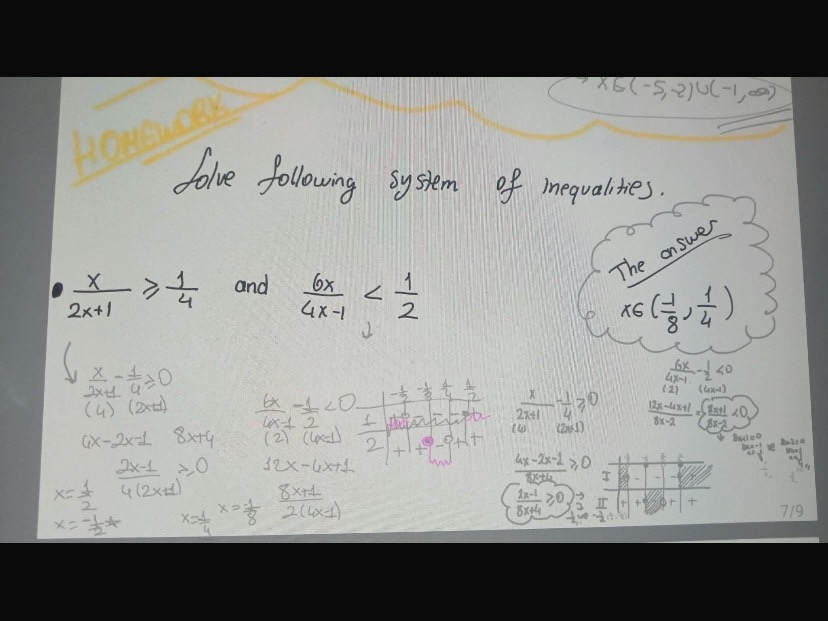
System of Rational Inequalities
 FORMULAS & RULES USED:
- To solve rational inequalities of the form \frac{P(x)}{Q(x)} \lesseqgtr 0:
- Move all terms to one side so the other side is 0.
- Find a common denominator to express as a single rational fraction.
- Determine the critical points (zeros of the numerator and denominator).
- Construct a sign chart to identify the intervals that satisfy the inequality.
- The solution to a system of inequalities is the intersection of the individual solution sets: S = S_1 \cap S_2.
 STEP-BY-STEP SOLUTION:
Step 1 — Solve the First Inequality
Move \frac{1}{4} to the left-hand side and find a common denominator:
\frac{x}{2x+1} \geq \frac{1}{4} \implies \frac{x}{2x+1} - \frac{1}{4} \geq 0
\frac{4x - (2x + 1)}{4(2x + 1)} \geq 0 \implies \frac{2x - 1}{4(2x + 1)} \geq 0
Find the critical points:
- Numerator: 2x - 1 = 0 \implies x = \frac{1}{2}
- Denominator: 2x + 1 = 0 \implies x = -\frac{1}{2} (restriction: x \neq -\frac{1}{2})
Analyze the sign of the quotient \frac{2x - 1}{2x + 1}:
- For x < -\frac{1}{2}: \frac{(-)}{(-)} > 0 \quad (+)
- For -\frac{1}{2} < x < \frac{1}{2}: \frac{(-)}{(+)} < 0 \quad (-)
- For x \geq \frac{1}{2}: \frac{(+)}{(+)} \geq 0 \quad (+)
Thus, the solution set for the first inequality is:
S_1 = \left(-\infty, -\frac{1}{2}\right) \cup \left[\frac{1}{2}, \infty\right)
Step 2 — Solve the Second Inequality
Move \frac{1}{2} to the left-hand side and combine terms:
\frac{6x}{4x-1} < \frac{1}{2} \implies \frac{6x}{4x-1} - \frac{1}{2} < 0
\frac{2(6x) - (4x - 1)}{2(4x - 1)} < 0 \implies \frac{12x - 4x + 1}{2(4x - 1)} < 0 \implies \frac{8x + 1}{2(4x - 1)} < 0
Find the critical points:
- Numerator: 8x + 1 = 0 \implies x = -\frac{1}{8}
- Denominator: 4x - 1 = 0 \implies x = \frac{1}{4} (restriction: x \neq \frac{1}{4})
Analyze the sign of the quotient \frac{8x + 1}{4x - 1}:
- For x < -\frac{1}{8}: \frac{(-)}{(-)} > 0 \quad (+)
- For -\frac{1}{8} < x < \frac{1}{4}: \frac{(+)}{(-)} < 0 \quad (-)
- For x > \frac{1}{4}: \frac{(+)}{(+)} > 0 \quad (+)
Thus, the solution set for the second inequality is:
S_2 = \left(-\frac{1}{8}, \frac{1}{4}\right)
Step 3 — Find the Intersection of the Solutions
The system requires both conditions to hold simultaneously (S = S_1 \cap S_2):
S_1 = \left(-\infty, -\frac{1}{2}\right) \cup \left[\frac{1}{2}, \infty\right)
S_2 = \left(-\frac{1}{8}, \frac{1}{4}\right)
Notice that:
- The interval S_2 = \left(-\frac{1}{8}, \frac{1}{4}\right) lies entirely within the interval \left(-\frac{1}{2}, \frac{1}{2}\right).
- Throughout \left(-\frac{1}{2}, \frac{1}{2}\right), the expression \frac{2x-1}{4(2x+1)} is strictly negative, meaning no points in S_2 satisfy the first inequality.
Therefore:
S_1 \cap S_2 = \emptyset
━━━━━━━━━━━━━━━━━━━━━━━━━━━
 FINAL ANSWER:
\text{No solution } (\emptyset)
━━━━━━━━━━━━━━━━━━━━━━━━━━━
 KEY CONCEPTS:
- Sign Chart Method: Rational inequalities must never be cross-multiplied without knowing the sign of the denominator, as multiplying by a negative number reverses the inequality sign.
- System Intersection: A value of x is only a solution to the system if it satisfies all inequalities in the system simultaneously.
 COMMON MISTAKES:
 Incorrect Approach (Regarding the note x \in (\frac{1}{8}, \frac{1}{4})):
- A sign error during the simplification of the second inequality (e.g., writing 8x - 1 < 0 instead of 8x + 1 < 0) yields the interval \left(\frac{1}{8}, \frac{1}{4}\right).
- Forgetting to intersect this result with the first inequality S_1. For example, testing x = \frac{1}{5} = 0.2 \in \left(\frac{1}{8}, \frac{1}{4}\right) into the first inequality gives:\frac{0.2}{2(0.2) + 1} = \frac{0.2}{1.4} = \frac{1}{7} \approx 0.143 \not\geq 0.25which is false.
- Correct Approach: Always test the critical points carefully and take the intersection of all individual solution sets.
Would you like to solve another rational inequality system to practice setting up sign charts?