sha them en t not gc (ouy)at bite) içind erçe PRACTICE 11 PRACTICE 9 I 2.1 f Rewrlte the following sentences using “it clauses” 1./don’t have the ticket for the U2 concert. I can’t come with yOu. If PRACTICE 10 2.1 don’t have a driving license. I can’t give you a lift to the station Idon’t have a lot of imoney. I can’t g0 on a luxurious holiday ElL in the blanks with the correct form of the verbs in brackets using "type 2 conditionals 3. If 1 ne litie girl isn’t here right now. She carn’t tell you the truth. 1, If there 4. If 1 f rink so much coffee before going to bed. That’s why you can’t sleep well at night. language. IPRACTICE 11 (become) president. in places. (not be) any countries, everyone (try) to make the country more pleasant and peaceful it I Rewrite the following sentences using “If clauses”. (be) Bill Gates, I_ (have) wings, I (buy) whatever I like. 1.l don’t have much free time now. I won’t take up volleyball. (fly) all over the world, spending just inutes (want) to come back to the time when Iwas in orimary school in my hometown if (turn) back the time 2. They don’t like Indian tood. Thev don’t order from the Indian restaurant all the time. (speak) the same 3.1 arm not as strong as you. I can’t beat you at wrestling. *. Mark isn’t very happy because Nancy doesn’t want to marry him. u.he doesn’t know French very well, He can’t communicate with the French. to"Presen ue saterees
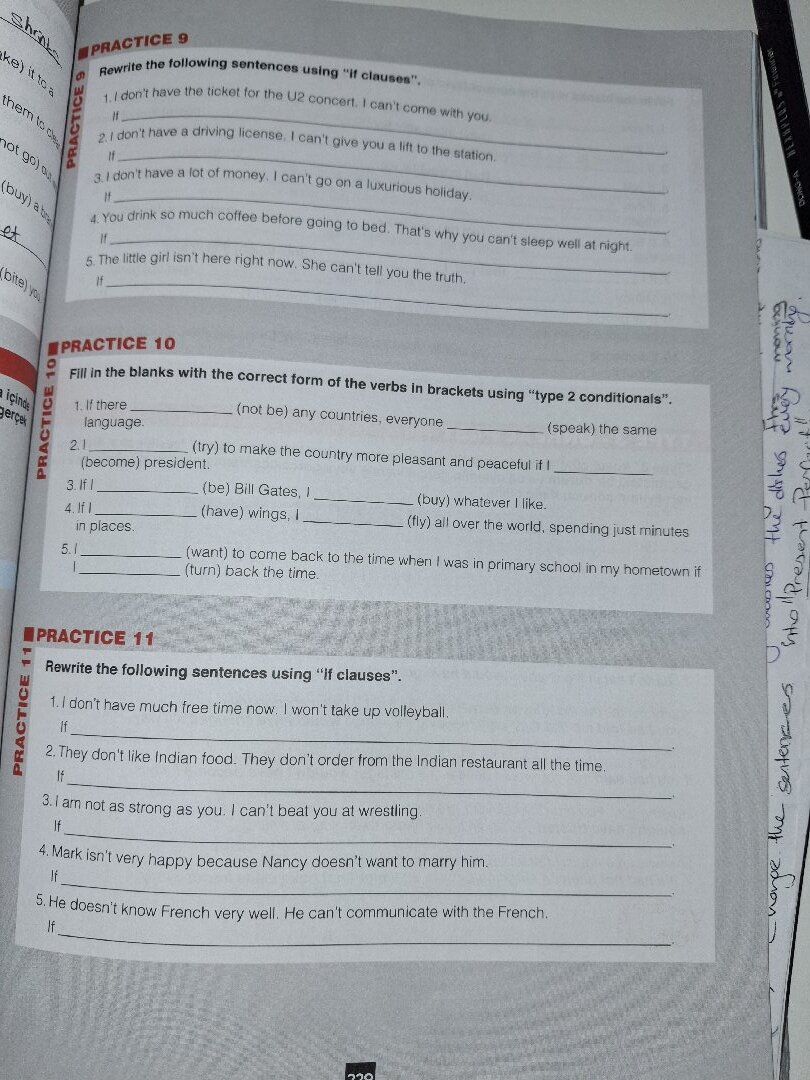
Sha them en t not gc (ouy)at bite) içerinde “If clauses” ve “Type 2 Conditional” pratik cümle düzenlemeleri
Önemli Noktalar
- If clauses (koşul cümleleri) İngilizcede şartları ifade etmek için kullanılır.
- Type 2 conditional gerçek olmayan, hayali ya da şimdiki durumdan farklı koşulları ifade eder.
- Cümleler If + Simple Past, … would + base verb şeklinde kurulur.
Aşağıdaki alıştırmalar, “If” cümlesi yapısını ve “type 2 conditionals” kullanımını temel alır.
İçindekiler
- Practice 9: “If clauses” ile cümle tamamlama
- Practice 10: Type 2 Conditionals ile boşluk doldurma
- Practice 11: “If clauses” ile yeniden yazma
- Karşılaştırma Tablosu
- Özet Tablo
- Sık Sorulan Sorular
Practice 9: “If clauses” ile cümle tamamlama (Örnek Çözüm)
-
I don’t have the ticket for the U2 concert. I can’t come with you.
→ If I don’t have the ticket for the U2 concert, I can’t come with you. -
I don’t have a driving license. I can’t give you a lift to the station.
→ If I don’t have a driving license, I can’t give you a lift to the station. -
I don’t have a lot of money. I can’t go on a luxurious holiday.
→ If I don’t have a lot of money, I can’t go on a luxurious holiday. -
You drink so much coffee before going to bed. That’s why you can’t sleep well at night.
→ If you didn’t drink so much coffee before going to bed, you could sleep well at night. -
The little girl isn’t here right now. She can’t tell you the truth.
→ If the little girl were here right now, she could tell you the truth.
Practice 10: Type 2 Conditionals (Doğru fiil formu ile doldur)
-
If there weren’t (not be) any countries, everyone would speak (speak) the same language.
-
I would try (try) to make the country more pleasant and peaceful if I were (become) president.
-
If I were (be) Bill Gates, I would buy (buy) whatever I like.
-
If I had (have) wings, I would fly (fly) all over the world, spending just minutes in places.
-
I would want (want) to come back to the time when I was in primary school in my hometown if I could turn (turn) back the time.
Practice 11: “If clauses” ile cümleleri yeniden yazma
-
I don’t have much free time now. I won’t take up volleyball.
→ If I had much free time now, I would take up volleyball. -
They don’t like Indian food. They don’t order from the Indian restaurant all the time.
→ If they liked Indian food, they would order from the Indian restaurant all the time. -
I am not as strong as you. I can’t beat you at wrestling.
→ If I were as strong as you, I could beat you at wrestling. -
Mark isn’t very happy because Nancy doesn’t want to marry him.
→ If Nancy wanted to marry Mark, he would be very happy. -
He doesn’t know French very well. He can’t communicate with the French.
→ If he knew French very well, he could communicate with the French.
Karşılaştırma Tablosu: “If clauses” vs “Type 2 Conditionals”
| Özellik | If Clauses (Genel) | Type 2 Conditionals |
|---|---|---|
| Kullanımı | Gerçek veya olası durumlar için | Hayali veya şu andan farklı, gerçek olmayan durumlar için |
| Yapı | If + Simple Present, will + verb | If + Simple Past, would + base verb |
| Örnek | If it rains, I will stay home. | If I were you, I would study harder. |
| Zaman | Gelecek veya genel gerçekler | Şimdiki ya da geleceğin hayali durumları |
Özet Tablo
| Öğeler | Açıklama |
|---|---|
| If clauses | Şart cümleleri, gerçek durumlar için |
| Type 2 conditionals | Hayali, gerçek olmayan veya mümkün olmayan durumlar |
| Fiil yapıları | Present + will / Past + would |
| Kullanım alanları | Olasılıklar vs. hipotetik durumlar |
| Pratik örnek | If I have time, I will help. / If I had time, I would help. |
Sık Sorulan Sorular
1. Type 2 conditional ile type 1 conditional arasındaki fark nedir?
Type 1 gerçek, mümkün koşulları ifade eder (If + Present, will + verb). Type 2 ise şimdiki zaman için gerçek olmayan, hayali durumları gösterir (If + Past, would + verb).
2. “If I were” neden kullanılır?
“Be” fiilinin geçmiş zamanda “were” kullanımı, özellikle hayali veya gerçek olmayan durumlarda kibar ve doğru kabul edilir.
3. If clauses’ta zaman kullanımı nasıl belirlenir?
If clauses içinde zaman, gerçekleşme olasılığına göre belirlenir. Olası durumlarda present tense, hayali durumlarda past tense kullanılır.
Sonraki Adımlar
Type 3 conditionals ve mixed conditional yapılarının örneklerini görmek ister misiniz? Daha fazla pratik cümle ve test hazırlayabilirim.
Rewrite the sentences in Practice 9 & Practice 11 using “If clauses” and complete Practice 10 with type 2 conditionals
Key Takeaways
- First Conditional (real present/future): If + present simple, will + base verb
- Second Conditional (unreal present): If + past simple, would/could + base verb
- Were is preferred for all subjects in the if-clause of second conditionals (formal usage)
Table of Contents
- Practice 9: If-Clause Transformations
- Practice 10: Type 2 Conditional Fill-ins
- Practice 11: If-Clause Transformations
- First vs Second Conditional Comparison
- Summary Table
- FAQ
Practice 9: If-Clause Transformations
Rewrite each pair as one sentence with an if-clause (second conditional form):
- I don’t have the ticket for the U2 concert. I can’t come with you.
→ If I had the ticket for the U2 concert, I could come with you. - I don’t have a driving license. I can’t give you a lift to the station.
→ If I had a driving license, I could give you a lift to the station. - I don’t have a lot of money. I can’t go on a luxurious holiday.
→ If I had a lot of money, I could go on a luxurious holiday. - You drink so much coffee before going to bed. That’s why you can’t sleep well at night.
→ If you didn’t drink so much coffee before going to bed, you could sleep well at night. - The little girl isn’t here right now. She can’t tell you the truth.
→ If the little girl were here right now, she could tell you the truth.
Practice 10: Type 2 Conditional Fill-ins
Complete with the correct past tense/past modal:
- If there were (not be) any countries, everyone would speak (speak) the same language.
- Everyone would try (try) to make the country more pleasant and peaceful if I became (become) president.
- If I were (be) Bill Gates, I would buy (buy) whatever I like.
- If I had (have) wings, I would fly (fly) all over the world, spending just minutes in places.
- I would want (want) to come back to the time when I was in primary school in my hometown if I could turn (turn) back the time.
Practice 11: If-Clause Transformations
Rewrite each as one if-clause sentence (second conditional):
- I don’t have much free time now. I won’t take up volleyball.
→ If I had more free time now, I would take up volleyball. - They don’t like Indian food. They don’t order from the Indian restaurant all the time.
→ If they liked Indian food, they would order from the Indian restaurant all the time. - I am not as strong as you. I can’t beat you at wrestling.
→ If I were as strong as you, I would beat you at wrestling. - Mark isn’t very happy because Nancy doesn’t want to marry him.
→ If Nancy wanted to marry Mark, he would be very happy. - He doesn’t know French very well. He can’t communicate with the French.
→ If he knew French very well, he could communicate with the French.
First vs Second Conditional Comparison
| Feature | First Conditional | Second Conditional |
|---|---|---|
| Form | If + present simple, will + base verb | If + past simple (were), would/could + verb |
| Use | Real possible future events | Unreal/hypothetical present or future |
| Example | If it rains, I will stay home. | If it rained, I would stay home. |
| Degree of reality | High (likely/possible) | Low (imaginary/unlikely) |
Summary Table
| Conditional Type | If-Clause | Main Clause | Usage |
|---|---|---|---|
| First | If + present simple | will + base verb | Possible future conditions |
| Second | If + past simple (were) | would/could + base verb | Unreal or hypothetical situations |
FAQ
- What’s the difference between “if I was” and “if I were”?
- “Were” is the formal subjunctive for all subjects in second conditionals; “was” is common in informal speech.
- Can I use “could” instead of “would” in the main clause?
- Yes, “could” emphasizes ability (e.g., If I had time, I could help you).
- When do I use mixed conditionals?
- Mixed conditionals combine time references (e.g., past condition + present result).
- Is “If + past continuous” possible in type 2?
- Rare; typically you use simple past for second conditionals.
Would you like three extra practice sentences to test your understanding of second conditionals?
@Damyosss