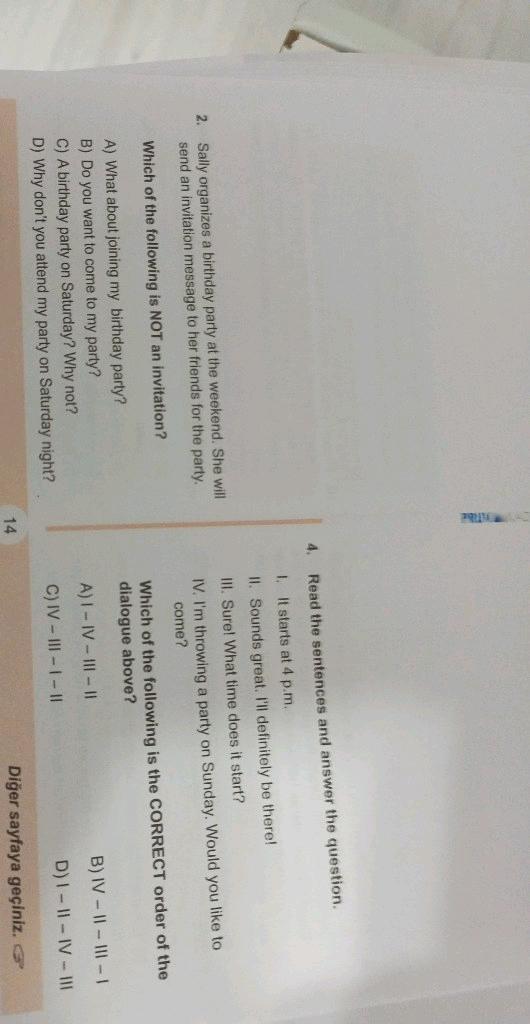
Sally organizes a birthday party at the weekend. She will send an invitation message to her friends for the party.
Which of the following is NOT an invitation?
A) What about joining my birthday party?
B) Do you want to come to my party?
C) A birthday party on Saturday? Why not?
D) Why don’t you attend my party on Saturday night?
Read the sentences and answer the question.
I. It starts at 4 p.m.
II. Sounds great. I’ll definitely be there!
III. Sure! What time does it start?
IV. I’m throwing a party on Sunday. Would you like to come?
Which of the following is the CORRECT order of the dialogue above?
A) I - IV - III - II
B) IV - II - III - I
C) IV - III - I - II
D) I - II - IV - III
8th Grade English: Friendship — Making Invitations & Dialogue Ordering
 KEY FORMULA / RULE: In English communication, making an invitation uses offering structures such as “Would you like to…?”, “What about / How about…?”, and “Why don’t you…?”, whereas phrases like “Why not?” or “Sure!” are used for accepting an offer. In dialogue ordering, an invitation is typically followed by acceptance/clarification, the answer to the inquiry, and a final confirmation.
 SOLUTION & OPTION ANALYSIS
Question 2: Identifying an Invitation
Sally wants to invite her friends to her birthday party, so the correct sentence must make an offer, not respond to one.
- A) What about joining my birthday party?: Uses “What about + V-ing…?” to make an invitation.
- B) Do you want to come to my party?: Uses “Do you want to…?” to extend an invitation.
- C) A birthday party on Saturday? Why not?: Expresses acceptance of an invitation already made; it does not invite someone.
- D) Why don’t you attend my party on Saturday night?: Uses “Why don’t you…?” as a direct suggestion/invitation.
 FINAL ANSWER (Question 2): C) A birthday party on Saturday? Why not?
Question 4: Ordering the Dialogue
- IV. “I’m throwing a party on Sunday. Would you like to come?” — Opens the conversation with an invitation.
- III. “Sure! What time does it start?” — Accepts the invitation conditionally and asks for the time.
- I. “It starts at 4 p.m.” — Answers the question regarding the time.
- II. “Sounds great. I’ll definitely be there!” — Concludes the conversation with an enthusiastic confirmation.
The correct chronological sequence is IV – III – I – II.
FINAL ANSWER (Question 4): C) IV – III – I – II
 EXAM INSIGHT / PITFALL: In LGS English Unit 1 (Friendship), always distinguish between the person making an offer (inviter) and the person accepting or refusing (invitee). Questions asking “What time does it start?” must immediately follow an invitation and precede the time response (“It starts at…”).