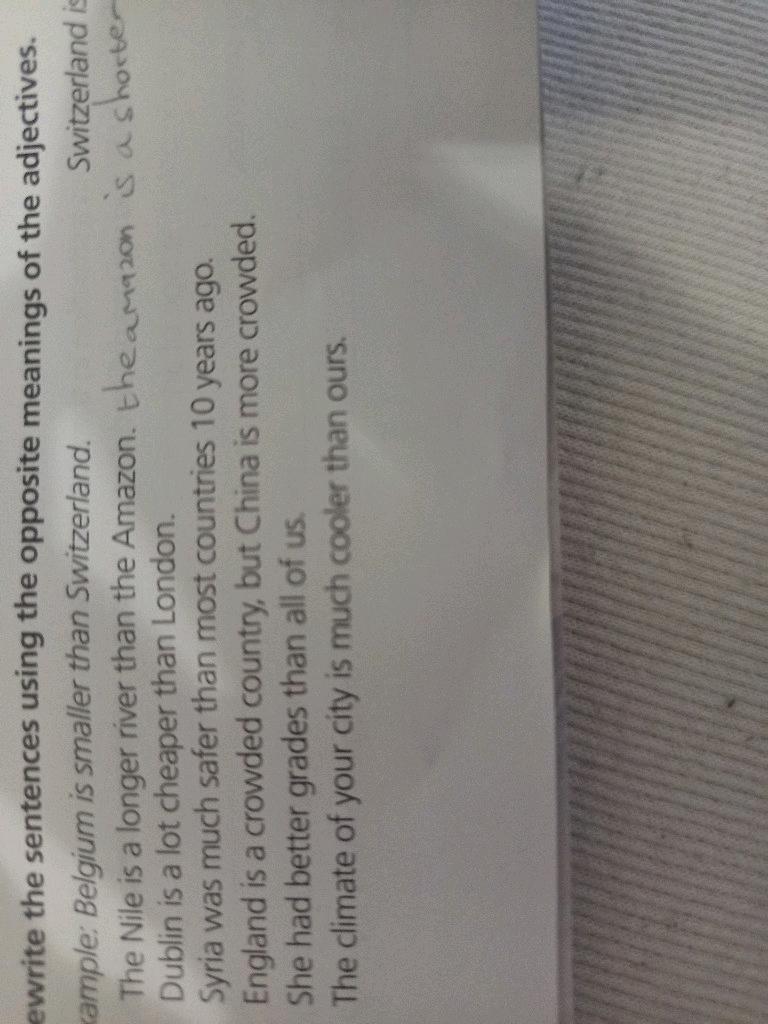
Rewrite the sentences using the opposite meanings of the adjectives.
Example: Belgium is smaller than Switzerland. Switzerland is larger than Belgium.
The Nile is a longer river than the Amazon. The Amazon is a shorter river than the Nile.
Dublin is a lot cheaper than London.
Syria was much safer than most countries 10 years ago.
England is a crowded country, but China is more crowded.
She had better grades than all of us.
The climate of your city is much cooler than ours.
Comparative Adjectives: Rewriting with Opposite Meanings
Comparative adjectives express differences between two entities. When reversing the subjects of a comparative sentence to maintain or invert the meaning, we replace the adjective with its antonym (e.g., smaller \rightarrow larger, cheaper \rightarrow more expensive, better \rightarrow worse).
 Rewritten Sentences
-
1. The Nile is a longer river than the Amazon.
- Answer: The Amazon is a shorter river than the Nile.
- Antonym: longer \rightarrow shorter
-
2. Dublin is a lot cheaper than London.
- Answer: London is a lot more expensive than Dublin.
- Antonym: cheaper \rightarrow more expensive
-
3. Syria was much safer than most countries 10 years ago.
- Answer: Most countries were much more dangerous than Syria 10 years ago.
- Antonym: safer \rightarrow more dangerous
-
4. England is a crowded country, but China is more crowded.
- Answer: China is a crowded country, but England is less crowded. (or: England is less crowded than China.)
- Antonym: more crowded \rightarrow less crowded
-
5. She had better grades than all of us.
- Answer: All of us had worse grades than her. (or: All of us had worse grades than she had.)
- Antonym: better \rightarrow worse
-
6. The climate of your city is much cooler than ours.
- Answer: The climate of our city is much warmer (or hotter) than yours.
- Antonym: cooler \rightarrow warmer / hotter
 EXAM INSIGHT / PITFALL: When forming opposites in English, short one-syllable adjectives usually take the suffix -er (short \rightarrow shorter, warm \rightarrow warmer), long multi-syllable adjectives require more / less (expensive \rightarrow more expensive), and irregular adjectives change completely (good/better \rightarrow bad/worse).