why i
Ph
BrH Ph-
Br + Ph
Major
(Resonance effect
(+R) of phenyl)
Br
H
Minor
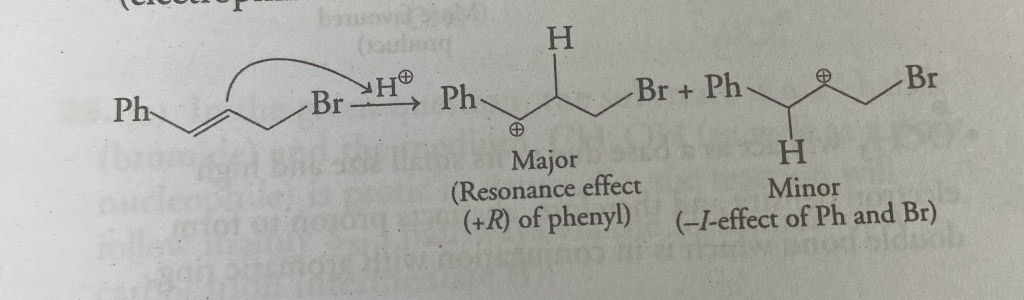
(-Leffect of Ph and Br) why is it +R in major and -I effect for the second
Stability of Benzylic vs. Non-Benzylic Carbocations
 FORMULAS & RULES USED:
- Resonance Effect (+R / +M): Delocalization of electrons through conjugated \pi-orbitals. Direct overlap stabilizes adjacent charge centers significantly more than inductive effects.
- Inductive Effect (-I): Transmission of charge through \sigma-bonds due to electronegativity differences. Electron-withdrawing groups (-I) intensify positive charge, thereby destabilizing a carbocation.
 STEP-BY-STEP SOLUTION:
Step 1 — Why the Major Intermediate Shows a +R Effect
When the electrophile (\text{H}^+) attacks the terminal position of the double bond, the positive charge is formed on the carbon directly bonded to the phenyl ring (benzylic position):
\text{Ph}-\overset{\oplus}{\text{C}}\text{H}-\text{CH}_2-\text{CH}_2\text{Br}
- The empty p-orbital of the positively charged carbon is in direct conjugation with the \pi-system of the aromatic ring.
- The phenyl ring donates \pi-electron density into this empty orbital via resonance, delocalizing the positive charge into the ortho and para positions of the ring:
\text{Ph}-\overset{\oplus}{\text{C}}\text{H}-\text{R} \longleftrightarrow \text{[Resonance contributors with charge in the ring]}
- Because the phenyl group acts as an electron donor through resonance to alleviate electron deficiency, it exerts a +R (positive resonance) effect, conferring high thermodynamic stability.
Step 2 — Why the Minor Intermediate Experiences a -I Effect
When \text{H}^+ attacks the carbon adjacent to the phenyl group, the carbocation is formed at the middle carbon:
\text{Ph}-\text{CH}_2-\overset{\oplus}{\text{C}}\text{H}-\text{CH}_2\text{Br}
- The carbocation center is separated from the phenyl ring by a saturated sp^3-hybridized carbon atom (-\text{CH}_2-).
- This sp^3 spacer disrupts orbital overlap, completely preventing any resonance delocalization between the phenyl ring and the positive charge.
- Without resonance, the aromatic ring interacts solely through \sigma-bonds. Because sp^2-hybridized carbons in the phenyl ring are more electronegative than sp^3 carbons, the phenyl ring acts as an electron-withdrawing group via \sigma-bonds (-I effect).
- In addition, the bromine atom is highly electronegative and pulls electron density through \sigma-bonds from the other side (-I effect).
- Both groups withdraw electron density from an already electron-deficient carbocation center, destabilizing it.
Step 3 — Conclusion on Intermediate Selectivity
- Major intermediate: Stabilized by powerful resonance delocalization (+R > -I).
- Minor intermediate: Resonance is blocked by the intervening sp^3 carbon; destabilized by two electron-withdrawing groups (-I of \text{Ph} and -I of \text{Br}).
━━━━━━━━━━━━━━━━━━━━━━━━━━━
 FINAL ANSWER:
The first intermediate is labeled +R because the carbocation is benzylic and directly conjugates with the aromatic \pi-system (delocalizing charge). The second intermediate is labeled -I because an intervening sp^3 -\text{CH}_2- group blocks resonance, leaving only the electron-withdrawing inductive (-I) effects of the phenyl ring and bromine to act upon the positive charge.
━━━━━━━━━━━━━━━━━━━━━━━━━━━
 KEY CONCEPTS:
- Benzylic Position: A carbon directly attached to a benzene ring. Any adjacent charge or radical benefits from extensive resonance over the aromatic \pi-cloud.
- Insulating sp^3 Carbon: An sp^3 center lacks unhybridized p-orbitals, acting as an insulator that terminates \pi-conjugation.
 COMMON MISTAKES:
 Incorrect Approach: Assuming the phenyl ring always donates electron density in every position.
- Correct Approach: The phenyl ring donates by resonance (+R) only when directly conjugated to the carbocation. When insulated by an sp^3 carbon, its net effect is electron-withdrawing (-I).
Would you like to see the step-by-step resonance structures of the benzylic carbocation to see how the charge is distributed?