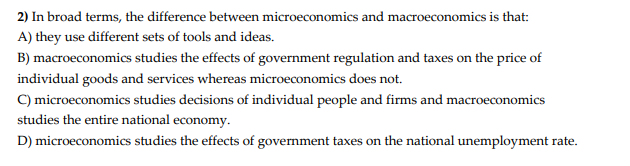
The correct answer is C.
Explanation:
-
Microeconomics focuses on the behavior and decision-making of individual economic agents, such as households, workers, and firms. It studies how these agents allocate scarce resources, how they respond to changes in prices and incomes, and how they interact in specific markets (e.g., supply and demand for a particular good).
-
Macroeconomics looks at the economy as a whole. It analyzes aggregate variables—total output (GDP), the overall unemployment rate, inflation, fiscal and monetary policy, and economic growth. Macroeconomics asks questions like “What determines a nation’s long-run growth rate?” or “How do government policies affect overall unemployment and inflation?”
Choice A is too vague (they actually use many of the same tools, like supply–demand analysis, but at different levels).
Choice B is incorrect because microeconomics also examines how taxes and regulations affect individual markets.
Choice D is backwards—studying taxes’ impact on national unemployment is clearly a macroeconomic question.
Thus, in broad terms:
Microeconomics = decisions of individual people and firms
Macroeconomics = behavior of the entire national (or global) economy
What is the difference between microeconomics and macroeconomics in broad terms?
Answer:
The question asks about the broad difference between microeconomics and macroeconomics and provides four options:
- A) They use different sets of tools and ideas.
- B) Macroeconomics studies the effects of government regulation and taxes on the price of individual goods and services whereas microeconomics does not.
- C) Microeconomics studies decisions of individual people and firms and macroeconomics studies the entire national economy.
- D) Microeconomics studies the effects of government taxes on the national unemployment rate.
Detailed Explanation
To understand the difference clearly, let’s define both fields:
| Microeconomics | Macroeconomics |
|---|---|
| Focuses on individual agents such as consumers, households, and firms. | Focuses on the economy as a whole, including aggregate indicators. |
| Studies individual markets, supply and demand, pricing, and resource allocation. | Studies national income, inflation, unemployment, economic growth, and fiscal/monetary policy. |
| Examples: How a firm sets prices, consumer behavior, labor markets. | Examples: GDP growth, inflation rate, unemployment rate, government policies affecting the whole economy. |
Analysis of the Options
-
Option A: “They use different sets of tools and ideas.”
This is true but very general and not the best description of their difference. -
Option B: “Macroeconomics studies the effects of government regulation and taxes on the price of individual goods and services whereas microeconomics does not.”
This is incorrect because microeconomics studies prices of individual goods and services, including effects of taxes and regulations on them. -
Option C: “Microeconomics studies decisions of individual people and firms and macroeconomics studies the entire national economy.”
This is correct and the best broad definition. -
Option D: “Microeconomics studies the effects of government taxes on the national unemployment rate.”
This is incorrect because unemployment rate is a macroeconomic variable studied in macroeconomics.
Summary Table
| Option | Statement | Correctness | Explanation |
|---|---|---|---|
| A | They use different sets of tools and ideas. | Partially true | True but too general to be the main difference. |
| B | Macroeconomics studies effects of regulation/taxes on prices of individual goods, micro does not. | False | Microeconomics studies individual prices and taxes too. |
| C | Micro studies individual decisions; macro studies entire national economy. | True | Best broad definition of the difference. |
| D | Micro studies effects of taxes on national unemployment rate. | False | Unemployment rate is a macroeconomic topic. |
Final Answer:
C) Microeconomics studies decisions of individual people and firms and macroeconomics studies the entire national economy.
If you want, I can also explain more about micro and macroeconomics or provide examples!