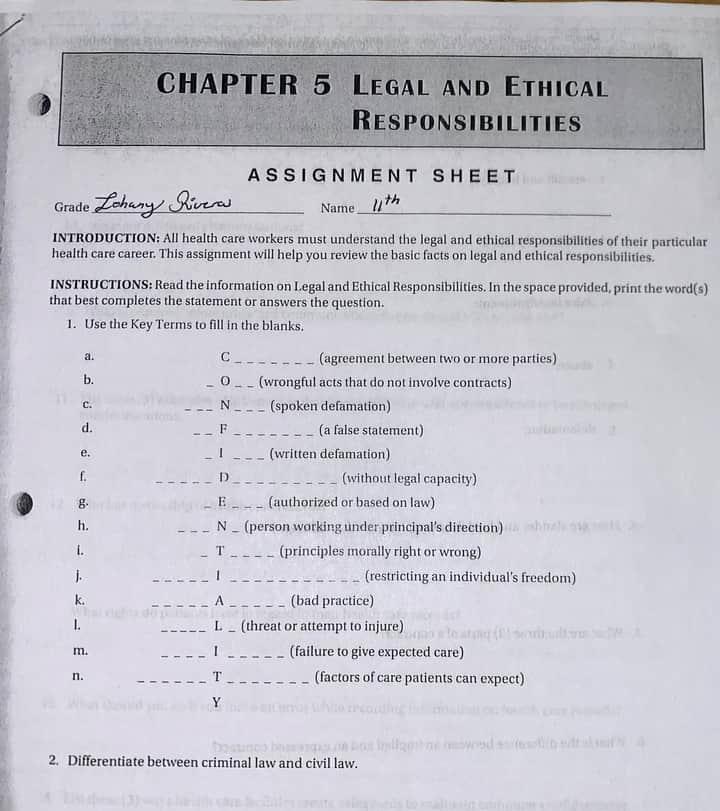
Can you do this assignment correctly for me please?
Chapter 5 Legal and Ethical Responsibilities - Assignment Answers
Önemli Noktalar
- Legal ve ethical responsibilities sağlık çalışanlarının mesleki görevlerini yerine getirirken uyacakları kurallardır
- Key terimler, sağlık hukukunda sık kullanılan kavramları kapsar
- Civil law ve criminal law arasındaki fark temel hukuki işlemleri ayırt eder
Legal and ethical responsibilities sağlık çalışanlarının mesleki faaliyetlerinde hem kanuni hem de vicdani kurallara uymalarını gerektirir.
İçindekiler
1. Use the Key Terms to Fill in the Blanks
a. Contract (agreement between two or more parties)
b. Omission (wrongful acts that do not involve contracts)
c. Slander (spoken defamation)
d. Libel (a false statement - actually this fits better with written defamation)
e. Libel (written defamation)
f. Incompetent (without legal capacity)
g. Expressed (authorized or based on law)
h. Employee (person working under principal’s direction)
i. Ethics (principles morally right or wrong)
j. Invasion of Privacy (restricting an individual’s freedom)
k. Malpractice (bad practice)
l. Assault (threat or attempt to injure)
m. Negligence (failure to give expected care)
n. Patient’s Rights (factors of care patients can expect)
o. Yes - This seems to be incomplete in the image
Note: Some blanks relate directly to terms like Contract, Omission, Slander, Libel, etc. The letter patterns and hints guide the correct answers.
2. Differentiate Between Criminal Law and Civil Law
-
Criminal Law deals with offenses against the state or society as a whole. It involves actions considered harmful or threatening to public safety and welfare, such as theft, assault, or murder. Criminal law cases are prosecuted by the government and can result in penalties like imprisonment or fines.
-
Civil Law involves disputes between individuals or organizations, typically concerning rights, contracts, or liabilities. It covers lawsuits over breaches of contract, property disputes, and personal injury claims. Resolution usually involves compensation rather than punishment.
Pro Tip: In healthcare, criminal law might apply if a professional intentionally harms a patient, while civil law addresses negligence or malpractice claims when care standards fall short.
Sonraki Adımlar
Would you like me to provide detailed definitions and examples for each legal and ethical term, or prepare a summary guide focusing on healthcare professional responsibilities?
Can you do this assignment correctly for me please?
Key Takeaways
- Understanding and correctly applying legal terms such as Contract, Tort, Slander, Negligence, etc., is essential in health care.
- Criminal law vs. Civil law differ in scope, burden of proof, and remedies/punishments.
- Clear knowledge of these concepts helps protect patient rights and professional responsibilities.
Direct Answer
Below are the completed fill-in-the-blanks for Chapter 5 and a concise differentiation between criminal law and civil law.
Table of Contents
1. Completed Fill-in-the-Blanks
a. Contract (agreement between two or more parties)
b. Tort (wrongful acts that do not involve contracts)
c. Slander (spoken defamation)
d. Defamation (a false statement)
e. Libel (written defamation)
f. Incompetent (without legal capacity)
g. Legal (authorized or based on law)
h. Agent (person working under a principal’s direction)
i. Ethics (principles morally right or wrong)
j. False imprisonment (restricting an individual’s freedom)
k. Malpractice (bad practice)
l. Assault (threat or attempt to injure)
m. Negligence (failure to give expected care)
n. Standards of care (factors of care patients can expect)
2. Criminal Law vs Civil Law
Definition
- Criminal law punishes offenses against society at large.
- Civil law resolves disputes between private parties.
Parties Involved
- Criminal: State (prosecutor) vs. Defendant
- Civil: Plaintiff vs. Defendant
Burden of Proof
- Criminal: “Beyond a reasonable doubt” (very high)
- Civil: “Preponderance of the evidence” (more likely than not)
Possible Outcomes
- Criminal: fines, imprisonment, probation
- Civil: monetary damages, injunctions
Punishment vs. Remedy
- Criminal: aims to punish and deter
- Civil: aims to compensate and make the injured party whole
Comparative Table
| Aspect | Criminal Law | Civil Law |
|---|---|---|
| Purpose | Punish wrongdoing against society | Resolve private disputes |
| Who sues? | Government (prosecutor) | Individual or organization |
| Proof level | Beyond a reasonable doubt | Preponderance of the evidence |
| Possible result | Jail, fines, probation | Monetary damages, court orders |
Summary Table
| Term | Definition |
|---|---|
| Contract | Agreement between two or more parties |
| Tort | Wrongful act not involving contracts |
| Slander / Libel | Spoken / written defamation |
| Defamation | False statement harming reputation |
| Incompetent | Lacking legal capacity |
| Legal | Authorized by law |
| Agent | Acts under another’s direction |
| Ethics | Moral principles |
| False imprisonment | Unlawful restriction of freedom |
| Malpractice | Professional negligence / bad practice |
| Assault | Threat or attempt to injure |
| Negligence | Failure to give expected care |
| Standards of care | Expected level of patient care |
FAQ
Q1: What’s the key difference between tort and contract?
A1: A contract is a voluntary agreement; a tort is a wrongful act independent of any agreement.
Q2: Why is the burden of proof higher in criminal cases?
A2: Because criminal convictions can lead to loss of liberty, the law requires proof “beyond a reasonable doubt.”
Q3: How does negligence differ from malpractice?
A3: Negligence is a failure to exercise reasonable care; malpractice is negligence by a professional.
Q4: Can one act lead to both criminal and civil liability?
A4: Yes. For example, assault may result in criminal prosecution and a civil lawsuit for damages.
What part would you like to explore further—additional practice questions on these terms or a deeper analysis of criminal vs civil procedure?
@Lumarah_AI_Dassari