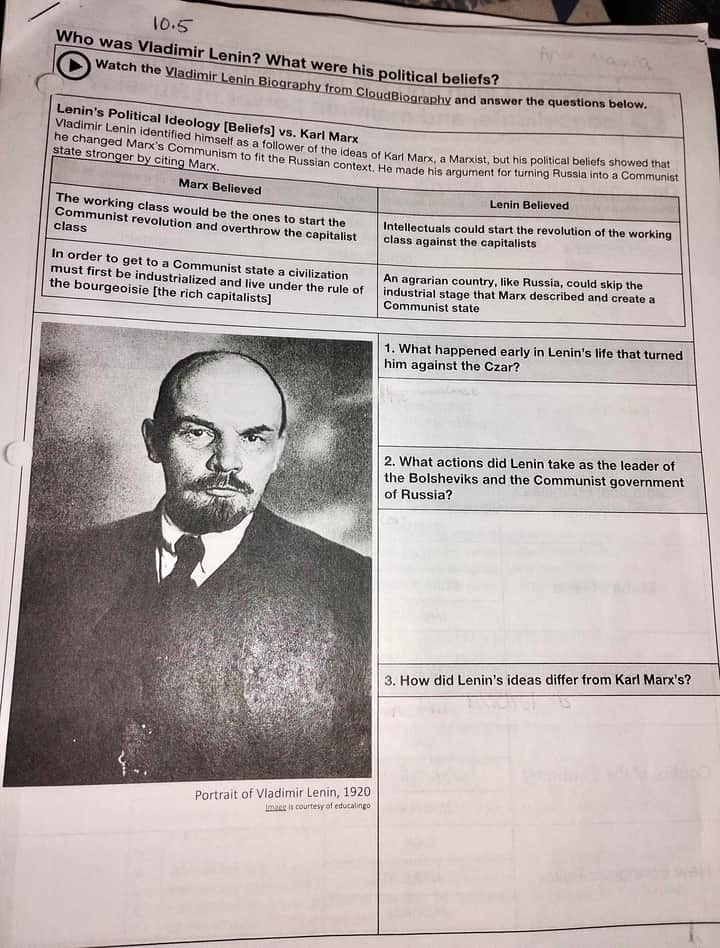
Can you do this assignment correctly for me please?
Who was Vladimir Lenin? What were his political beliefs?
Önemli Noktalar
- Vladimir Lenin, Rus devrimci lider ve Sovyetler Birliği’nin kurucusudur
- Lenin’in siyasi ideolojisi, Karl Marx’ın fikirlerine dayansa da, Rusya’nın özel koşullarına göre uyarlanmıştır
- Lenin, işçi sınıfından ziyade entelektüellerin devrimi başlatabileceğini savunmuştur
- Marx’ın sanayi öncesi aşamaya vurgu yapması yerine, Lenin tarım toplumu olan Rusya’nın doğrudan komünist devrime geçebileceğini söylemiştir
1. What happened early in Lenin’s life that turned him against the Czar?
Lenin’s brother, Aleksandr Ulyanov, was executed in 1887 for plotting to assassinate Czar Alexander III. This olay deeply influenced Lenin and made him strongly oppose the autocratic czarist regime.
2. What actions did Lenin take as the leader of the Bolsheviks and the Communist government of Russia?
- Led the October Revolution in 1917, overthrowing the Provisional Government
- Established the first Communist state, the Russian Soviet Federative Socialist Republic
- Nationalized land, banks, and industry
- Signed the Treaty of Brest-Litovsk to exit World War I
- Implemented War Communism policies during the civil war to control resources
- Organized the Red Army to defeat anti-Bolshevik forces (Whites)
3. How did Lenin’s ideas differ from Karl Marx’s?
| Aspect | Karl Marx Believed | Lenin Believed |
|---|---|---|
| Who starts the revolution? | Working class would start the revolution and overthrow capitalists | Intellectuals could lead the revolution on behalf of the working class |
| Path to Communism | Society must industrialize first and live under bourgeois rule | An agrarian country like Russia could skip industrialization and go directly to Communism |
Lenin adapted Marx’s ideas to Russia’s largely rural, underdeveloped context, arguing for a vanguard party of dedicated revolutionaries to lead the revolution rather than waiting for a fully industrial proletariat.
Would you like me to provide a more detailed explanation of Lenin’s role in the Russian Revolution or a summary comparing other communist leaders?
Who was Vladimir Lenin? What were his political beliefs?
Key Takeaways
- Vladimir Lenin was the leader of the 1917 Bolshevik Revolution and the first head of the Soviet state.
- He adapted Marxism to Russia by advocating for a vanguard party and revolution in an agrarian society.
- As head of government, he implemented policies like War Communism, the Cheka, and the New Economic Policy.
- Table of Contents
1. Vladimir Lenin Biography
Vladimir Ilyich Ulyanov (1870–1924), known by his alias Lenin, was a Russian revolutionary, political theorist, and the architect of the October Revolution. He founded the Russian Communist Party (Bolsheviks) and served as head of government of Soviet Russia from 1917 to 1924. He aimed to establish a dictatorship of the proletariat by overthrowing the Tsarist autocracy and replacing it with a socialist state.
2. Early Life Turning Point
Early in his life, Lenin was radicalized by a personal tragedy. In 1887, his elder brother, Alexander Ulyanov, was executed for participating in a plot to assassinate Tsar Alexander III. This event convinced Lenin that only the violent overthrow of the autocracy could bring social justice to Russia.
3. Actions as Bolshevik Leader
- Organized the October Revolution in 1917, seizing key government institutions in Petrograd.
- Signed the Treaty of Brest-Litovsk (1918) to exit World War I, ceding territory to Germany.
- Implemented War Communism: nationalization of industry, forced grain requisitioning, and centralized distribution.
- Founded the Cheka (secret police) to suppress dissent and the Red Terror.
- Introduced the New Economic Policy (1921) to stabilize the economy by allowing limited private trade and small-scale manufacturing.
4. Lenin’s Ideas vs Marx’s Ideas
| Aspect | Karl Marx Believed | Vladimir Lenin Believed |
|---|---|---|
| Revolutionary Class | The working class (proletariat) would lead the revolution against the capitalist bourgeoisie. | A vanguard of professional revolutionaries (intellectuals and dedicated party members) must guide the masses. |
| Stage of Development | A country must be fully industrialized before a socialist revolution can succeed. | An agrarian nation like Russia could skip prolonged industrial capitalism via a tightly led revolution. |
| Party Structure & Strategy | Revolution emerges organically from workers’ struggle; no formal party leadership model specified. | Advocated democratic centralism: strict party discipline, centralized decision-making, and unified action. |
| State & Transition | After revolution, a temporary dictatorship of the proletariat would wither away eventually, leading to a classless, stateless society. | Emphasized a strong, centralized state to defend the revolution and suppress counter-revolution until socialism. |
Summary Table
| Question | Answer |
|---|---|
| What radicalized Lenin against the Czar early in his life? | Execution of his brother Alexander Ulyanov in 1887 for plotting regicide. |
| Major actions as Bolshevik leader | October Revolution, Treaty of Brest-Litovsk, War Communism, Cheka & Red Terror, New Economic Policy. |
| Key difference from Marx | Advocated a vanguard party and revolution in agrarian Russia, whereas Marx expected spontaneous proletarian uprisings in industrial states. |
FAQ
-
What was the dictatorship of the proletariat?
- A transitional state in which the working class holds political power to suppress the former ruling classes and defend the revolution.
-
Why did Lenin introduce the New Economic Policy (NEP)?
- To restore the economy after civil war by permitting limited private enterprise and market mechanisms.
-
How did the Cheka function under Lenin?
- As the Bolsheviks’ secret police, it arrested, tried, and executed perceived enemies of the revolution without standard legal procedures.
-
What role did the April Theses play?
- Lenin’s April 1917 directives called for “All power to the Soviets,” rejection of cooperation with the Provisional Government, and immediate socialist reforms.
What aspect of Lenin’s leadership would you like to explore further—his economic policies, political theory, or the organization of the Bolshevik Party?