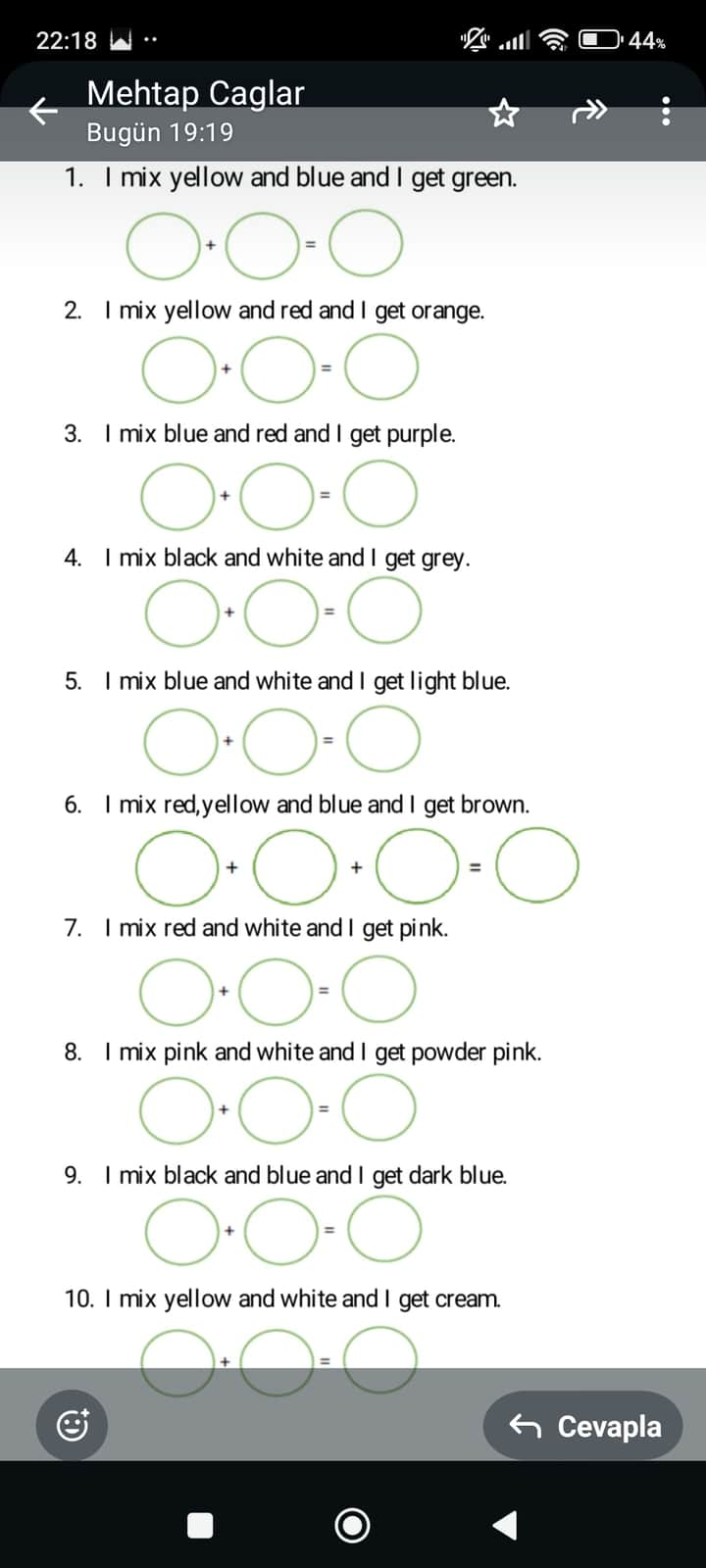
Color Mixing Answers for Resimli Soru 17-02-2026 23:16:56
Önemli Noktalar
- Primary colors: Yellow, Blue, Red
- Mixing two primary colors creates secondary colors: Green, Orange, Purple
- Adding White to a color lightens it, produces tints
- Mixing all primary colors typically produces Brown
- Mixing Black and White creates Grey shades
To fill the blanks:
- Yellow + Blue = Green
- Yellow + Red = Orange
- Blue + Red = Purple
- Black + White = Grey
- Blue + White = Light Blue
- Red + Yellow + Blue = Brown
- Red + White = Pink
- Pink + White = Powder Pink
- Black + Blue = Dark Blue
- Yellow + White = Cream
İçindekiler
- Primary and Secondary Colors
- Tinting and Shading
- Mixing Three Colors
- Summary Table
- Sık Sorulan Sorular
Primary and Secondary Colors
Primary colors (Yellow, Blue, Red) are the base colors that cannot be made by mixing other colors. Mixing two primary colors in equal proportions yields secondary colors:
- Yellow + Blue = Green
- Yellow + Red = Orange
- Blue + Red = Purple
Pro Tip: Remember the color wheel to visualize how colors blend to form new hues.
Tinting and Shading
Adding White to any color produces a lighter version called a tint:
- Blue + White = Light Blue
- Red + White = Pink
- Pink + White = Powder Pink
- Yellow + White = Cream
Adding Black darkens a color to produce a shade:
- Black + White = Grey (neutral grey)
- Black + Blue = Dark Blue
Warning: Too much white or black can wash out or muddy the color, respectively.
Mixing Three Colors
When the three primary colors (Red, Yellow, Blue) are mixed, the resulting color is Brown due to the combination of all wavelengths, producing a muted look.
Özet Tablo
| Soru No | Mix | Result |
|---|---|---|
| 1 | Yellow + Blue | Green |
| 2 | Yellow + Red | Orange |
| 3 | Blue + Red | Purple |
| 4 | Black + White | Grey |
| 5 | Blue + White | Light Blue |
| 6 | Red + Yellow + Blue | Brown |
| 7 | Red + White | Pink |
| 8 | Pink + White | Powder Pink |
| 9 | Black + Blue | Dark Blue |
| 10 | Yellow + White | Cream |
Sık Sorulan Sorular
1. Why do mixing primary colors create secondary colors?
Primary colors combine their wavelengths of light, resulting in new colors perceived as secondary colors. This is fundamental in subtractive color mixing such as paints.
2. What is the difference between tint and shade?
A tint is a color made lighter by adding white; a shade is a color made darker by adding black. Both modify the original hue’s lightness and darkness.
3. Why does mixing all primary colors result in brown, not black or white?
Combining all three primary pigments absorbs most wavelengths, which results in a muddy brown color due to imperfect pigment mixing. True black may need additional pigment or specific combinations.
Sonraki Adımlar
Would you like me to explain the color wheel theory or how additive (light) vs subtractive (paint) color mixing differ in detail?
- Yellow + Blue = Green
- Yellow + Red = Orange
- Blue + Red = Purple
- Black + White = Grey
- Blue + White = Light Blue
- Red + Yellow + Blue = Brown
- Red + White = Pink
- Pink + White = Powder Pink
- Black + Blue = Dark Blue
- Yellow + White = Cream
Bu renk karışımlarını kullanarak örnek cümleler oluşturmak ister misiniz?
@Ilhan_Ates