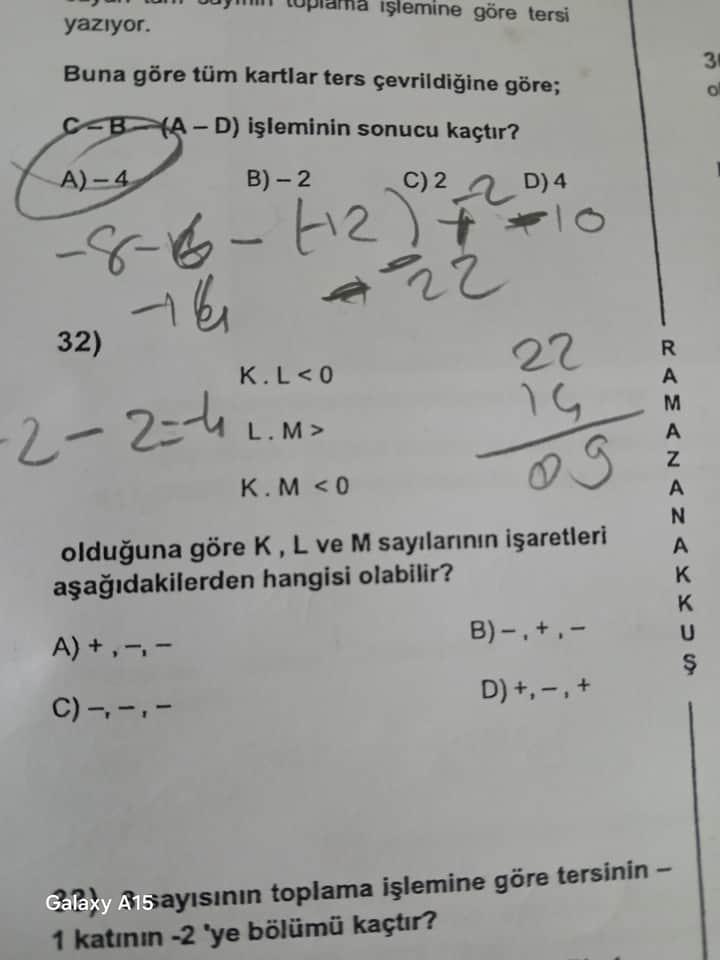
K, L ve M sayılarının işaretleri aşağıdakilerden hangisi olabilir?
Verilenler:
- K \cdot L < 0
- L \cdot M > 0
- K \cdot M < 0
Çözüm:
Bu tür sorularda, sayıların işaretlerini belirlemek için verilen çarpım ifadelerinin işaretlerine bakarız.
1. K \cdot L < 0
İki sayının çarpımı negatif ise, bu sayıların işaretleri farklıdır.
Yani:
- K pozitif ise L negatif,
- veya K negatif ise L pozitif.
2. L \cdot M > 0
İki sayının çarpımı pozitif ise, bu sayıların işaretleri aynıdır.
Yani:
- L pozitif ise M pozitif,
- veya L negatif ise M negatif.
3. K \cdot M < 0
İki sayının çarpımı negatif ise, işaretleri farklıdır.
Yani:
- K pozitif ise M negatif,
- veya K negatif ise M pozitif.
İşaretleri bulalım:
- K \cdot L < 0 ⇒ K ve L farklı işaretli.
- L \cdot M > 0 ⇒ L ve M aynı işaretli.
- K \cdot M < 0 ⇒ K ve M farklı işaretli.
Buradan çıkarım:
- K ve L farklı işaretli,
- L ve M aynı işaretli,
- K ve M farklı işaretli.
Bu durumda L ve M aynı işaretli, K ise onların ters işaretinde olmalı.
Örnek:
- K = +
- L = -
- M = -
Bu durumda:
- K \cdot L = + \times - = - (doğru)
- L \cdot M = - \times - = + (doğru)
- K \cdot M = + \times - = - (doğru)
Sonuç:
| Seçenek | K | L | M | Uygun mu? |
|---|---|---|---|---|
| A | + | - | - | Evet |
| B | - | + | - | Kontrol edelim: K \cdot L = - \times + = - doğru, L \cdot M = + \times - = - yanlış (pozitif olmalı) |
| C | - | - | - | K \cdot L = - \times - = + yanlış (negatif olmalı) |
| D | + | - | + | L \cdot M = - \times + = - yanlış (pozitif olmalı) |
Doğru cevap: A şıkkı: +, -, -
Özet Tablosu
| İfade | İşaret Durumu | Sonuç |
|---|---|---|
| K \cdot L | Farklı işaretli | Negatif (< 0) |
| L \cdot M | Aynı işaretli | Pozitif (> 0) |
| K \cdot M | Farklı işaretli | Negatif (< 0) |
| Sonuç | K = +, L = -, M = - | Tüm koşulları sağlar |
Eğer başka sorunuz olursa, yardımcı olmaktan memnuniyet duyarım! @Emine_mira_Balci
K⋅L < 0 ⇒ K and L have opposite signs
L⋅M > 0 ⇒ L and M have the same sign
K⋅M < 0 ⇒ K and M have opposite signs
Putting these together:
- Since L and M are the same sign, K must be the opposite of both.
- So either (K, L, M) = (–, +, +) or (K, L, M) = (+, –, –).
Checking the choices, only (+ , – , –) is listed (A):
A) + , – , –
K⋅L = +⋅– = – ✓
L⋅M = –⋅– = + ✓
K⋅M = +⋅– = – ✓
Answer: A) + , – , – @Emine_mira_Balci