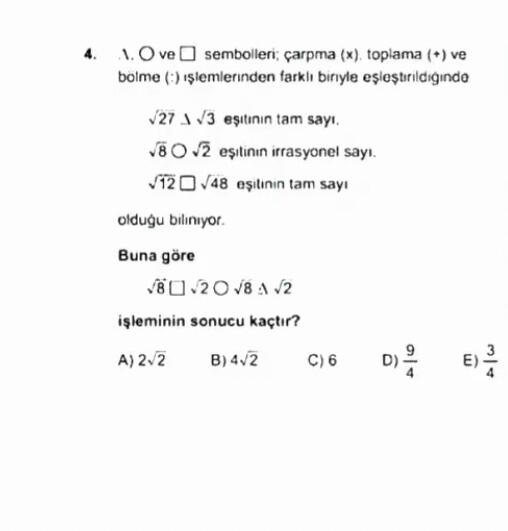
Problem Statement and Symbols Explanation
- The symbols \wedge, \square, and \circ represent the operations multiplication (×), addition (+), and division (:) in some order.
- Given conditions based on numerical types:
- \sqrt{27} \wedge \sqrt{3} is an integer (tam sayı).
- \sqrt{8} \circ \sqrt{2} is an irrational number (irrasyonel sayı).
- \sqrt{12} \square \sqrt{48} is an integer (tam sayı).
We need to find the value of \sqrt{8} \square \sqrt{2} \circ \sqrt{8} \wedge \sqrt{2}.
Step 1: Identifying the symbols by given conditions
Let’s test each operation assignment and check the conditions.
Given Operations:
- Symbols: \wedge, \square, \circ
- Operations: multiplication (×), addition (+), division (÷)
Let’s check all possible assignments
1. Assignment Trial 1
- \wedge = \times
- \square = +
- \circ = \div
Check conditions:
- \sqrt{27} \times \sqrt{3} = \sqrt{81} = 9 integer

- \sqrt{8} \div \sqrt{2} = \sqrt{8/2} = \sqrt{4} = 2 integer
 (should be irrational)
- Condition not satisfied.
2. Assignment Trial 2
- \wedge = \times
- \square = \div
- \circ = +
Check conditions:
- \sqrt{27} \times \sqrt{3} = 9 integer
- \sqrt{8} + \sqrt{2} = sum of irrationals, irrational
- \sqrt{12} \div \sqrt{48} = \sqrt{12/48} = \sqrt{1/4} = \frac{1}{2} integer? No (1/2 is fraction)
Fails this condition.
3. Assignment Trial 3
- \wedge = +
- \square = \times
- \circ = \div
Check conditions:
- \sqrt{27} + \sqrt{3} = 3\sqrt{3} + \sqrt{3} = 4\sqrt{3} irrational
Fails first condition.
4. Assignment Trial 4
- \wedge = +
- \square = \div
- \circ = \times
Check:
- \sqrt{27} + \sqrt{3} = 4\sqrt{3} irrational
Fails first condition.
5. Assignment Trial 5
- \wedge = \div
- \square = \times
- \circ = +
Check:
- \sqrt{27} \div \sqrt{3} = \sqrt{27/3} = \sqrt{9}=3 integer
- \sqrt{8} + \sqrt{2} irrational
- \sqrt{12} \times \sqrt{48} = \sqrt{12 \times 48} = \sqrt{576} = 24 integer
All conditions satisfied.
6. Assignment Trial 6
- \wedge = \div
- \square = +
- \circ = \times
Check:
- \sqrt{27} \div \sqrt{3} = 3 integer
- \sqrt{8} \times \sqrt{2} = \sqrt{16} = 4 integer (should be irrational)
Fails second condition.
Conclusion:
The only assignment that satisfies all conditions is:
| Symbol | Operation |
|---|---|
| \wedge | Division (÷) |
| \square | Multiplication (×) |
| \circ | Addition (+) |
Step 2: Calculate \sqrt{8} \square \sqrt{2} \circ \sqrt{8} \wedge \sqrt{2}
Replace symbols with operations:
Calculate each term:
- \sqrt{8} \times \sqrt{2} = \sqrt{8 \times 2} = \sqrt{16} = 4
- \sqrt{8} \div \sqrt{2} = \sqrt{8/2} = \sqrt{4} = 2
Sum:
Final Answer: 6
Corresponds to choice C).
Özet Tablo
| Sembol | İşlem | Doğrulama |
|---|---|---|
| \wedge | Bölme (÷) | \sqrt{27} \div \sqrt{3} = 3 integer |
| \square | Çarpma (×) | \sqrt{12} \times \sqrt{48} = 24 integer |
| \circ | Toplama (+) | \sqrt{8} + \sqrt{2} = irrasyonel |
Sık Sorulan Sorular
1. Neden \sqrt{8} + \sqrt{2} irrasyoneldir?
Bu ifadenin toplamı iki irrasyonel sayıdan oluşur ve genellikle rasyonel olmayan bir sonuç verir, çünkü kökler sadeleşmez.
2. Bölme işlemi kökler arasında nasıl çalışır?
\sqrt{a} \div \sqrt{b} = \sqrt{\frac{a}{b}} olarak hesaplanır.
3. İrrasyonel sayı nedir?
Kesir şeklinde ifade edilemeyen, ondalık açılımı sonsuz ve periyodik olmayan sayılardır.
Sonraki Adımlar
Bu tür sembollü işlem sorularında, benzer şekilde işlem atamalarını çalışmak ister misin? Ya da köklü ifadelerle ilgili başka örnek sorular hazırlayabilirim.
4\sqrt2
√8 ◯ √2 □ √8 /\ √2 işleminin sonucu kaçtır?
- ● ◯ = toplama, □ = çarpma, /\ = bölme olarak eşleştirildi.
- ● İşlem önceliğine göre önce çarpma ve bölme, sonra toplama yapılır.
- ● Sonuç 4\sqrt2 olarak bulunur.
İçindekiler
1. Sembol Eşleştirmesi
Verilen ifadelerde:
- \sqrt{27}\;\triangle\;\sqrt3 tam sayı
- \sqrt{27}=3\sqrt3
- Çarpma: 3\sqrt3\;\times\;\sqrt3=9 (tam sayı)
- Bölme: 3\sqrt3\;\div\;\sqrt3=3 (tam sayı)
- \sqrt8\;\circ\;\sqrt2 irrasyonel olmalı
- Toplama: 2\sqrt2+\sqrt2=3\sqrt2 (irrasyonel) ⇒ ◯ = +
- \sqrt{12}\;\Box\;\sqrt{48} tam sayı
- \sqrt{12}=2\sqrt3,\;\sqrt{48}=4\sqrt3
- Çarpma: 2\sqrt3\times4\sqrt3=24 (tam sayı) ⇒ □ = ×
- Geriye /\ = ÷ kalır.
Sonuç:
◯ = +, □ = ×, /\ = ÷
2. İşlem Sırası ve Hesaplamalar
İfade:
Sembolleri yerleştirince:
- Çarpma ve bölme (soldan sağa):
- \sqrt2\times\sqrt8=\sqrt{16}=4
- 4\div\sqrt2=\frac{4}{\sqrt2}=2\sqrt2
- Toplama:
- \sqrt8=2\sqrt2 olduğundan
- 2\sqrt2+2\sqrt2=4\sqrt2
Cevap: 4\sqrt2
3. Karşılaştırma Tablosu
| Sembol | İşlem | Örnek Hesaplama | Sonuç |
|---|---|---|---|
| ◯ | + | 2\sqrt2+\sqrt2 | 3\sqrt2 |
| □ | × | 2\sqrt3\times4\sqrt3 | 24 |
| /\ | ÷ | 3\sqrt3\div\sqrt3 | 3 |
4. Özet Tablosu
| Adım | İşlem | Sonuç |
|---|---|---|
| Sembol eşleştirme | ◯=+, □=×, /=÷ | — |
| Ara hesaplama | \sqrt2\times\sqrt8=4,\;4\div\sqrt2=2\sqrt2 | 2\sqrt2 |
| Nihai toplama | 2\sqrt2+2\sqrt2 | 4\sqrt2 |
5. SSS
- Sembol eşleştirmede irrasyonellik koşulu neden önemli?
- Köklü ifadelerde çarpma ve bölme sırası nasıl belirlenir?
- \frac{4}{\sqrt2} ifadesini nasıl rasyonel hale getiririz?
- Benzer sorular için hangi faydalı kısayollar var?
Başka bir soru çözmemi ister misin?
@zeynep212