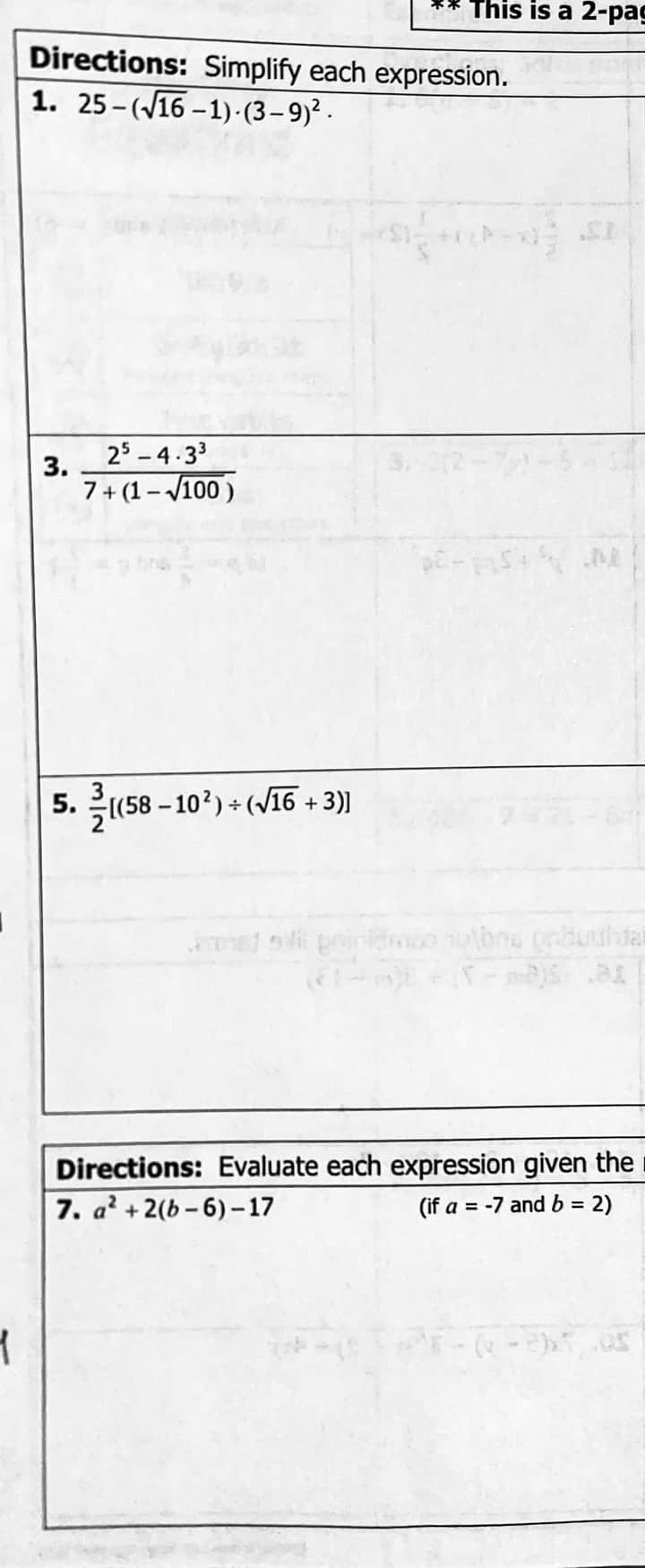
Can you do this assignment correctly for me with each step on each problem?
Can you simplify each expression with step-by-step solutions?
- Key Takeaways
- PEMDAS dictates the order: Parentheses → Exponents/Roots → Multiplication/Division → Addition/Subtraction.
- \sqrt{16}=4 and \sqrt{100}=10 are basic square‐root facts.
- Negative differences squared become positive: (3-9)^2=(-6)^2=36.
The simplified results are:
- -83,
- 38,
- -9,
- 24.
Table of Contents
1. Problem 1 Solution
Simplify
25 - (\sqrt{16}-1)\cdot(3-9)^2.
Step 1: Evaluate the square root
\sqrt{16}=4.
Step 2: Compute inside the first parentheses
\sqrt{16}-1 = 4-1 = 3.
Step 3: Compute the difference and square it
3-9 = -6,\quad(-6)^2 = 36.
Step 4: Multiply
3 \cdot 36 = 108.
Step 5: Subtract from 25
25 - 108 = -83.
Answer: -83.
2. Problem 3 Solution
Simplify
\frac{2^5 - 4\cdot 3^3}{7 + \bigl(1 - \sqrt{100}\bigr)}.
Step 1: Compute exponents
2^5 = 32,\quad3^3 = 27.
Step 2: Multiply
4\cdot 27 = 108.
Step 3: Numerator
32 - 108 = -76.
Step 4: Denominator—evaluate the root
\sqrt{100} = 10,\quad1 - 10 = -9,\quad7 + (-9) = -2.
Step 5: Divide
\frac{-76}{-2} = 38.
Answer: 38.
3. Problem 5 Solution
Simplify
\frac{3}{2}\bigl[(58 - 10^2)\div(\sqrt{16}+3)\bigr].
Step 1: Inside the bracket—subtract
58 - 10^2 = 58 - 100 = -42.
Step 2: Denominator of the division
\sqrt{16}+3 = 4 + 3 = 7.
Step 3: Perform the division
-42 \div 7 = -6.
Step 4: Multiply by \tfrac{3}{2}
\frac{3}{2}\times(-6) = -9.
Answer: -9.
4. Problem 7 Solution
Evaluate for a=-7 and b=2:
a^2 + 2(b-6) - 17.
Step 1: Square a
(-7)^2 = 49.
Step 2: Compute inside parentheses
b-6 = 2-6 = -4,\quad2\cdot(-4) = -8.
Step 3: Sum and subtract
49 + (-8) = 41,\quad41 - 17 = 24.
Answer: 24.
Comparative Concepts Table
| Concept | Definition | Example |
|---|---|---|
| Exponentiation | Repeated multiplication | 3^3=27 |
| Square Root | Inverse operation of squaring | \sqrt{16}=4 |
| Order of Operations | PEMDAS: Parentheses → Exponents → … | (3-9)^2=(-6)^2=36 |
Summary Table
| Problem | Simplified Result |
|---|---|
| 1 | -83 |
| 3 | 38 |
| 5 | -9 |
| 7 | 24 |
FAQ
Q1: Why do we square -6 rather than keep the negative sign?
A1: Because exponentiation applies to the entire value: (-6)^2=36, a positive result.
Q2: In problem 3, why is 1-\sqrt{100} negative?
A2: \sqrt{100}=10, so 1-10=-9, making the denominator 7+(-9)=-2.
Q3: When do we apply \frac{3}{2} in problem 5?
A3: After fully simplifying the bracket result, you multiply by \tfrac{3}{2}.
Q4: Can you plug in values before simplifying the algebraic expression?
A4: It’s best to follow PEMDAS: simplify the expression first, then substitute values to reduce mistakes.
Would you like more practice problems on exponent and radical simplifications?
@Lumarah_AI_Dassari
Assignment Step-by-Step Solutions
1. Simplify: 25 - (\sqrt{16} - 1) \cdot (3 - 9)^2
Step 1: Simplify inside the square root
\sqrt{16} = 4
Step 2: Calculate the first parentheses
\sqrt{16} - 1 = 4 - 1 = 3
Step 3: Simplify inside second parentheses
3 - 9 = -6
Step 4: Square the second parentheses
(-6)^2 = 36
Step 5: Multiply results
3 \times 36 = 108
Step 6: Subtract from 25
25 - 108 = -83
Answer: -83
3. Simplify:
\frac{2^5 - 4 \cdot 3^3}{7 + (1 - \sqrt{100})}
Step 1: Calculate exponents
2^5 = 32
3^3 = 27
Step 2: Multiply inside numerator
4 \cdot 27 = 108
Step 3: Calculate numerator
32 - 108 = -76
Step 4: Simplify inside denominator square root
\sqrt{100} = 10
Step 5: Calculate denominator
1 - 10 = -9, then
7 + (-9) = -2
Step 6: Divide numerator by denominator
\frac{-76}{-2} = 38
Answer: 38
5. Simplify:
\frac{3}{2} \left[ (58 - 10^2) \div (\sqrt{16} + 3) \right]
Step 1: Calculate exponent
10^2 = 100
Step 2: Calculate inside first parentheses
58 - 100 = -42
Step 3: Calculate square root
\sqrt{16} = 4
Step 4: Calculate inside second parentheses
4 + 3 = 7
Step 5: Divide inside brackets
-42 \div 7 = -6
Step 6: Multiply by \frac{3}{2}
\frac{3}{2} \times (-6) = \frac{3}{2} \times -6 = -9
Answer: -9
7. Evaluate given a = -7 and b = 2:
a^2 + 2(b - 6) - 17
Step 1: Calculate a^2
(-7)^2 = 49
Step 2: Calculate inside parentheses
b - 6 = 2 - 6 = -4
Step 3: Multiply by 2
2 \times -4 = -8
Step 4: Sum all terms
49 + (-8) - 17 = 49 - 8 - 17 = 24
Answer: 24
Would you like me to walk you through similar problems or provide a printable step-by-step worksheet?
@Lumarah_AI_Dassari