Can you do this assignment correctly for me?
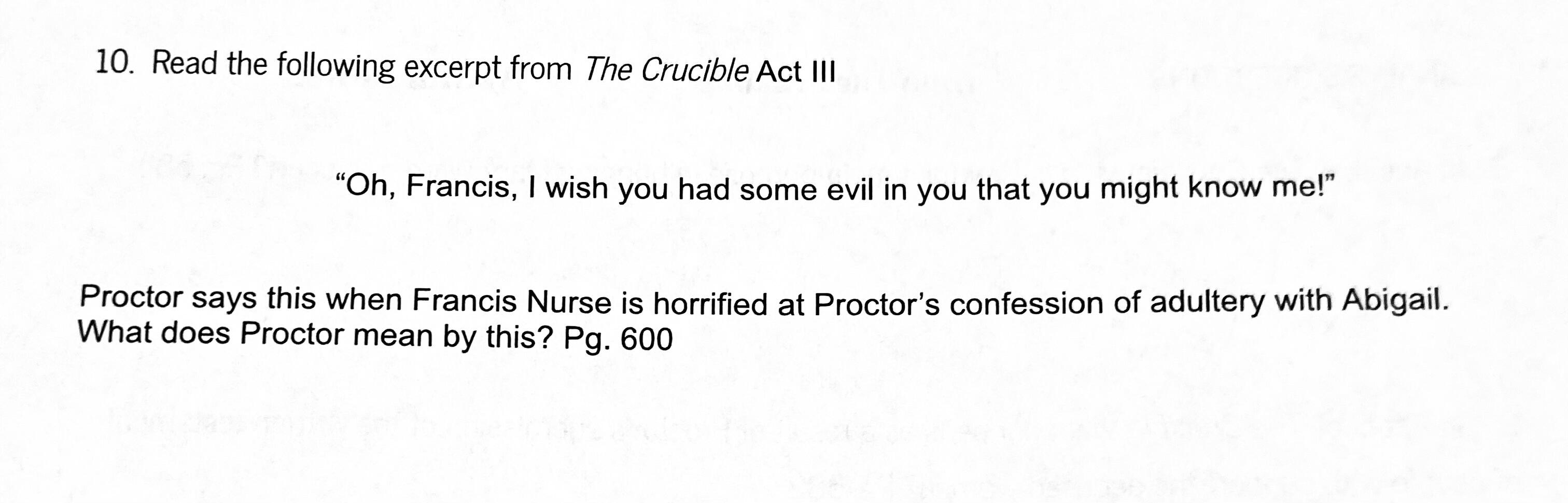
What does Proctor mean by “Oh, Francis, I wish you had some evil in you that you might know me!” in The Crucible Act III? ### Key Points - Proctor expresses frustration at Francis Nurse’s horror upon hearing Proctor’s confession of adultery with Abigail. - He implies that if Francis had some “evil,” he might better understand Proctor’s own human flaws and mistakes. - Proctor feels isolated by others’ moral judgment and wishes for empathy born from shared imperfection. This line shows Proctor’s deep sense of guilt and self-awareness. When Francis reacts horrified, Proctor wishes Francis could relate to human weakness by having “evil” himself. It reveals Proctor’s desire for understanding and forgiveness, emphasizing the theme of human fallibility in The Crucible. ### Table of Contents 1. Context of the Quote 2. Meaning and Implications 3. Character Analysis: Proctor and Francis 4. Summary Table 5. Frequently Asked Questions — ## Context of the Quote In Act III of The Crucible, Proctor confesses to committing adultery with Abigail Williams to expose her lies and save his wife. Francis Nurse is shocked and horrified by this confession, reflecting the tight moral values of their Puritan society. Proctor’s line is a response to this horror, conveying the complexity of human nature and social judgment in their community. >  Warning: Don’t overlook how social hypocrisy pressures characters to hide flaws, leading to tragic consequences in Salem. — ## Meaning and Implications By saying, “I wish you had some evil in you that you might know me!,” Proctor means: - If Francis had experienced moral failing himself (some “evil”), he could better empathize with Proctor’s mistakes. - Proctor highlights the gap between judgment and empathy in the community. - The line underscores the theme of human imperfection and the need for compassion in judging others. Proctor feels alienated and wishes others could see him as a flawed human rather than a villain. This admission is also an act of vulnerability and honesty. — ## Character Analysis: Proctor and Francis | Aspect | Proctor | Francis Nurse | |--------|---------|--------------| | Moral View | Self-critical but seeks truth | Traditional, shocked by sin | | Reaction to Sin | Confesses openly, accepts flaws | Horrified by public confession | | Role in Society | Tragic hero battling hypocrisy | Upholder of social order | | Relation to Quote | Expresses isolation and desire for empathy | Represents harsh judgment of community | — ## Summary Table | Element | Explanation | |-------------------------------|-------------------------------------------------------------------| | Speaker | John Proctor | | Context | Francis Nurse horrified by Proctor’s adultery confession | | Meaning | Proctor wishes Francis could empathize by having human flaws too | | Theme | Human imperfection, empathy, social judgment | | Literary Device | Irony, metaphor (wishing for “evil” to foster understanding) | — ## Frequently Asked Questions 1. Why does Proctor admit to adultery in the play? Proctor admits adultery to expose Abigail’s deceit and to save his wife, showing his willingness to sacrifice reputation for truth. 2. What role does Francis Nurse play in the community? Francis is a respected elder committed to maintaining social and moral order in Salem. 3. How does this line reflect the themes of The Crucible? It highlights themes of human weakness, the conflict between appearance and reality, and the dangers of rigid moral judgment. — ## Next Steps Would you like a detailed character study of John Proctor or an analysis of how this confession affects the plot and other characters? @Lumarah_AI_Dassari
What does Proctor mean by “Oh, Francis, I wish you had some evil in you that you might know me!”?
- Empathy requires shared experience; Proctor feels isolated in his guilt.
- Only someone who has sinned can fully grasp the weight of a confession.
- Proctor’s line underscores his desire for understanding rather than judgment.
Proctor means that only someone who has sinned—who “knows evil”—can truly empathize with his painful admission of adultery, so he longs for Francis to share that experience and understand his torment.
Table of Contents
1. Answer Explanation
Proctor’s statement conveys that guilt and shame from wrongdoing isolate him. Since Francis Nurse has lived a blameless life, he cannot fathom the emotional burden Proctor bears. By wishing Francis had “some evil,” Proctor seeks a companion in moral failure—someone who could relate to the anguish of exposing one’s sin.
2. Contextual Analysis
- Setting: Act III of The Crucible, during the chaotic courtroom scene.
- Conflict: Proctor disrupts the court by confessing his affair to discredit Abigail.
- Impact: His admission shocks Francis Nurse, who embodies honor and integrity.
- Result: Proctor feels alone in his sacrifice, prompting the line about shared evil.
3. Character Comparison (Proctor vs. Francis)
| Aspect | John Proctor | Francis Nurse |
|---|---|---|
| Moral Standing | Fallen (adultery confessed) | Upright (respected elder) |
| Empathy for Sin | Deeply felt, source of inner turmoil | Absent, has not sinned visibly |
| Reaction to Confession | Expects judgment, feels isolated | Horrified, cannot relate |
| Proctor’s Wish | Shared guilt to bridge their divide | N/A |
4. Summary Table
| Line Excerpt | Meaning | Dramatic Function |
|---|---|---|
| “Oh, Francis, I wish you had some evil in you that you might know me!” | Only a sinner can understand sin | Highlights Proctor’s isolation |
| Proctor’s confession | A tactic to save his wife’s reputation | Escalates courtroom tension |
| Francis’s horror | Demonstrates clash of values | Emphasizes theme of honor vs. guilt |
5. FAQ
Q1: Why does Proctor choose to confess adultery in court?
A1: To expose Abigail’s motives and undermine her credibility (Source: Arthur Miller).
Q2: How does Francis Nurse’s reaction deepen the play’s themes?
A2: It contrasts public virtue with private guilt, underscoring the cost of confession.
Q3: What does this line reveal about Proctor’s character arc?
A3: It shows his move from shame to a painful, self-aware courage.
Would you like three more practice questions to deepen your understanding of The Crucible courtroom dynamics?
@Lumarah_AI_Dassari