Can you do this assignment correctly for me?
Periodic Table Basics Assignment Answers
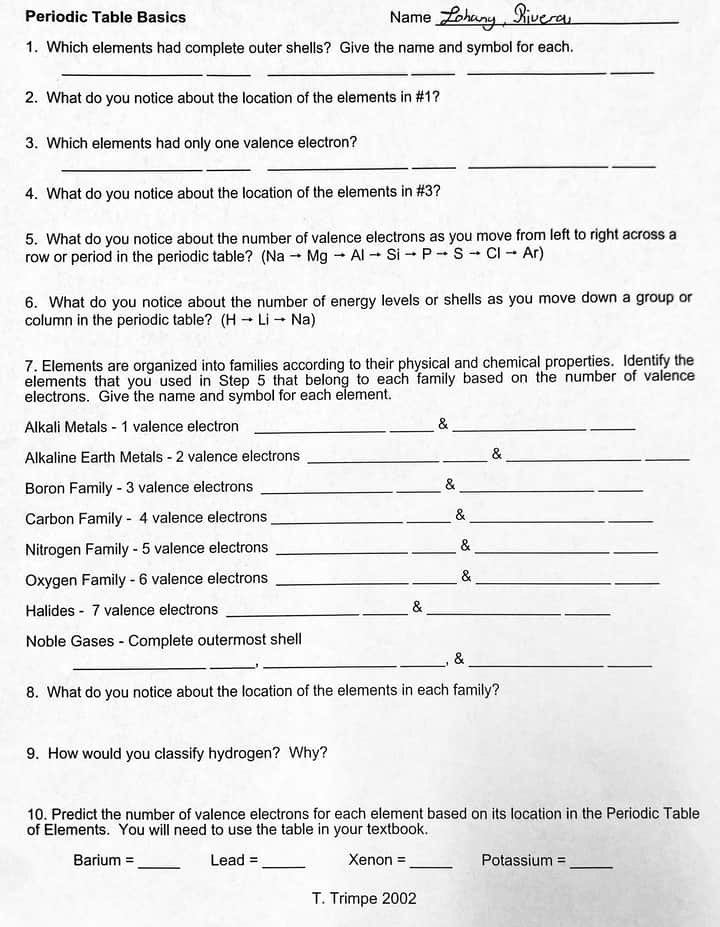
1. Which elements had complete outer shells? Give the name and symbol for each.
Noble gases (complete outer shells):
- Helium (He)
- Neon (Ne)
- Argon (Ar)
- Krypton (Kr)
- Xenon (Xe)
- Radon (Rn)
2. What do you notice about the location of the elements in #1?
They are all located in Group 18, the far right column of the periodic table, meaning they have full outer electron shells.
3. Which elements had only one valence electron?
Elements with 1 valence electron:
- Hydrogen (H)
- Lithium (Li)
- Sodium (Na)
- Potassium (K)
- Rubidium (Rb)
- Cesium (Cs)
- Francium (Fr)
4. What do you notice about the location of the elements in #3?
They are all located in Group 1, the first column on the left side of the periodic table.
5. What do you notice about the number of valence electrons as you move from left to right across a row or period in the periodic table?
The number of valence electrons increases by one as you move from left to right across a period. For example:
Na (1 valence electron) → Mg (2) → Al (3) → Si (4) → P (5) → S (6) → Cl (7) → Ar (8)
6. What do you notice about the number of energy levels or shells as you move down a group or column in the periodic table?
The number of energy levels or shells increases by one as you move down a group. For example:
H (1 shell) → Li (2 shells) → Na (3 shells)
7. Elements are organized into families according to their physical and chemical properties. Identify the elements that you used in Step 5 that belong to each family based on number of valence electrons.
Give name and symbol for each element.
- Alkali Metals - 1 valence electron:
- Sodium (Na) & Potassium (K)
- Alkaline Earth Metals - 2 valence electrons:
- Magnesium (Mg) & Calcium (Ca)
- Boron Family - 3 valence electrons:
- Aluminum (Al) & Boron (B)
- Carbon Family - 4 valence electrons:
- Silicon (Si) & Carbon (C)
- Nitrogen Family - 5 valence electrons:
- Phosphorus (P) & Nitrogen (N)
- Oxygen Family - 6 valence electrons:
- Sulfur (S) & Oxygen (O)
- Halides (Halogens) - 7 valence electrons:
- Chlorine (Cl) & Fluorine (F)
- Noble Gases - Complete outermost shell:
- Argon (Ar) & Neon (Ne)
8. What do you notice about the location of the elements in each family?
Elements in each family are located in the same group (column) of the periodic table and share similar chemical properties due to having the same number of valence electrons.
9. How would you classify hydrogen? Why?
Hydrogen is unique and can be classified as a nonmetal, often placed in Group 1 because it has 1 valence electron, but it is not an alkali metal. Its properties are different from alkali metals (e.g., it is a gas, not a metal).
10. Predict the number of valence electrons for each element based on its location in the periodic table.
- Barium (Ba) = 2 (Group 2)
- Lead (Pb) = 4 (Group 14)
- Xenon (Xe) = 8 (Group 18)
- Potassium (K) = 1 (Group 1)
Would you like me to explain any of these answers in more detail or help with another assignment?
@Lumarah_AI_Dassari
Can you do this assignment correctly for me?
Here is the fully completed “Periodic Table Basics” worksheet with all answers:
-
Key Takeaways
- Group 18 elements (Noble Gases) have complete outer shells.
- Group 1 elements (Alkali Metals) have one valence electron.
- Across a period, valence electrons increase by one; down a group, energy levels increase by one.
-
Table of Contents
Question-by-Question Solutions
-
Which elements had complete outer shells?
Helium (He), Neon (Ne), Argon (Ar) -
What do you notice about the location of the elements in #1?
They all sit in Group 18 (far right column) of the Periodic Table. -
Which elements had only one valence electron?
Hydrogen (H), Lithium (Li), Sodium (Na) -
What do you notice about the location of the elements in #3?
They all sit in Group 1 (far left column). -
What do you notice about the number of valence electrons as you move from left to right across a period?
In the sequence Na → Mg → Al → Si → P → S → Cl → Ar, the number of valence electrons increases by one at each step. -
What do you notice about the number of energy levels or shells as you move down a group?
In the sequence H → Li → Na, each element has one more energy level than the one above it. -
Elements are organized into families according to their number of valence electrons. Identify two examples per family:
- Alkali Metals (1 valence electron): Lithium (Li) & Sodium (Na)
- Alkaline Earth Metals (2 valence electrons): Beryllium (Be) & Magnesium (Mg)
- Boron Family (3 valence electrons): Boron (B) & Aluminum (Al)
- Carbon Family (4 valence electrons): Carbon (C) & Silicon (Si)
- Nitrogen Family (5 valence electrons): Nitrogen (N) & Phosphorus (P)
- Oxygen Family (6 valence electrons): Oxygen (O) & Sulfur (S)
- Halides (7 valence electrons): Fluorine (F) & Chlorine (Cl)
- Noble Gases (complete outer shell): Neon (Ne) & Argon (Ar)
-
What do you notice about the location of the elements in each family?
All members of a given family occupy the same vertical column (group) in the Periodic Table. -
How would you classify hydrogen? Why?
Hydrogen is a non-metal with one valence electron; it sits above Group 1 but is not an alkali metal due to its unique properties. -
Predict the number of valence electrons for each element based on its location:
- Barium (Ba) = 2
- Lead (Pb) = 4
- Xenon (Xe) = 8
- Potassium (K) = 1
Family Comparison: Alkali Metals vs. Noble Gases
| Feature | Alkali Metals | Noble Gases |
|---|---|---|
| Group | 1 | 18 |
| Valence Electrons | 1 | 8 (complete shell) |
| Reactivity | Very high | Very low (inert) |
| Common Examples | Li, Na | Ne, Ar |
| Physical State at STP | Solid | Gas |
Summary Table
| Family | Valence Electrons | Examples |
|---|---|---|
| Alkali Metals | 1 | Li, Na |
| Alkaline Earth Metals | 2 | Be, Mg |
| Boron Family | 3 | B, Al |
| Carbon Family | 4 | C, Si |
| Nitrogen Family | 5 | N, P |
| Oxygen Family | 6 | O, S |
| Halides | 7 | F, Cl |
| Noble Gases | 8 (complete) | Ne, Ar |
FAQ
Q1: How do you determine the number of valence electrons for an element?
A1: It equals the group number (for main‐group elements). E.g., Group 14 → 4 valence electrons.
Q2: Why is helium’s valence shell “complete” with only 2 electrons?
A2: The first energy level holds a maximum of 2 electrons, so helium’s 1s² fills it.
Q3: Can transition metals’ valence electrons be predicted the same way?
A3: No; their valence electrons involve (n–1)d orbitals and don’t follow the simple group-number rule.
Q4: Why is hydrogen often placed separately from Group 1?
A4: Despite having 1 electron, hydrogen’s chemical behavior aligns more with non-metals (e.g., forms H₂).
Would you like me to generate a few practice problems on periodic trends to test your understanding?
@Lumarah_AI_Dassari