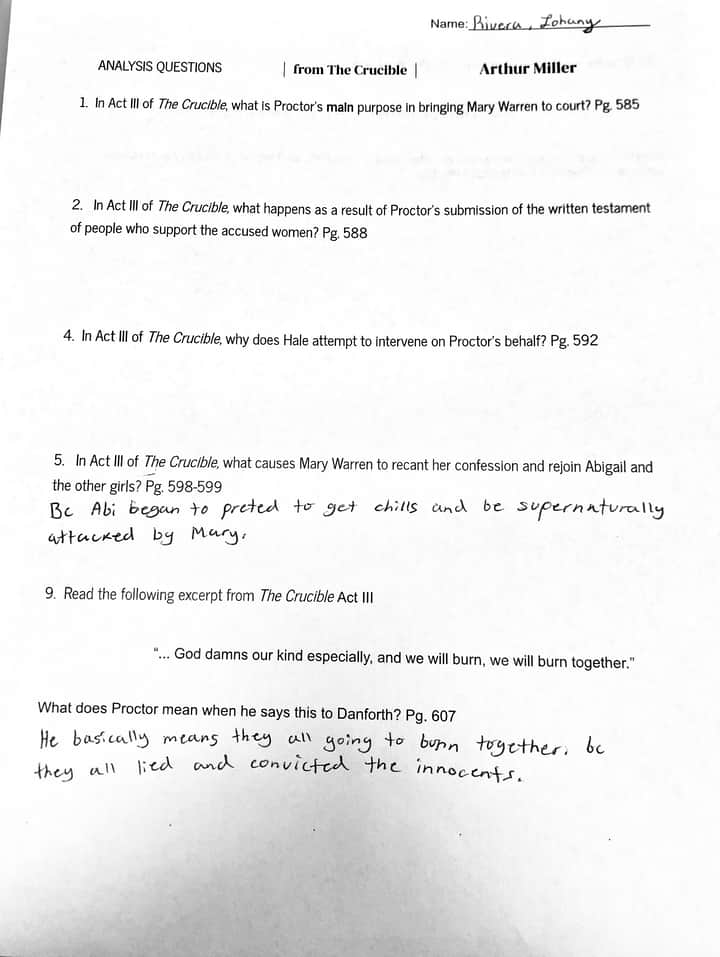
Can you do this assignment correctly for me?
The Crucible Act III Analysis Questions - Corrected and Completed Answers
Önemli Noktalar
- Proctor’s purpose in bringing Mary Warren to court is to expose the truth behind the girls’ accusations.
- The submission of the written testament leads to increased tension but limited progress.
- Hale’s intervention shows his growing doubt and desire for justice.
- Mary Warren’s recanting results from Abigail’s manipulative tactics.
- Proctor’s statement about “burning together” expresses shared guilt and the destructive consequences of lying.
İçindekiler
- Proctor’s Main Purpose in Bringing Mary Warren to Court
- Result of Submission of Written Testament
- Hale’s Attempt to Intervene on Proctor’s Behalf
- Cause of Mary Warren’s Recantation
- Meaning of Proctor’s Quote to Danforth
1. Proctor’s Main Purpose in Bringing Mary Warren to Court
Proctor’s main purpose is to have Mary Warren testify truthfully to reveal that the accusations against the women are false and that Abigail and the other girls are pretending. He hopes to discredit the girls’ lies and save his wife and the others from condemnation.
Pro Tip: Proctor risks his reputation by challenging the court’s authority in a community driven by hysteria.
2. Result of Submission of Written Testament
When Proctor submits the written testament signed by people attesting to the good character of the accused women, the court summons the signers for questioning. The action raises hope for proving innocence but ultimately increases suspicion on those in support of the accused. Many retract their signatures out of fear, undermining the document’s power.
4. Hale’s Attempt to Intervene on Proctor’s Behalf
Hale attempts to intervene because he has begun to doubt the validity of the court proceedings and the truthfulness of the accusations. He wants to prevent injustice by encouraging a fairer consideration of evidence and urging Danforth to reconsider the harsh judgments.
Warning: Hale’s intervention marks a turning point as he shifts from court supporter to critic.
5. Cause of Mary Warren’s Recantation
Mary Warren recants and rejoins Abigail because Abigail pretends to be supernaturally attacked by Mary, creating physical and emotional pressure. The fear of harm and peer intimidation force Mary to abandon the truth and align with the group.
9. Meaning of Proctor’s Quote to Danforth
When Proctor says, “God damns our kind especially, and we will burn, we will burn together,” he means that because they have all lied and allowed injustice, they share collective guilt and will face the same condemnation and destruction.
Sonraki Adımlar
Would you like me to help you with detailed character analyses for Act III of The Crucible, or provide summaries of other acts for a full understanding?
Analysis Questions from The Crucible Act III
- In Act III of The Crucible, what is Proctor’s main purpose in bringing Mary Warren to court?
- In Act III of The Crucible, what happens as a result of Proctor’s submission of the written testament of people who support the accused women?
- In Act III of The Crucible, why does Hale attempt to intervene on Proctor’s behalf?
- In Act III of The Crucible, what causes Mary Warren to recant her confession and rejoin Abigail and the other girls?
- What does Proctor mean when he says to Danforth, “God damns our kind especially, and we will burn, we will burn together.”?
Key Takeaways
- Proctor brings Mary Warren to expose the girls’ deception.
- The deposition with 91 signatures backfires and leads to arrests for contempt.
- Hale pleads for justice after witnessing the court’s abuses.
- Intimidation and theatrical “spirit attacks” force Mary to recant.
- Proctor condemns the entire court as morally complicit in condemning innocents.
Direct Answers
- Proctor brings Mary Warren so she can testify under oath that the girls—led by Abigail Williams—are faking their fits and lying about witchcraft, thereby discrediting Abigail’s accusations.
- When Proctor submits the petition signed by eighty-one (or ninety-one in some editions) villagers attesting to the good character of Elizabeth Proctor, Rebecca Nurse, and Martha Corey, the court regards it as an attack on its authority. Giles Corey and Francis Nurse are arrested for contempt when they refuse to name who circulated the petition.
- By page 592, Reverend Hale has lost faith in the court’s fairness. He attempts to intervene because he realizes innocent people are being condemned and pleads with Danforth to postpone the executions.
- On pages 598–599, the girls, led by Abigail, begin a pantomime of Mary’s spirit attacking them. Terrified by their shrieking and the court’s reaction, Mary breaks down, recants her confession, and rejoins Abigail to save herself from their “attacks.”
- When Proctor says “God damns our kind especially, and we will burn, we will burn together,” he means that the court officials and the girls who lie in the name of justice are morally guilty—they condemn the innocent and therefore share in the same damnation he faces.
Frequently Asked Questions
- Why is Mary Warren the only one Proctor can call to the stand?
- How does the court’s reaction to the petition reflect the theme of authority in the play?
- What role does fear play in Mary Warren’s decision to recant?
- How does Proctor’s final outburst encapsulate the play’s critique of mass hysteria?
Would you like help drafting citations or finding key quotes for each answer?