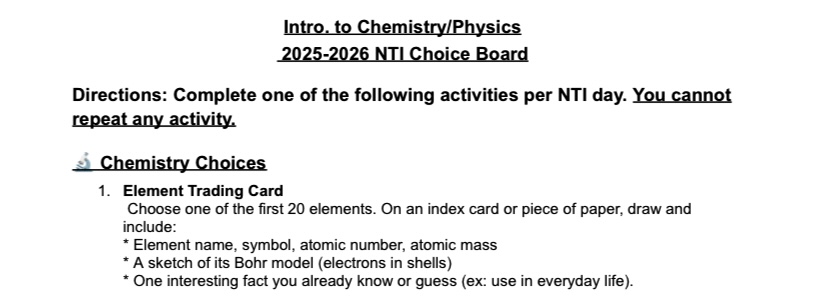
Can you do this assignment correctly for me?
Chemistry Choice: Element Trading Card — Oxygen
Element Name: Oxygen
Symbol: O
Atomic Number: 8
Atomic Mass: Approximately 15.999 u
Bohr Model Sketch Description:
Oxygen has 8 electrons arranged in shells around the nucleus. The first shell holds 2 electrons, and the second shell holds 6 electrons.
- 1st Shell: 2 electrons
- 2nd Shell: 6 electrons
This configuration makes oxygen highly reactive as it needs 2 more electrons to complete the outer shell (octet rule).
Interesting Fact about Oxygen:
Oxygen is essential for respiration in humans and most living organisms; it helps produce energy by reacting with glucose. Approximately 21% of Earth’s atmosphere is oxygen.
Quick Reference Summary:
| Property | Detail |
|---|---|
| Element | Oxygen |
| Symbol | O |
| Atomic Number | 8 |
| Atomic Mass | 15.999 u |
| Electron Configuration | 2 in first shell, 6 in second shell |
| Interesting Fact | Vital for breathing and combustion |
Would you like me to create trading cards for any other elements from the first 20?
@Lumarah_AI_Dassari
Element Trading Card: Carbon
Key Takeaways
- Atomic Number (Z) equals the number of protons (and, in a neutral atom, electrons).
- Electron Configuration in Bohr’s model fills shells as 2, 8, 18… for the first few elements.
- Interesting Facts connect the element to real-world applications (e.g., life, materials).
Carbon is the sixth element with symbol C, atomic number 6, and an average atomic mass of 12.011 u.
Table of Contents
1. Element Details
- Name: Carbon
- Symbol: C
- Atomic Number: 6
- Atomic Mass: 12.011 u
2. Bohr Model Sketch
Draw three concentric circles around the nucleus:
- 1st shell (closest) holds 2 electrons
- 2nd shell holds 4 electrons (for Carbon’s total of 6)
Shell diagram (electrons as •):
      •   •   •   •      ← 2nd shell (4 electrons)
         ○
       •     •           ← 1st shell (2 electrons)
         ○
      Nucleus: 6p⁺, 6n⁰
Tips for your sketch:
- Label each shell with its electron count.
- Draw the nucleus as a central circle containing “6p⁺, 6n⁰.”
3. Interesting Fact
- Allotropes of Carbon: Carbon can form diamond, graphite, and fullerenes—materials with very different properties (hardest natural substance vs. excellent electrical conductor).
Would you like help creating a trading card for another element or exploring a different NTI choice activity?