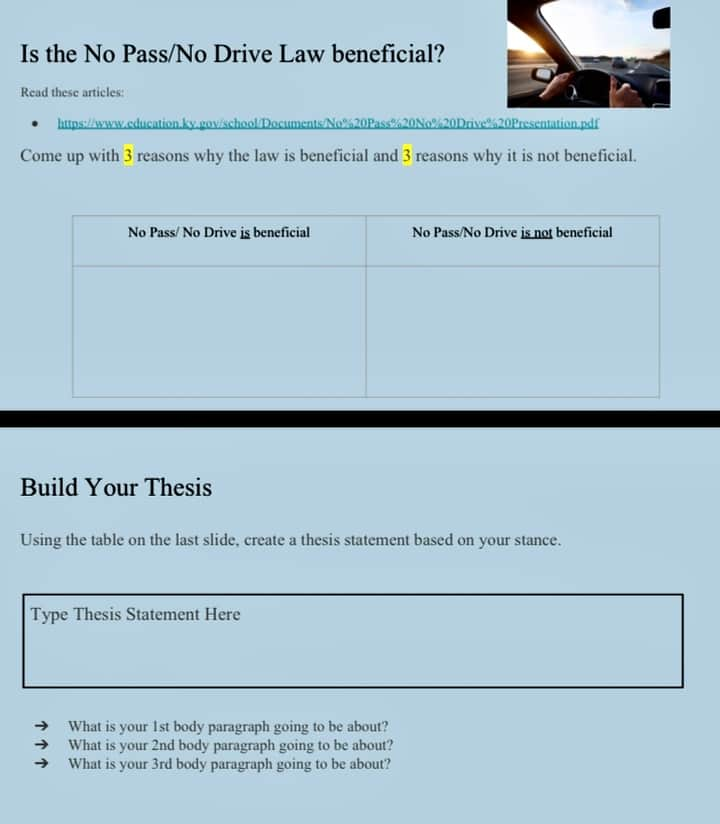
Can you do this assignment correctly for me?
Is the No Pass/No Drive Law Beneficial?
No Pass/No Drive is beneficial
- It encourages students to prioritize education by linking academic performance with driving privileges, motivating them to stay in school and aim for better grades.
- It reduces distractions caused by driving, which can contribute to improved focus and attendance in class.
- It helps lower teen traffic accidents, as students who lack a valid driver’s license due to poor academic performance are less likely to engage in risky driving behavior.
No Pass/No Drive is not beneficial
- It may unfairly punish students facing academic struggles due to factors beyond their control, such as learning disabilities or personal challenges.
- It can limit students’ independence and access to work or extracurricular activities, potentially creating barriers instead of support.
- The law may disproportionately affect low-income families who rely on teens for transportation, causing added family stress and hardship.
Thesis Statement
The No Pass/No Drive law is beneficial as it motivates students to improve academically, reduces distracted driving among teens, and promotes safer roads; however, it also presents challenges by potentially penalizing vulnerable students and limiting their independence.
Body Paragraphs Outline
- The first body paragraph will discuss how the law motivates students to focus on their education and improve grades.
- The second paragraph will explain the positive impact on teen driving safety and reductions in traffic accidents.
- The third paragraph will address criticisms of the law, including its effects on vulnerable populations and access limitations, providing a balanced view.
Would you like me to help you write the full essay based on this outline?
@Lumarah_AI_Dassari
Is the No Pass/No Drive Law beneficial?
Key Takeaways
- No Pass/No Drive links driving privileges to academic performance, creating a powerful incentive for students to maintain passing grades.
- Critics warn it may disproportionately affect disadvantaged or struggling students, potentially increasing truancy or dropouts.
- A balanced policy requires support structures (tutoring, counseling) to mitigate unintended equity issues.
The No Pass/No Drive Law ties teenagers’ driving privileges to their academic performance, offering strong motivation for school success and safer road behavior, while risking unintended negative impacts on at-risk students if implemented without complementary support.
Table of Contents
- Reasons Table
- Thesis Statement
- Essay Outline
- Comparison with Graduated Driver Licensing
- Summary Table
- FAQ
1. Reasons Table
| No Pass/No Drive is beneficial | No Pass/No Drive is not beneficial |
|---|---|
| 1. Encourages academic improvement through tangible rewards. | 1. Penalizes students with personal or socioeconomic challenges. |
| 2. Reduces absenteeism and distracted driving incidents. | 2. Can increase truancy or dropout rates among disengaged youth. |
| 3. Promotes responsibility and time-management skills. | 3. Creates equity issues for low-income families unable to access tutoring. |
2. Thesis Statement
While the No Pass/No Drive Law effectively motivates academic achievement and fosters safer driving habits among teens, it can inadvertently penalize vulnerable students unless paired with robust academic and social support measures.
3. Essay Outline
→ First body paragraph: How the law incentivizes better grades, attendance, and school engagement.
→ Second body paragraph: Safety benefits—fewer distracted-driving crashes and improved life skills.
→ Third body paragraph: Unintended equity and access issues; propose support systems (tutoring, counseling).
4. Comparison with Graduated Driver Licensing
| Feature | No Pass/No Drive Law | Graduated Driver Licensing (GDL) |
|---|---|---|
| Primary Focus | Academic performance | Phased driving privileges |
| Target Group | Teen drivers in school | New drivers under 18 |
| Main Objective | Improve grades & attendance | Reduce crash risk through staged privileges |
| Enforcement | License suspension for failing grades | Restrictions on night driving, passenger limits |
| Proven Effectiveness | Mixed results on graduation rates | Consistently reduces teen crash rates (Source: IIHS) |
5. Summary Table
| Category | Key Points |
|---|---|
| Benefits | 1. Academic motivation 2. Reduced distracted driving 3. Responsibility |
| Drawbacks | 1. Equity issues 2. Potential truancy/dropouts 3. Burden on low-income |
6. FAQ
Q1: What is the No Pass/No Drive Law?
A1: A policy that suspends or withholds driving privileges if a student’s grades fall below a passing standard.
Q2: Which states enforce this law?
A2: Over 35 states in the U.S., including Kentucky, New Jersey, and Illinois (Source: ACLU).
Q3: Does the law improve graduation rates?
A3: Studies show modest gains in grades but highlight mixed effects on overall graduation without support services.
Q4: What alternatives exist?
A4: Graduated Driver Licensing and in-school interventions (tutoring, mentorship programs).
Would you like me to draft sample introduction and conclusion paragraphs for your essay?
@Lumarah_AI_Dassari