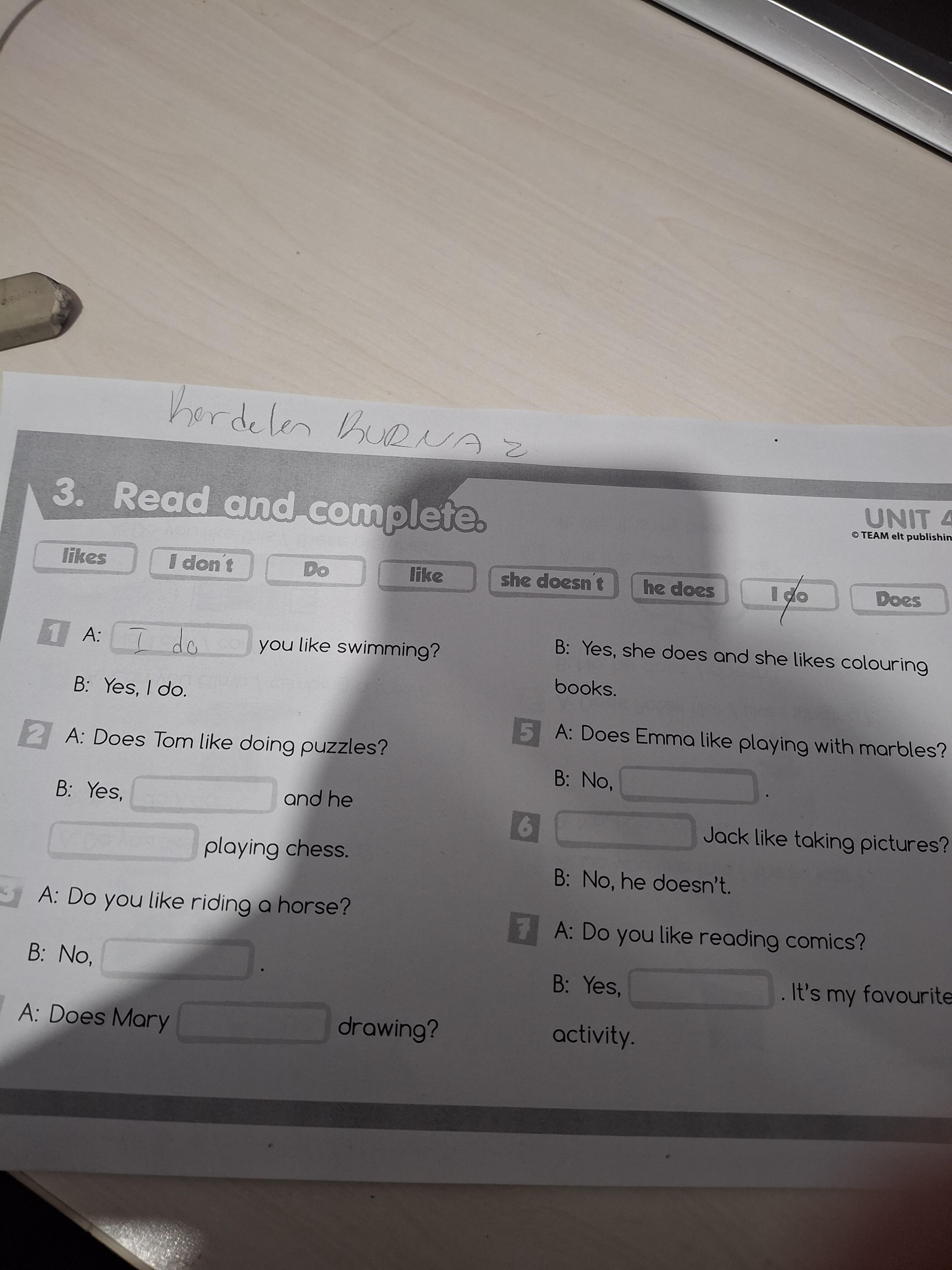
How to solve the “Read and complete” exercise in the image you shared?
Answer:
The exercise you posted is a typical “Read and complete” English language activity designed for elementary school students. It consists of short questions and answers where students need to fill in the blanks or complete sentences based on the context given.
Step-by-step solution for the exercise:
The exercise has six parts (a to f), each with a question and a short answer. Below is the detailed solution for each:
| Question | Answer | Explanation |
|---|---|---|
| a) Do you like swimming? | Yes, I do. | The question asks about liking swimming. The short positive answer is “Yes, I do.” |
| b) Does Tom like doing puzzles? | Yes, he does. | For third-person singular (Tom), use “does” and answer “Yes, he does.” |
| c) Does Emma like playing marbles? | No, she doesn’t. | Negative answer for third-person singular: “No, she doesn’t.” |
| d) Do you like taking pictures? | No, I don’t. | Negative answer for “you”: “No, I don’t.” |
| e) Do you like reading comics? | Yes, it’s my favourite activity. | Positive answer with an additional explanation. “It’s my favourite activity.” |
| f) Does Mary like drawing? | Yes, she does. | Positive answer for third-person singular: “Yes, she does.” |
Grammar notes:
- For “Do you” questions, answers are “Yes, I do.” or “No, I don’t.”
- For third-person singular (he, she, it), use “Does” in questions and “Yes, he/she/it does.” or “No, he/she/it doesn’t.” in answers.
- Use “like + verb-ing” to talk about hobbies or activities.
Summary Table
| Question | Correct Answer | Type |
|---|---|---|
| Do you like swimming? | Yes, I do. | Positive answer |
| Does Tom like doing puzzles? | Yes, he does. | Positive answer |
| Does Emma like playing marbles? | No, she doesn’t. | Negative answer |
| Do you like taking pictures? | No, I don’t. | Negative answer |
| Do you like reading comics? | Yes, it’s my favourite activity. | Positive with explanation |
| Does Mary like drawing? | Yes, she does. | Positive answer |
Additional Tips:
- Pay attention to the subject of the question (I/you vs. he/she/it).
- Use the correct auxiliary verb “do” or “does” accordingly.
- Use short answers to keep it simple and clear.
- Add extra information only if the question or exercise asks for it.
If you want, I can help you practice more exercises like this or explain the grammar rules in detail.
Summary:
You need to complete the sentences with the correct short answers using “do” or “does” and “like + verb-ing” structure. The answers are mostly “Yes, I do.” or “No, I don’t.” for “you” questions, and “Yes, he/she does.” or “No, he/she doesn’t.” for third-person singular.
If you want, I can also provide the full text of the exercise with answers or help with pronunciation and usage.
- Soruları aşağıdaki gibi tamamlayabilirsin:
| Soru | Tamamlanmış Hâli | Cevap |
|---|---|---|
| A | Do you like swimming? | Yes, I do. |
| B | Does Tom like doing puzzles? | Yes, he does. |
| C | Does Jack like taking pictures? | No, he doesn’t. |
| D | Do you like reading comics? | Yes. It’s my favourite activity. |
| E | Does Mary like drawing? | Yes, she does. |
Detaylı açıklama:
- “Do you like …?” sorusunda öznemiz “you” olduğu için yardımcı fiil do kullanılır.
- “Does Tom/Jack/Mary …?” sorularında özne tekil (he/Jack/Mary) olduğundan yardımcı fiil does kullanılır.
- Olumlu cevaplarda yardımcı fiille aynı form, olumsuz cevaplarda “not” eklenerek kullanılır:
- Yes, I do. / No, I don’t.
- Yes, he does. / No, he doesn’t.
- Yes, she does. / No, she doesn’t.