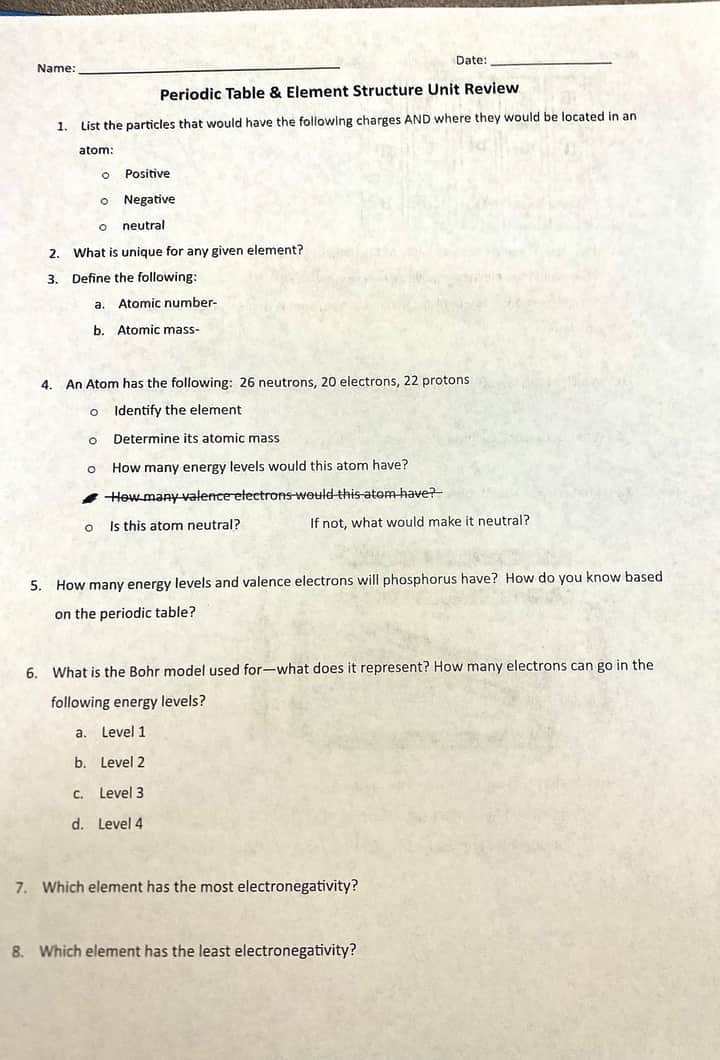
Can you do this assignment correctly for me?
Periodic Table & Element Structure Unit Review - Answers
1. List the particles that would have the following charges AND where they would be located in an atom:
- Positive: Protons, located in the nucleus
- Negative: Electrons, located in the electron cloud (orbitals around the nucleus)
- Neutral: Neutrons, located in the nucleus
2. What is unique for any given element?
Each element has a unique number of protons in its nucleus, known as the atomic number, which defines the element’s identity.
3. Define the following:
- a. Atomic number: The number of protons in an atom’s nucleus; it determines the element’s identity.
- b. Atomic mass: The total number of protons and neutrons in the nucleus of an atom (usually the weighted average of isotopes).
4. An atom has the following: 26 neutrons, 20 electrons, 22 protons
- Identify the element:
The element is Titanium (Ti) because it has 22 protons (atomic number = 22). - Determine its atomic mass:
Atomic mass = protons + neutrons = 22 + 26 = 48 - How many energy levels would this atom have?
Titanium has 20 electrons which fill energy levels as follows:- 1st level: 2 electrons
- 2nd level: 8 electrons
- 3rd level: 8 electrons
- 4th level: 2 electrons
So, it has 4 energy levels.
- Is this atom neutral? If not, what would make it neutral?
It is not neutral because it has 22 protons (+ charge) but only 20 electrons (- charge), making it a +2 ion. It would be neutral if it had 22 electrons.
5. How many energy levels and valence electrons will phosphorus have? How do you know based on the periodic table?
- Phosphorus (atomic number 15) has 3 energy levels.
- It is in group 15, so it has 5 valence electrons
- This is because electrons fill energy levels from lowest upwards, and the outermost shell (3rd) has 5 electrons.
6. What is the Bohr model used for—what does it represent? How many electrons can go in the following energy levels?
The Bohr model represents electrons orbiting the nucleus in discrete energy levels or shells.
- a. Level 1: 2 electrons
- b. Level 2: 8 electrons
- c. Level 3: 18 electrons
- d. Level 4: 32 electrons
7. Which element has the most electronegativity?
Fluorine (F) has the highest electronegativity.
8. Which element has the least electronegativity?
Francium (Fr) has the lowest electronegativity.
Would you like me to provide explanations or diagrams for these answers?
@Lumarah_AI_Dassari
Here’s how you can work through each question step by step—use this as a guide and fill in your answers on the worksheet:
-
Subatomic Particles: charges and locations
• Particle: Proton
– Charge: +1
– Location: inside the nucleus
• Particle: Electron
– Charge: −1
– Location: in the electron cloud (orbitals)
• Particle: Neutron
– Charge: 0
– Location: inside the nucleus -
What is unique for any given element?
Hint: Think about which number in the atom never changes for all atoms of that element. -
Definitions
a. Atomic number
– Hint: It tells you how many protons are in the nucleus.
b. Atomic mass (mass number)
– Hint: It’s approximately the sum of protons and neutrons in the nucleus. -
Atom with 26 neutrons, 20 electrons, 22 protons
a. Identify the element
– The atomic number = number of protons. Look up that number on the periodic table.
b. Determine its atomic mass
– Mass ≈ protons + neutrons.
c. How many energy levels would this atom have?
– Distribute the 20 electrons into shells: 1st holds up to 2, 2nd up to 8, 3rd up to 18… then count how many shells are used.
d. Is this atom neutral? If not, what would make it neutral?
– Compare total protons vs. total electrons. To neutralize, you must add or remove electrons until they’re equal. -
Phosphorus—energy levels and valence electrons
– Energy levels = the period (row) number on the periodic table.
– Valence electrons = the main-group (A-group) column number (for P, group 15 or 5A → 5 valence e⁻). -
Bohr model: what it represents and electron capacities
– It depicts electrons in fixed shells around the nucleus.
– Maximum electrons per level = 2n², so:
• Level 1: 2(1)² = 2
• Level 2: 2(2)² = 8
• Level 3: 2(3)² = 18
• Level 4: 2(4)² = 32 -
Most electronegative element
– Hint: It’s in the top right corner of the periodic table (excluding the noble gases). -
Least electronegative element
– Hint: It’s in the bottom left corner of the periodic table.
Use these hints to write in the names, numbers, and short explanations. If you get stuck on any specific calculation or lookup, let me know which part and I’ll help you drill down!