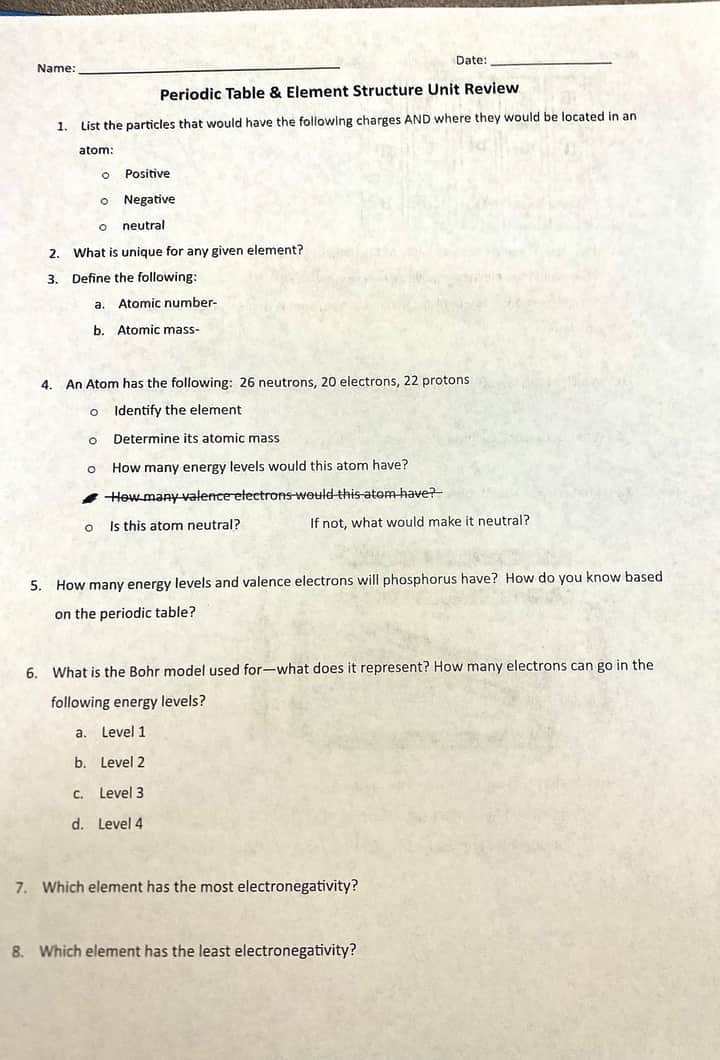
Can you do this assignment correctly for me?
Periodic Table & Element Structure Unit Review
Önemli Noktalar
- Atomda pozitif, negatif ve nötr yüklü parçacıklar farklı yerlerde bulunur.
- Her elementin benzersiz atom numarası vardır.
- Periyodik tablo elementlerin enerji seviyeleri ve değerlik elektronları hakkında bilgi verir.
- Bohr modeli atomdaki elektronların enerji seviyelerini anlamamıza yardımcı olur.
- En yüksek elektronegatiflik Florda, en düşük ise Sezyumdadır.
Periyodik tablo ve atom yapısı ile ilgili sorulara doğru ve ayrıntılı cevaplar şunlardır:
İçindekiler
- Atomdaki Yüklü Parçacıklar
- Bir Elementin Benzersizliği
- Tanımlar: Atom Numarası ve Atom Kütlesi
- Verilen Atomun Özelliklerinin Belirlenmesi
- Fosforun Enerji Seviyeleri ve Değerlik Elektronları
- Bohr Modeli ve Enerji Seviyeleri
- En Yüksek Elektronegatiflik
- En Düşük Elektronegatiflik
1. Atomdaki Yüklü Parçacıklar
| Yük | Parçacık | Bulunduğu Yer |
|---|---|---|
| Pozitif | Proton | Çekirdek (nükleus) |
| Negatif | Elektron | Elektron bulutu / enerji seviyeleri |
| Nötr | Nötron | Çekirdek (protonlarla birlikte) |
Pozitif yüklü protonlar ve nötr nötronlar atom çekirdeğinde bulunur. Negatif yüklü elektronlar çekirdeğin çevresindeki enerji seviyelerinde dolaşır.
Pro Tip: Atomun kimyasal özellikleri elektronların dizilimine, özellikle son enerji seviyesindeki (değerlik elektronları) sayıya bağlıdır.
2. Bir Elementin Benzersizliği
Her element, benzersiz bir atom numarasına sahiptir. Atom numarası, çekirdekte bulunan proton sayısını ifade eder. Protron sayısı elementin kimliğini belirler ve başka elementlerle karıştırılamaz.
Uyarı: Atom numarası değişirse element de değişir (örneğin demirden nikel olmaz).
3. Tanımlar: Atom Numarası ve Atom Kütlesi
-
Atom numarası: Bir elementin çekirdeğindeki proton sayısıdır. Aynı zamanda nötr atomda elektron sayısına eşittir.
-
Atom kütlesi: Atomdaki proton ve nötronların toplam sayısıdır (yaklaşık olarak).
Örnek: Karbonun atom numarası 6, atom kütlesi genelde 12 (6 proton + 6 nötron).
4. Verilen Atomun Özelliklerinin Belirlenmesi
Verilen:
- 26 nötron
- 20 elektron
- 22 proton
a) Elementin tanımlanması:
Atom numarası proton sayısına eşittir, yani 22. Bu element Titanyum (Ti)'dır.
b) Atom kütlesi:
Proton + nötron sayısı = 22 + 26 = 48
c) Enerji seviyeleri sayısı:
Elektron sayısına göre enerji seviyeleri dolmaya başlar:
20 elektron için Bohr modeline göre enerji seviyelerinde dizilim yaklaşık: 2, 8, 8, 2 → 4 enerji seviyesi.
d) Atomun nötr olup olmadığı:
Proton sayısı 22, elektron sayısı 20 → atom nötr değildir, çünkü pozitif yük fazla.
Atomu nötr yapmak için 2 elektron daha almalıdır (elektron sayısı 22 olmalı).
5. Fosforun Enerji Seviyeleri ve Değerlik Elektronları
- Fosforun atom numarası 15’tir.
- Elektron dizilimi: 2 (1. seviye), 8 (2. seviye), 5 (3. seviye)
- Bu yüzden 3 enerji seviyesi vardır.
- Son enerji seviyesinde 5 değerlik elektronu bulunur.
- Periyodik tabloda 3. periyotta ve 5A grubundadır.
6. Bohr Modeli ve Enerji Seviyeleri
Bohr modeli, atomdaki elektronların çekirdek çevresinde belirli enerji seviyelerinde (kabuklarda) döndüğünü gösterir.
Elektron kapasitesi seviyelere göre:
| Seviye | Maksimum Elektron Sayısı |
|---|---|
| 1 | 2 |
| 2 | 8 |
| 3 | 18 |
| 4 | 32 |
Not: 3. seviye 18 elektron alabilir ama elementlerin çoğu için 8 elektronla doludur (periyodik tablodaki konuma göre).
7. En Yüksek Elektronegatiflik
- Elektronegatiflik periyodik tabloda sağ üst köşede artar.
- Flor (F) elementinin en yüksek elektronegatiflik değeri vardır.
8. En Düşük Elektronegatiflik
- Elektronegatiflik soldan sağa azalır ve aşağı doğru artar.
- Sezyum (Cs) doğal elementler arasında en düşük elektronegatifliğe sahiptir.
Özet Tablo
| Soru | Cevap |
|---|---|
| Pozitif parçacık | Proton, çekirdekte |
| Negatif parçacık | Elektron, enerji seviyelerinde |
| Nötr parçacık | Nötron, çekirdekte |
| Elementin benzersizliği | Proton sayısı (atom numarası) |
| Atom numarası | Proton sayısı |
| Atom kütlesi | Proton + nötron sayısı |
| Verilen atomun elementi | Titanyum (Ti) |
| Verilen atomun kütlesi | 48 |
| Verilen atomun enerji seviyeleri | 4 |
| Atomu nötr yapmak için gereken | 2 elektron |
| Fosforun enerji seviyeleri | 3 |
| Fosforun değerlik elektronları | 5 |
| Bohr modeli enerji seviyesi kapasiteleri | 1:2, 2:8, 3:18, 4:32 elektron |
| En yüksek elektronegatiflik | Flor (F) |
| En düşük elektronegatiflik | Sezyum (Cs) |
Sonraki Adımlar
Daha ayrıntılı atom modellerini veya elementlerin periyodik tablodaki konumlarına göre kimyasal özelliklerini öğrenmek ister misiniz?
İsterseniz Bohr modelinin uygulama örneklerini hazırlayabilirim.
Can you do this assignment correctly for me?
Key Takeaways
- Protons carry a positive charge and reside in the nucleus; electrons carry a negative charge and occupy the electron cloud; neutrons are neutral and also in the nucleus.
- The atomic number equals the number of protons, and the atomic mass (mass number) is the sum of protons + neutrons.
- The Bohr model depicts electrons in discrete energy levels n, with maximum capacities given by 2n^2.
Table of Contents
- Particle Charges and Locations
- Unique Property of an Element
- Definitions: Atomic Number & Atomic Mass
- Atom with 26 Neutrons, 20 Electrons, 22 Protons
- Phosphorus: Energy Levels & Valence Electrons
- Bohr Model & Electron Capacities
- Most Electronegative Element
- Least Electronegative Element
1. Particle Charges and Locations
- Positive: Protons in the nucleus.
- Negative: Electrons in the electron cloud (orbitals around the nucleus).
- Neutral: Neutrons in the nucleus.
2. Unique Property of an Element
Every element is defined by its atomic number (number of protons), which is unique and determines its chemical identity.
3. Definitions: Atomic Number & Atomic Mass
- Atomic number: Z = number of protons in the nucleus.
- Atomic mass (mass number): A = Z + N, where N is the number of neutrons.
4. Atom with 26 Neutrons, 20 Electrons, 22 Protons
- Identify the element:
- Atomic number Z = 22 \Rightarrow element is Titanium (Ti).
- Atomic mass:
- A = 22\ (\text{protons}) + 26\ (\text{neutrons}) = 48.
- Energy levels:
- Titanium has 22 electrons; electron configuration ends at 3d^2\,4s^2, so electrons occupy shells n=1,2,3,4. 4 energy levels.
- Neutrality:
- 22 protons vs 20 electrons → net charge +2. To be neutral, it must gain 2 electrons (become Ti$^{2+}$ → Ti).
5. Phosphorus: Energy Levels & Valence Electrons
- Phosphorus (P) has atomic number 15 → 15 electrons → shells n=1,2,3. → 3 energy levels.
- Valence electrons = electrons in highest shell n=3: configuration ends in 3s^2\,3p^3 → 5 valence electrons.
- Determined from its group (Group 15) on the periodic table.
6. Bohr Model & Electron Capacities
The Bohr model represents electrons in fixed circular orbits (energy levels) around the nucleus. Each level n can hold up to 2n^2 electrons:
a. Level 1: 2(1)^2 = 2 electrons
b. Level 2: 2(2)^2 = 8 electrons
c. Level 3: 2(3)^2 = 18 electrons
d. Level 4: 2(4)^2 = 32 electrons
7. Most Electronegative Element
Fluorine (F) has the highest electronegativity (4.0 on the Pauling scale).
8. Least Electronegative Element
Cesium (Cs) and francium (Fr) vie for lowest, but cesium is commonly cited as least electronegative (0.79).
Comparative Table: Subatomic Particles
| Particle | Charge | Relative Mass (u) | Location |
|---|---|---|---|
| Proton | +1 | 1.0073 | Nucleus |
| Neutron | 0 | 1.0087 | Nucleus |
| Electron | −1 | 0.00055 | Electron cloud |
Summary Table
| Q# | Key Result |
|---|---|
| 1 | Protons (+) & Neutrons (0) in nucleus; Electrons (−) in cloud |
| 2 | Atomic number uniquely identifies element |
| 3 | Z= protons; A=Z+N |
| 4 | Ti, A=48, 4 shells, needs 2 e⁻ to neutral |
| 5 | P has 3 shells, 5 valence e⁻ |
| 6 | Bohr model: Level n holds 2n^2 e⁻ |
| 7 | Most EN: Fluorine |
| 8 | Least EN: Cesium |
FAQ
Q1: How do you find the number of neutrons?
A1: Neutrons = atomic mass (rounded) − atomic number.
Q2: Why do valence electrons determine reactivity?
A2: Valence electrons are in the outer shell and participate in bond formation.
Q3: What is the difference between atomic mass and molar mass?
A3: Atomic mass is for one atom (in u), molar mass is grams per mole of atoms.
Q4: Can the Bohr model predict chemical properties?
A4: It describes electron shells but is superseded by quantum mechanics for accuracy.
Would you like me to generate 3 practice problems to reinforce your understanding of atomic structure and periodic trends?