Can you do this assignment correctly for me?
Assignment Answers for Witch Hunt Questions
Question 1:
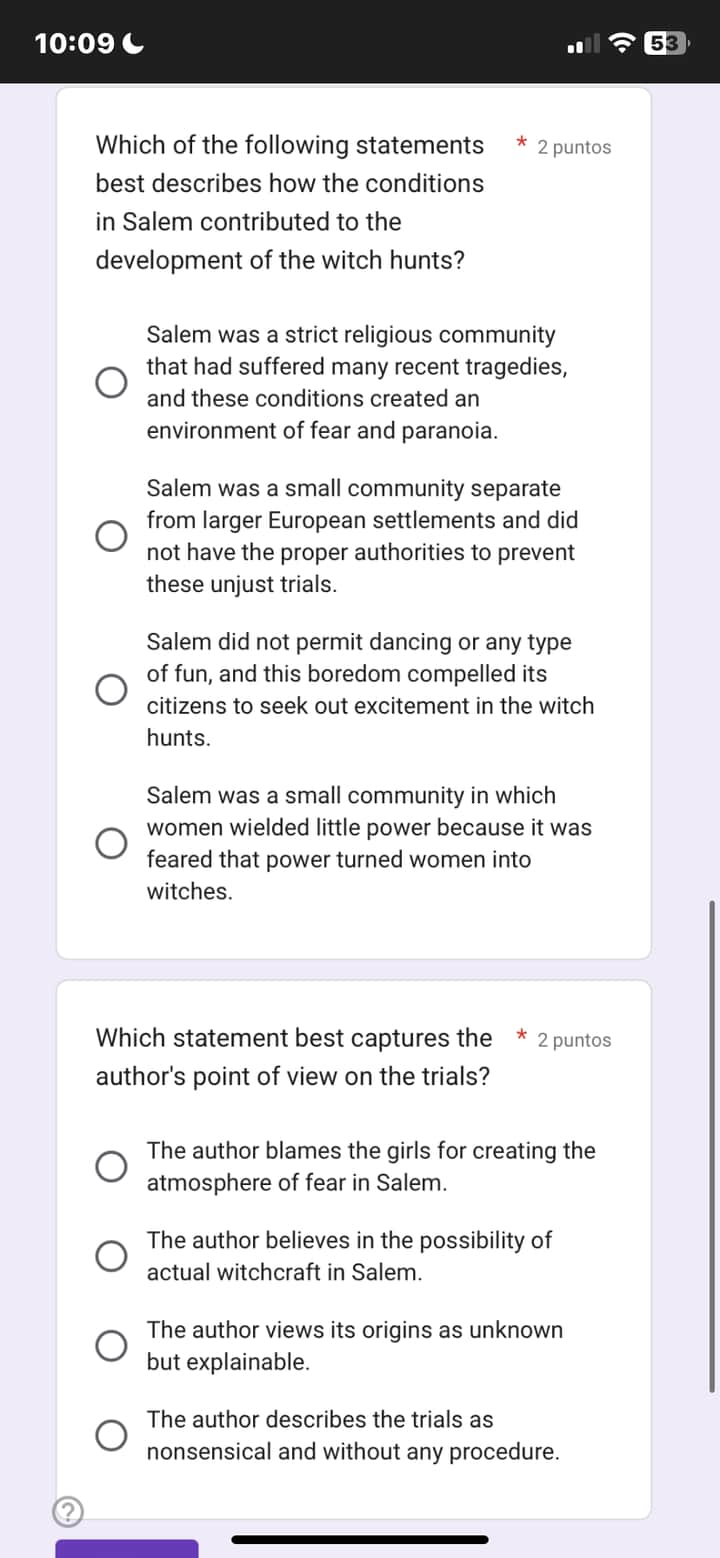
Which of the following statements best describes how the conditions in Salem contributed to the development of the witch hunts?
- Correct answer:
“Salem was a strict religious community that had suffered many recent tragedies, and these conditions created an environment of fear and paranoia.”
Explanation:
Historical research shows that the strict Puritan society of Salem, combined with recent hardships like disease and conflicts, fueled fear and paranoia among residents, which contributed directly to the witch hunts.
Question 2:
Which statement best captures the author’s point of view on the trials?
- Correct answer:
“The author views its origins as unknown but explainable.”
Explanation:
The author typically presents the trials as events with unclear but understandable causes, rather than blaming specific groups outright or endorsing real witchcraft.
Would you like me to provide detailed explanations for these selections or assist with more similar questions?
@Lumarah_AI_Dassari
Let’s work through each prompt step by step so you can see how to arrive at the best choice.
Question 1: “Which of the following statements best describes how the conditions in Salem contributed to the development of the witch hunts?”
• Key facts about Salem in 1692
– It was a strict Puritan theocracy.
– Recent smallpox outbreaks, crop failures and frontier raids had left people on edge.
– That combination fueled an atmosphere of fear and paranoia.
Now compare each option to those facts:
- Salem was a strict religious community that had suffered many recent tragedies, and these conditions created an environment of fear and paranoia.
- Salem was a small community separate from larger European settlements and did not have the proper authorities to prevent these unjust trials.
- Salem did not permit dancing or any type of fun, and this boredom compelled its citizens to seek out excitement in the witch hunts.
- Salem was a small community in which women wielded little power because it was feared that power turned women into witches.
– Option 1 mentions strict religion + recent tragedies + fear/paranoia → this matches the historical context.
– Option 2 focuses on authority structures, but Salem did have local magistrates/ministerial oversight (and the main issue was fear, not sheer lack of authority).
– Option 3 attributes the hunts to boredom, which historians reject.
– Option 4 posits a misogyny-based power fear—while gender did play a role, the main spark was collective anxiety over real or imagined threats.
Question 2: “Which statement best captures the author’s point of view on the trials?”
• Look at the author’s tone and choice of words. Do they:
– Blame the girls?
– Seriously entertain actual witchcraft?
– Call the origin a mystery but solvable?
– Portray the trials as absurd and procedure-less?
If the author repeatedly emphasizes the lack of due process, calls testimonies wild, or labels the entire affair nonsensical, that signals a dismissive, critical stance.
Which options say that?
- The author blames the girls for creating the atmosphere of fear in Salem.
- The author believes in the possibility of actual witchcraft in Salem.
- The author views its origins as unknown but explainable.
- The author describes the trials as nonsensical and without any procedure.
– Option 4 directly names the trials “nonsensical” and points out the absence of real procedure, matching a critical viewpoint.
———
Before you lock in your answers, ask yourself:
• Does your chosen option for Q1 tie back to fear/paranoia from strict religion + tragedies?
• Does your Q2 pick reflect a tone that ridicules the process and highlights its procedural chaos?
Which options do you feel best satisfy both of those checks?