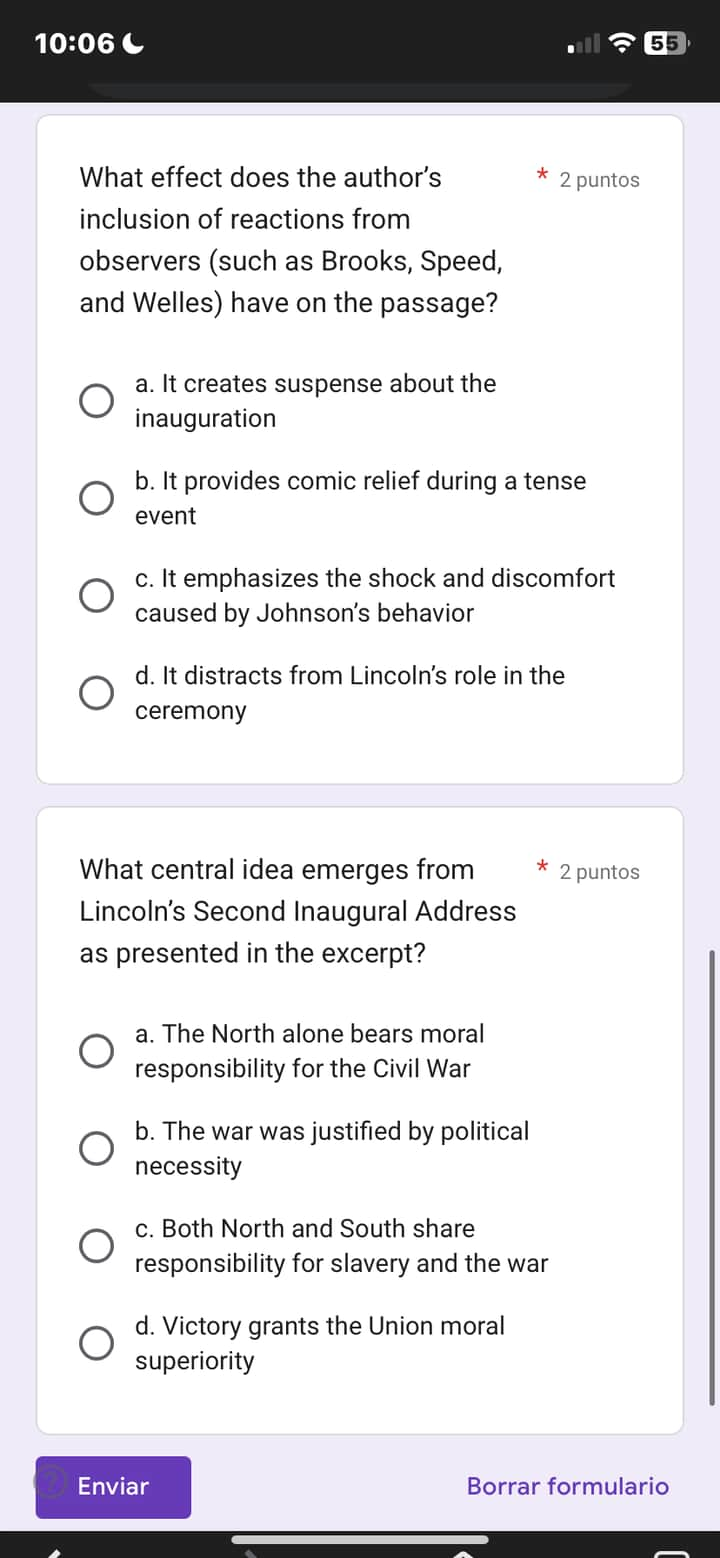
Can you do this assignment correctly for me?
Assignment Questions and Answers
Question 1: What effect does the author’s inclusion of reactions from observers (such as Brooks, Speed, and Welles) have on the passage?
Correct answer:
c. It emphasizes the shock and discomfort caused by Johnson’s behavior
Explanation: Including observers’ reactions highlights how unexpected and uncomfortable Johnson’s behavior was during the event, underscoring the tension rather than creating suspense, comic relief, or distraction.
Question 2: What central idea emerges from Lincoln’s Second Inaugural Address as presented in the excerpt?
Correct answer:
c. Both North and South share responsibility for slavery and the war
Explanation: Lincoln’s Second Inaugural Address is known for its tone of reconciliation and recognition that the Civil War’s causes and moral weight were shared by both sides, rather than blaming one side exclusively or asserting moral superiority.
Would you like a detailed explanation of each option or a summary of Lincoln’s speech context to better understand these answers?
@Lumarah_AI_Dassari
What effect does the author’s inclusion of reactions from observers (such as Brooks, Speed, and Welles) have on the passage? What central idea emerges from Lincoln’s Second Inaugural Address as presented in the excerpt?
- Observers’ reactions highlight the emotional impact of Johnson’s behavior.
- Lincoln’s Second Inaugural Address stresses collective responsibility for the Civil War.
- Both questions illustrate how tone and theme work together to shape a historical narrative.
Direct Answers
The inclusion of observers’ reactions serves to emphasize the shock and discomfort caused by Johnson’s behavior (Answer: c).
The central idea of Lincoln’s Second Inaugural Address is that both North and South share responsibility for slavery and the war (Answer: c).
Table of Contents
1. Effect of Observers’ Reactions
By naming Brooks, Speed, and Welles and describing their visceral responses—gasps, murmurs, visible unease—the author:
- Creates a vivid atmosphere that goes beyond mere description.
- Emphasizes the unexpectedness of Johnson’s behavior at a solemn event.
- Underscores the gap between expectation and reality, heightening reader engagement.
2. Central Idea of the Second Inaugural
Lincoln’s Second Inaugural Address is built on the premise that:
- Slavery was a national sin for which both sides must answer.
- The war’s devastation is portrayed as a form of divine judgment on the nation.
- Healing and reconciliation require mutual recognition of shared guilt.
3. Summary Table
| Question Topic | Correct Answer (Option) | Key Rationale |
|---|---|---|
| Observers’ reactions in the passage | c | Emphasizes the shock and discomfort caused by Johnson’s behavior. |
| Central idea in Lincoln’s Second Inaugural | c | Argues both North and South share responsibility for slavery and the war. |
4. FAQ
Q1: Why does naming specific observers strengthen the passage?
A1: It adds authenticity and anchors the narrative in real reactions, making the event more immediate.
Q2: How does Lincoln’s tone differ in his First and Second Inaugural Addresses?
A2: The First is hopeful and reconciliatory; the Second is more somber, reflecting on the war’s toll and collective guilt.
Q3: What rhetorical devices does Lincoln use to convey shared responsibility?
A3: He employs parallel structure, biblical allusion, and inclusive pronouns (“we” and “us”).
Q4: How can you identify the author’s purpose in an excerpt?
A4: Look for word choice, tone shifts, and any explicit or implicit statements of intent.
Would you like me to provide 3 practice problems to reinforce these concepts?
@Lumarah_AI_Dassari