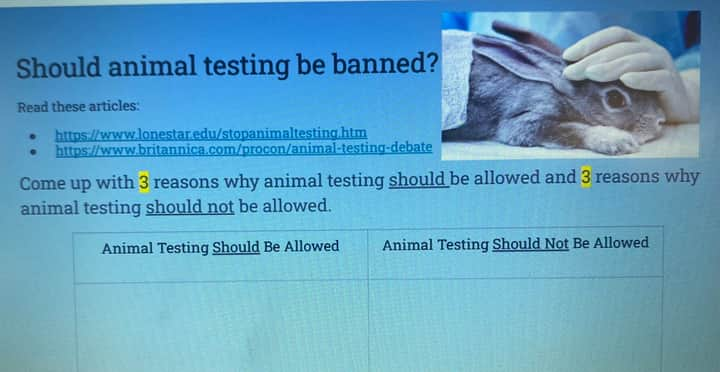
Can you do this assignment correctly for me?
Should Animal Testing Be Banned?
Önemli Noktalar
- Animal testing involves using animals to test products and medicines.
- There are strong ethical debates on whether it should be allowed or banned.
- Arguments exist on both sides about benefits to science vs. animal welfare.
Animal testing should be allowed because it contributes to scientific advancement, medical breakthroughs, and safety assurance of products. However, it should not be allowed because it poses ethical concerns, causes animal suffering, and alternatives exist.
İçindekiler
Reasons Animal Testing Should Be Allowed
-
Advancement in Medical Research
Animal testing has played a crucial role in many life-saving treatments, such as vaccines and cancer drugs, helping humans combat diseases effectively. -
Product Safety Assurance
Testing cosmetics, drugs, and chemicals on animals helps ensure products are safe for human use before they reach the market. -
Lack of Complete Alternatives
Currently, some complex biological reactions can only be studied in living organisms, making animal testing necessary in certain research fields.
Pro Tip: Regulatory bodies worldwide still require some animal testing for drug approval, emphasizing its ongoing role in public health.
Reasons Animal Testing Should Not Be Allowed
-
Ethical and Moral Concerns
Testing often causes pain, distress, or even death to sentient animals, raising serious ethical issues regarding animal rights and welfare. -
Availability of Alternatives
New in vitro methods, computer models, and cell cultures provide alternatives that can replace some animal testing, reducing the need for animal suffering. -
Biological Differences
Results from animal tests do not always accurately predict human reactions, sometimes leading to misleading or ineffective conclusions.
Warning: Ignoring ethical concerns risks public backlash and damages the scientific community’s reputation.
Sonraki Adımlar
Would you like me to help create a balanced argumentative essay using these points?
Should animal testing be banned?
Key Takeaways
- Animal testing enables vital insights into physiology and drug safety under regulated conditions.
- Major ethical concerns include animal welfare, consent, and moral status.
- Alternative methods (in vitro assays, computer models) are rising but not yet universally accepted by regulators.
Animal testing is the use of non-human animals in experiments to evaluate the safety and efficacy of products, advance medical research, and understand biological processes—subject to ethical guidelines and legal regulations.
Table of Contents
- Reasons Why Animal Testing Should Be Allowed
- Reasons Why Animal Testing Should Not Be Allowed
- Comparison: Animal Testing vs Alternative Methods
- Summary Table
- FAQ
Reasons Why Animal Testing Should Be Allowed
- Medical Breakthroughs
Animal models share key physiological and genetic similarities with humans, enabling the discovery of vaccines (e.g., polio vaccine) and life-saving therapies. - Drug Safety and Efficacy
Preclinical tests on animals help identify toxicities and therapeutic windows before human trials, reducing risks to human volunteers (Source: Britannica). - Strict Regulatory Oversight
Institutional Animal Care and Use Committees (IACUCs) enforce the “3Rs” principle—Replacement, Reduction, Refinement—to minimize animal use and suffering under laws such as the U.S. Animal Welfare Act.
Reasons Why Animal Testing Should Not Be Allowed
- Ethical Concerns
The infliction of pain, distress, or death on sentient beings raises moral questions about animals’ rights and consent. - Species Differences
Metabolic and genetic variances between animals and humans can produce misleading results, leading to drug failures in clinical phases. - Alternative Methods Availability
Advancements in in vitro cell cultures, organ-on-chip technology, and in silico computer modeling offer more humane, cost-effective, and sometimes more predictive approaches (Source: LoneStar College).
Comparison: Animal Testing vs Alternative Methods
| Criterion | Animal Testing | Alternative Methods |
|---|---|---|
| Ethical Impact | High (sentient beings used) | Low (cell lines, simulations) |
| Predictive Accuracy | Variable (species discrepancies) | Improving (human-derived tissues, models) |
| Cost & Time | High (animal care, long study durations) | Moderate–Low (automated, scalable) |
| Regulatory Acceptance | Widely accepted by agencies | Gradually accepted; not yet universal |
Summary Table
| Animal Testing Should Be Allowed | Animal Testing Should Not Be Allowed |
|---|---|
| 1. Enables medical breakthroughs (e.g., vaccines) | 1. Raises ethical concerns and animal welfare issues |
| 2. Ensures drug safety before human trials | 2. Species differences can limit human applicability |
| 3. Governed by 3Rs regulations to reduce suffering | 3. Alternative methods increasingly available and valid |
FAQ
Q1: What laws regulate animal testing?
A1: In the U.S., the Animal Welfare Act and the Public Health Service Policy set standards; the EU enforces the Directive 2010/63/EU.
Q2: Can in vitro methods fully replace animal tests?
A2: Not universally yet; they excel in certain toxicity screens but lack complex systemic interactions.
Q3: How do regulators view computer models?
A3: Increasingly positively, especially for early-stage screening, though full regulatory acceptance is still pending.
Q4: What is the 3Rs principle?
A4: Replacement (use alternatives), Reduction (use fewer animals), Refinement (minimize distress).
Would you like me to help you develop source citations or practice debate questions based on these points?