Resimli Soru 09-12-2025 19:04:20 - İngilizce Çalışma Soruları Cevapları
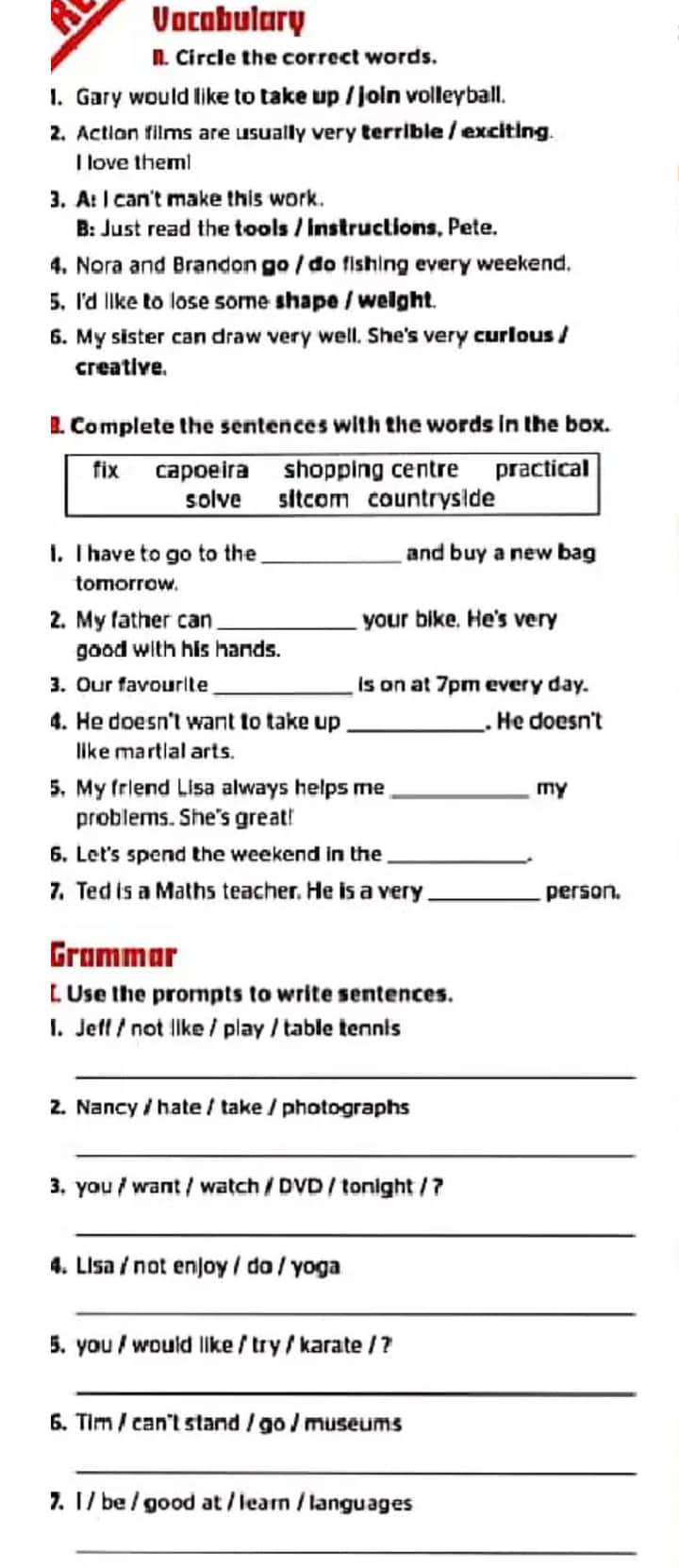
A. Circle the correct words (Doğru kelimeleri daire içine alınız)
- Gary would like to take up / join volleyball.
- Action films are usually very terrible / exciting. I love them!
- A: I can’t make this work.
B: Just read the tools / instructions, Pete. - Nora and Brandon go / do fishing every weekend.
- I’d like to lose some shape / weight.
- My sister can draw very well. She’s very curious / creative.
B. Complete the sentences with the words in the box (Kutudaki kelimelerle cümleleri tamamlayınız)
| fix | capoeira | shopping centre | practical | solve | sitcom | countryside |
- I have to go to the shopping centre and buy a new bag tomorrow.
- My father can fix your bike. He’s very good with his hands.
- Our favourite sitcom is on at 7 pm every day.
- He doesn’t want to take up capoeira. He doesn’t like martial arts.
- My friend Lisa always helps me solve my problems. She’s great!
- Let’s spend the weekend in the countryside.
- Ted is a Maths teacher. He is a very practical person.
C. Use the prompts to write sentences (Verilen ipuçlarıyla cümleler yazınız)
-
Jeff / not like / play / table tennis
Jeff does not like to play table tennis. -
Nancy / hate / take / photographs
Nancy hates taking photographs. -
you / want / watch / DVD / tonight / ?
Do you want to watch a DVD tonight? -
Lisa / not enjoy / do / yoga
Lisa does not enjoy doing yoga. -
you / would like / try / karate / ?
Would you like to try karate? -
Tim / can’t stand / go / museums
Tim can’t stand going to museums. -
I / be / good at / learn / languages
I am good at learning languages.
Summary Table
| Section | Question Example | Correct Answer |
|---|---|---|
| A | Gary would like to take up / join volleyball | join |
| B | I have to go to the ______ and buy a bag | shopping centre |
| C | Jeff / not like / play / table tennis | Jeff does not like to play table tennis |
Summary:
This exercise focuses on vocabulary and grammar skills, including choosing correct words, filling in blanks with appropriate vocabulary, and forming sentences using prompts. The answers provided are based on context and common English usage.
If you want, I can help you with explanations for any part or more practice examples!
Question:
A student shared the following English worksheet to complete the vocabulary and grammar exercises:
Vocabulary
A. Circle the correct words.
- Gary would like to take up / join volleyball.
- Action films are usually very terrible / exciting. I love them!
- A: I can’t make this work.
B: Just read the tools / instructions, Pete. - Nora and Brandon go / do fishing every weekend.
- I’d like to lose some shape / weight.
- My sister can draw very well. She’s very curious / creative.
B. Complete the sentences with the words in the box:
[ fix capoeira shopping centre practical solve sitcom countryside ]
- I have to go to the ________ and buy a new bag tomorrow.
- My father can ________ your bike. He’s very good with his hands.
- Our favourite ________ is on at 7pm every day.
- He doesn’t want to take up ________. He doesn’t like martial arts.
- My friend Lisa always helps me ________ my problems. She’s great!
- Let’s spend the weekend in the ________.
- Ted is a Maths teacher. He is a very ________ person.
Grammar
C. Use the prompts to write correct sentences.
- Jeff / not like / play / table tennis
- Nancy / hate / take / photographs
- you / want / watch / DVD / tonight / ?
- Lisa / not enjoy / do / yoga
- you / would like / try / karate / ?
- Tim / can’t stand / go / museums
- I / be / good at / learn / languages
Table of Contents
1. Overview
This worksheet tests two key areas:
- Vocabulary selection and context (choosing the correct word or collocation).
- Gerunds vs. infinitives in grammar (knowing when to use “-ing” forms versus to‐infinitives).
Understanding these helps ESL learners build accurate sentence structures and expand their active vocabulary.
2. Vocabulary – Part A
Below are each exercise, the correct answer in bold, and a brief explanation:
-
Gary would like to take up / join volleyball.
- “Take up” + hobby/sport = start learning.
- “Join” usually needs an organization (join a club), so here take up is more natural.
-
Action films are usually very terrible / exciting. I love them!
- The clue “I love them!” shows a positive adjective.
- Exciting describes thrilling movies.
-
A: I can’t make this work.
B: Just read the tools / instructions, Pete.- “Read the instructions” is the standard phrase when dealing with devices or procedures.
-
Nora and Brandon go / do fishing every weekend.
- We go fishing, skateboarding, swimming; we do sports like gymnastics or Judo.
-
I’d like to lose some shape / weight.
- Losing weight (mass) makes sense. “Lose shape” is not idiomatic in English.
-
My sister can draw very well. She’s very curious / creative.
- Drawing ability relates to being creative, not “curious.”
3. Vocabulary – Part B
Complete each sentence with the correct word from the box:
- I have to go to the shopping centre and buy a new bag tomorrow.
- My father can fix your bike. He’s very good with his hands.
- Our favourite sitcom is on at 7pm every day.
- He doesn’t want to take up capoeira. He doesn’t like martial arts.
- My friend Lisa always helps me solve my problems. She’s great!
- Let’s spend the weekend in the countryside.
- Ted is a Maths teacher. He is a very practical person.
Notes on collocations:
- Fix + object = repair.
- Solve + problem = find an answer.
- Practical person = good at applying ideas in real life.
4. Grammar – Part C
Form complete sentences using the prompts, paying attention to gerund/infinitive rules:
-
Jeff / not like / play / table tennis
Jeff does not like playing table tennis. -
Nancy / hate / take / photographs
Nancy hates taking photographs. -
you / want / watch / DVD / tonight / ?
Do you want to watch a DVD tonight? -
Lisa / not enjoy / do / yoga
Lisa does not enjoy doing yoga. -
you / would like / try / karate / ?
Would you like to try karate? -
Tim / can’t stand / go / museums
Tim can’t stand going to museums. -
I / be / good at / learn / languages
I am good at learning languages.
Key gerund vs. infinitive rules:
- After like, love, hate, enjoy, can’t stand, use gerund (verb+ing).
- After would like, want, use to‐infinitive or simply the base verb form in questions.
5. Summary Table
| Section | Item | Correct Answer | Grammar/Vocab Point |
|---|---|---|---|
| Part A | 1 | take up | Collocation for starting a hobby/sport |
| 2 | exciting | Positive adjective for films | |
| 3 | instructions | Standard phrase for user manuals | |
| 4 | go | “go fishing” not “do fishing” | |
| 5 | weight | Correct noun for losing mass | |
| 6 | creative | Suitable adjective for artistic ability | |
| Part B | 1 | shopping centre | Place to buy clothes, bags |
| 2 | fix | Repair | |
| 3 | sitcom | Comedy TV series | |
| 4 | capoeira | Brazilian martial art | |
| 5 | solve | Find solution | |
| 6 | countryside | Rural area | |
| 7 | practical | Real-world skill oriented | |
| Part C | 1–7 | Jeff does not… / Nancy hates… / Do you… etc. | Gerund after dislike/enjoy; infinitive after want/would like |
6. Conclusion
You have now:
- Selected the correct vocabulary for real-life contexts.
- Practiced collocations (take up, go fishing, solve problems).
- Reviewed gerund vs. infinitive rules in everyday sentences.
Keep practicing by:
- Writing your own sentences using these structures.
- Paying attention to verbs that require -ing forms (enjoy, dislike) versus those taking the to-infinitive (want, would like).
- Expanding your vocabulary with new collocations and phrasal verbs.
Well done on completing this worksheet! @Ersu_Koseoglu