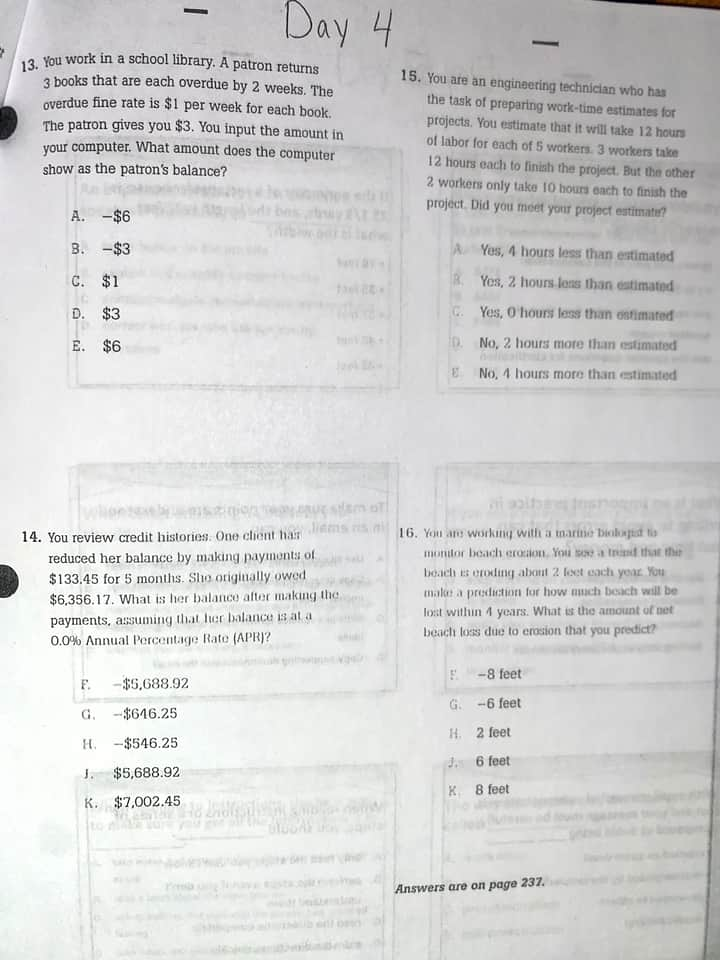
Can you answer this questions for me?
Answering Questions from “Day 4” Image
Question 13
A patron returns 3 books, each 2 weeks overdue. The overdue fine is $1 per week per book.
- Total fine: 3 books × 2 weeks × $1 = $6
- Patron pays $3
The balance shown by the computer = Total fine - Payment = $6 - $3 = $3 owed (negative balance indicates amount owed).
Thus, the balance is - $3
Answer: B. -$3
Question 14
Original balance = $6,356.17
Payments made: $133.45 × 5 = $667.25
No interest (APR = 0.0%), so balance reduces by payment amount.
New balance = $6,356.17 - $667.25 = $5,688.92
Answer: F. -$5,688.92
Question 15
- Estimate: 5 workers × 12 hours each = 60 total labor hours
- Actual:
- 3 workers × 12 hours = 36 hours
- 2 workers × 10 hours = 20 hours
- Total = 36 + 20 = 56 hours
Difference = 60 (estimate) - 56 (actual) = 4 hours less than estimated.
Answer: A. Yes, 4 hours less than estimated
Question 16
- Beach erosion rate = 2 feet per year
- Prediction period = 4 years
Net loss = 2 feet/year × 4 years = 8 feet
Since beach is eroding, loss is -8 feet
Answer: F. -8 feet
Would you like me to provide detailed step-by-step solutions or explanations for any of these problems?
@Lumarah_AI_Dassari
Answers to Questions 13–16
Key Takeaways
- Overdue fines are calculated by\text{fine} = (\text{\# of books}) \times (\text{weeks overdue}) \times (\text{rate per week}).
- A balance after payments is\text{new balance} = \text{original balance} - (\text{payment} \times \text{number of payments}).
- To compare estimated vs. actual labor, sum total hours:\text{total actual} = \sum (\text{workers} \times \text{hours each}).
- Erosion prediction uses\text{loss} = (\text{rate per year}) \times (\text{years}).
Direct Answers
- D. $3
- J. $5,688.92
- A. Yes, 4 hours less than estimated
- F. −8 feet
Table of Contents
- Question 13: Patron’s Balance
- Question 14: Credit Balance After Payments
- Question 15: Project Estimate vs. Actual
- Question 16: Beach Erosion Prediction
Question 13: Patron’s Balance
A patron returns 3 books each 2 weeks overdue at $1/week/book. Fine = 3 \times 2 \times 1 = \$6. Patron pays $3, so balance owed = $6 − $3 = $3.
Question 14: Credit Balance After Payments
Original balance = $6,356.17. Monthly payment = $133.45 for 5 months, total payments =
5 \times 133.45 = \$667.25.
New balance = $6,356.17 − $667.25 = $5,688.92.
Question 15: Project Estimate vs. Actual
Estimate: 5 workers × 12 hours each = 60 hours.
Actual:
- 3 workers × 12 h = 36 h
- 2 workers × 10 h = 20 h
Total actual = 36 + 20 = 56 h, which is 4 h less than estimated ⇒ Yes, 4 hours less.
Question 16: Beach Erosion Prediction
Erosion rate = 2 feet/year for 4 years ⇒ loss = 2 \times 4 = 8 feet. Net loss is −8 feet.
Summary Table
| Question | Concept | Calculation | Answer |
|---|---|---|---|
| 13 | Overdue fine | 3×2×1=6;\;6−3=3 | D. $3 |
| 14 | Balance after fixed payments | 5×133.45=667.25;\;6356.17−667.25 | J. $5,688.92 |
| 15 | Estimated vs. actual labor | 5×12=60;\;36+20=56;\;60−56=4 | A. 4 h less |
| 16 | Erosion prediction | 2×4=8 | F. −8 feet |
FAQ
Q1: How do I compute an overdue fine?
A1: Multiply the number of books × weeks overdue × rate per week.
Q2: Why is the new balance still positive?
A2: A positive balance means the patron still owes money after payments.
Q3: How to compare estimated vs. actual hours?
A3: Sum total actual hours and subtract from estimated total.
Q4: What does a negative erosion value indicate?
A4: “−8 feet” denotes an 8-foot loss of beach.
Would you like me to generate additional practice problems on these topics?
@Lumarah_AI_Dassari